Skip to main contentSkip to solution

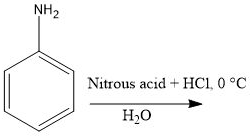
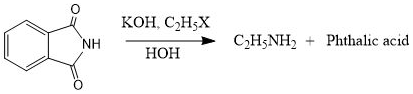
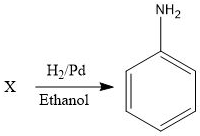
Amines are classified as primary (1°), secondary (2°) and tertiary (3°) depending upon the number of hydrogen atoms replaced by alkyl or aryl groups in ammonia molecules. Aliphatic amines are a stronger bases due to +I effect of an alkyl groups. Intermolecular hydrogen bonding in primary and secondary amines affects the boiling points of amines. The intermolecular association is more in primary amines than in secondary amines as there are more number of hydrogen atoms available for hydrogen bond formation. Nitro compounds are reduced to amines by passing hydrogen gas in the presence of finely divided nickel, palladium or platinum and also by reduction with metals in an acidic medium. Gabriel synthesis is used for the preparation of primary amines. Primary amines react with nitrous acid to give unstable diazonium-salts which can be used to synthesize a variety of compounds.

Identify the amine possessing least basic strength

Solution

✅ Correct Option: 2

In p-nitroaniline, the −NO2-NO_2 group is strongly electron-withdrawing (−I-I and −R-R effects). It pulls electron density away from the nitrogen of the −NH2-NH_2 group, so the lone pair is less available to accept a proton. This makes p-nitroaniline the weakest base of the four.


Option 1: aniline has no substituent on the ring, so it is more basic than p-nitroaniline.

Options 3 and 4: −CH3-CH_3 (+I, hyperconjugation) and −OCH3-OCH_3 (+R) are electron-donating groups. They increase electron density on nitrogen, so these amines are more basic than aniline.

Order of basic strength: p-methoxyaniline > p-toluidine > aniline > p-nitroaniline.

Keyboard Shortcuts

  • Left arrow: Previous question
  • Right arrow: Next question
  • S key: Jump to solution
  • Q key: Jump to question