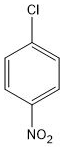
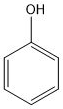
Q1:

Aldehydes, Ketones & Carboxylic Acids

Easy

The reduction of cyclohexanone with NaBH4_4 produces

Answer options
Option 1
Correct Answer
Explanation for 2025: 26 May Shift 2 CHE question 1

Q2:

Solutions

Medium

Vapour pressures of chloroform(CHCl3_3) and dichloromethane (CH2_2Cl2_2) at 298 K are 200 mmHg and 415 mmHg, respectively. Calculate the vapor pressure of the solution prepared by mixing 0.2 mol of CHCl3_3 and 0.5 mol of CH2_2Cl2_2 at 298 K

Answer options
Option 2
Correct Answer
Explanation for 2025: 26 May Shift 2 CHE question 2

Q3:

Coordination Compounds

Hard

Arrange the following complexes in increasing order of their magnetic moment

(A) [Cr(H2_2O)6_6]3+^{3+}

(B) [Co(NH3_3)6_6]3+^{3+}

(C) [FeCl6_6]4−^{4-}

(D) [Mn(CN)6_6]3−^{3-}

Answer options
Option 2
Correct Answer
Explanation for 2025: 26 May Shift 2 CHE question 3

Q5:

Haloalkanes & Haloarenes

Easy

The reaction of two molecules of 1-chlorobenzene with sodium metal in the presence of dry ether to form diphenyl is known as

Answer options
Option 1
Correct Answer
Explanation for 2025: 26 May Shift 2 CHE question 5

Q7:

Coordination Compounds

Easy

Select the correct statements from the following:

(A) EDTA is used in the treatment of lead poisoning

(B) vitamin B12_{12} is a coordination complex of Co

(C) chlorophyll is a coordination complex of Fe

(D) Wilkinson catalyst is a rhodium complex used for hydrogenation of alkenes

Answer options
Option 1
Correct Answer
Explanation for 2025: 26 May Shift 2 CHE question 7

Q9:

Electrochemistry

Easy

Calculate the Gibbs free energy for the given reaction, with the standard electrode potential equal to 1.1 V.

Zn(s) + Cu2+^{2+}(aq) → Zn2+^{2+}(aq) + Cu (s)

Answer options
Option 3
Correct Answer
Explanation for 2025: 26 May Shift 2 CHE question 9

Q11:

Coordination Compounds

Easy

What is the coordination number of Fe in [Fe(CO)5_5] and [Fe(C2_2O4_4)3_3]3−^{3-} respectively?

Answer options

Q12:

Amines

Medium

Arrange the following amines in increasing order of basicity in aqueous solution

(A) (CH3_3)2_2NH

(B) CH3_3NH2_2

(C) (CH3_3)3_3N

(D) NH3_3

Answer options

Q13:

Electrochemistry

Medium

In the Cell reaction

Mg(s) + 2Ag+^+(aq) → Mg2+^{2+}(aq) + 2Ag(s)

Ecell0=3.17VE^0_{cell} = 3.17V. By doubling the concentration of Mg2+^{2+}, EcellE_{cell} is

Answer options

Q14:

Coordination Compounds

Medium

Match the complexes given in List-I with oxidation state and the type of complexes given in List-II

List-I (Complex)List-II (Oxidation state and type of complex)
(A) [Co(NH3_3)6_6]3+^{3+}(I) +2 and Inner orbital complex
(B) [CoF6_6]3−^{3-}(II) +2 and Outer orbital complex
(C) [NiCl4_4]2−^{2-}(III) +3 and Outer orbital complex
(D) [Ni(CN)4_4]2−^{2-}(IV) +3 and Inner orbital complex
Answer options

Q15:

Amines

Easy

Which of the following amine forms a stable diazonium salt ?

Answer options

Q16:

Alcohols, Phenols & Ethers

Easy

Which of the following statements is correct for ortho and para nitrophenols ?

(A) They can be separated by steam distillation

(B) o-Nitrophenol undergoes intramolecular hydrogen bonding

(C) p-Nitrophenol undergoes inter molecular hydrogen bonding

(D) p-Nitrophenol is less volatile

Answer options

Q18:

Aldehydes, Ketones & Carboxylic Acids

Easy

Match List-I with List-II

List-I (Name of the test/Reaction)List-II (Species)
(A) Tollen's Test(I) Cu2+^{2+} and OH−^-
(B) Fehling's Test(II) Zn-Hg and HCl
(C) Clemmensen reduction(III) 2[Ag(NH3_3)2_2]+^+ and OH−^-
(D) Wolff Kishner reduction(IV) Hydrazine KOH/ethylene glycol
Answer options

Q19:

Electrochemistry

Medium

While charging the lead storage battery......

Answer options

Q21:

Alcohols, Phenols & Ethers

Easy

Match List-I with List-II

List-IList-II
(A) Acetone to secondary alcohol(I) CrO3_3
(B) Ethanol to Diethyl ether(II) Zn
(C) Ethanol to ethanal(III) NaBH4_4
(D) Phenol to Benzene(IV) H2_2SO4_4 at 413 K
Answer options

Q22:

Solutions

Medium

Choose the correct statements from the following:

(A) two different solutions of sucrose of same molality prepared in different solvents will have the same depression in freezing point.

(B) the osmotic pressure of a solution is given by the equation Π=CRT\Pi = CRT (where C is the molarity of the solution)

(C) decreasing order of osmotic pressure for 0.01 M aqueous solution of BaCl2_2, KCl, CH3_3COOH and sucrose is

BaCl2_2 > KCl > CH3_3COOH > sucrose

(D) according to Raoult's law the vapor pressure exerted by a volatile component of a solution is directly proportional to its mole fraction in the solution

Answer options

Q23:

Coordination Compounds

Medium

Calculate the spin only magnetic moment of a Ni2+^{2+} in [Ni(CN)4_4]2−^{2-} (atomic number of Ni is 28).

Answer options

Q25:

d & f Block Elements

Easy

Match the items given in List-I with items given in List-II

List-IList-II
(A) Interstitial Compounds(I) Large number of complex
(B) Alloy formation(II) Chemically inert
(C) Transition metals(III) Ni
(D) Catalytic hydrogenation(IV) Blend of different metals
Answer options

Q26:

Solutions

Easy

2.5 g of the following substances are dissolved in 500 mL of water. Arrange the resultant solutions in increasing order of their molarity;

(A) C6_6H12_{12}O6_6 (180 g mol−1^{-1})

(B) NH2_2CONH2_2 (60 g mol−1^{-1})

(C) NaCl (58.5 g mol−1^{-1})

(D) MgSO4_4 (120 g mol−1^{-1})

Answer options

Q27:

d & f Block Elements

Medium

Arrange the following transition elements of the first series in increasing order of their densities

(A) Sc

(B) V

(C) Zn

(D) Cu

Answer options

Q28:

Alcohols, Phenols & Ethers

Medium

Arrange the following componds in increasing order of their acidity :

(A) Phenol

(B) 4-methylphenol

(C) 3-nitrophenol

(D) 4-nitrophenol

Answer options

Q29:

Electrochemistry

Medium

For strong electrolytes, Λm\Lambda_m increases with dilution and is represented by the equation Λm=Λm0−Ac1/2\Lambda_m = \Lambda^0_m - Ac^{1/2}. Here, the value of the constant A depends upon

(A) Nature of solvent.

(B) Temperature.

(C) Charges on cation and anions produced.

(D) Type of electrolyte.

Answer options

Q30:

Alcohols, Phenols & Ethers

Easy

The reagents involved in the following conversion are
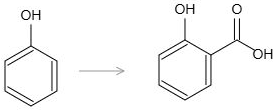
Figure

Answer options

Q32:

Solutions

Medium

Calculate the lowering of vapour pressure caused by the addition of 50 g of sucrose (mol mass = 342 g mol−1^{-1}) to 750 g of water, if the vapour pressure of pure water at 25°C is 23.8 mm Hg.

Answer options

Q33:

Haloalkanes & Haloarenes

Easy

Match List-I with List-II

List-IList-II
(A) Freons(I) Paint remover
(B) DDT(II) Refrigeration
(C) Dichloromethane(III) Fire extinguisher
(D) Tetrachloromethane(IV) Insecticide
Answer options

Q34:

Solutions

Easy

The reverse osmosis occurs when

Answer options

Q35:

Haloalkanes & Haloarenes

Easy

The nitration of chlorobenzene gives the major product as:

Answer options

Q36:

Aldehydes, Ketones & Carboxylic Acids

Easy

Which of the following compounds will undergo Cannizzaro reaction

Answer options

Q40:

Haloalkanes & Haloarenes

Medium

Identify the chiral molecule from the following,
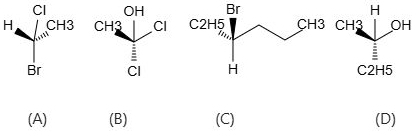
Figure

Answer options

Q41:

Chemical Kinetics

Medium

The chemical reactions proceed at different rates which depend on various factors like concentration, temperature, etc. Rate law is an expression which relates the rate of reaction with concentration of various reacting species in the reaction. For a first order reaction, the concentration of the reactant after time tt is related with its initial concentration by the relation,

C=C0e−ktC = C_0e^{-kt}. The rate constants for different orders have different expressions. For a first order reaction,

k=2.303tlog⁡aa−xk = \frac{2.303}{t}\log\frac{a}{a-x}, where aa is the initial concentration and xx is the extent of reaction.

A reaction which is first order with respect to the reactant A has a rate constant of 6 min−1^{-1}. If the reaction is started with [A] = 5.0 mol L−1^{-1} when would [A] reach the value of 0.05 mol L−1^{-1}

Answer options

Q42:

Chemical Kinetics

Easy

The chemical reactions proceed at different rates which depend on various factors like concentration, temperature, etc. Rate law is an expression which relates the rate of reaction with concentration of various reacting species in the reaction. For a first order reaction, the concentration of the reactant after time tt is related with its initial concentration by the relation,

C=C0e−ktC = C_0e^{-kt}. The rate constants for different orders have different expressions. For a first order reaction,

k=2.303tlog⁡aa−xk = \frac{2.303}{t}\log\frac{a}{a-x}, where aa is the initial concentration and xx is the extent of reaction.

The quantity kk in a rate law expression is

Answer options

Q43:

Chemical Kinetics

Easy

The chemical reactions proceed at different rates which depend on various factors like concentration, temperature, etc. Rate law is an expression which relates the rate of reaction with concentration of various reacting species in the reaction. For a first order reaction, the concentration of the reactant after time tt is related with its initial concentration by the relation,

C=C0e−ktC = C_0e^{-kt}. The rate constants for different orders have different expressions. For a first order reaction,

k=2.303tlog⁡aa−xk = \frac{2.303}{t}\log\frac{a}{a-x}, where aa is the initial concentration and xx is the extent of reaction.

The Rate law relates the rate of a chemical reaction to

Answer options

Q44:

Chemical Kinetics

Medium

The chemical reactions proceed at different rates which depend on various factors like concentration, temperature, etc. Rate law is an expression which relates the rate of reaction with concentration of various reacting species in the reaction. For a first order reaction, the concentration of the reactant after time tt is related with its initial concentration by the relation,

C=C0e−ktC = C_0e^{-kt}. The rate constants for different orders have different expressions. For a first order reaction,

k=2.303tlog⁡aa−xk = \frac{2.303}{t}\log\frac{a}{a-x}, where aa is the initial concentration and xx is the extent of reaction.

A first order reaction is one-fifth completed in 40 minutes. Calculate the time required for its 100% completion

Answer options

Q45:

Chemical Kinetics

Easy

The chemical reactions proceed at different rates which depend on various factors like concentration, temperature, etc. Rate law is an expression which relates the rate of reaction with concentration of various reacting species in the reaction. For a first order reaction, the concentration of the reactant after time tt is related with its initial concentration by the relation,

C=C0e−ktC = C_0e^{-kt}. The rate constants for different orders have different expressions. For a first order reaction,

k=2.303tlog⁡aa−xk = \frac{2.303}{t}\log\frac{a}{a-x}, where aa is the initial concentration and xx is the extent of reaction.

Which plot is linear with negative slope for a first order reaction

Answer options

Q46:

Biomolecules

Easy

Carbohydrates are naturally formed organic compounds from various plants. The common chemical formula, (Cx(H2O)yC_x(H_2O)_y) was considered as hydrates of carbon to derive the various carbohydrates. For instance, the general formula for glucose (C6H12O6C_6H_{12}O_6) easily fits into the above formula. Carbohydrates also called saccharides are classified on the basis of their behavior towards hydrolysis. Monosaccharides cannot be hydrolyzed further to simpler units of polyhydroxy aldehyde or ketones. About 20 monosaccharides are known to occur in nature. Carbohydrates that yield large number of monosaccharide units are called polysacccharides. Amino acids contain (-NH2_2) and (-COOH), which can be classified in various forms. Proteins are polymers of alpha amino acids which are connected to each other by a peptide bond or peptide linkage. When a native protein is subjected to physical change, its globules unfold and helix get uncoiled and the protein loses its biological activity. The protein is said to be denaturated.

The two monosaccharides units are joined together through which linkage ?

Answer options

Q47:

Biomolecules

Easy

Carbohydrates are naturally formed organic compounds from various plants. The common chemical formula, (Cx(H2O)yC_x(H_2O)_y) was considered as hydrates of carbon to derive the various carbohydrates. For instance, the general formula for glucose (C6H12O6C_6H_{12}O_6) easily fits into the above formula. Carbohydrates also called saccharides are classified on the basis of their behavior towards hydrolysis. Monosaccharides cannot be hydrolyzed further to simpler units of polyhydroxy aldehyde or ketones. About 20 monosaccharides are known to occur in nature. Carbohydrates that yield large number of monosaccharide units are called polysacccharides. Amino acids contain (-NH2_2) and (-COOH), which can be classified in various forms. Proteins are polymers of alpha amino acids which are connected to each other by a peptide bond or peptide linkage. When a native protein is subjected to physical change, its globules unfold and helix get uncoiled and the protein loses its biological activity. The protein is said to be denaturated.

The peptide linkage formed between the reaction of glycine and alanine is represented as

Answer options

Q48:

Biomolecules

Easy

Carbohydrates are naturally formed organic compounds from various plants. The common chemical formula, (Cx(H2O)yC_x(H_2O)_y) was considered as hydrates of carbon to derive the various carbohydrates. For instance, the general formula for glucose (C6H12O6C_6H_{12}O_6) easily fits into the above formula. Carbohydrates also called saccharides are classified on the basis of their behavior towards hydrolysis. Monosaccharides cannot be hydrolyzed further to simpler units of polyhydroxy aldehyde or ketones. About 20 monosaccharides are known to occur in nature. Carbohydrates that yield large number of monosaccharide units are called polysacccharides. Amino acids contain (-NH2_2) and (-COOH), which can be classified in various forms. Proteins are polymers of alpha amino acids which are connected to each other by a peptide bond or peptide linkage. When a native protein is subjected to physical change, its globules unfold and helix get uncoiled and the protein loses its biological activity. The protein is said to be denaturated.

During denaturation process of protein which structure(s) remain intact ?

Answer options

Q49:

Biomolecules

Easy

Carbohydrates are naturally formed organic compounds from various plants. The common chemical formula, (Cx(H2O)yC_x(H_2O)_y) was considered as hydrates of carbon to derive the various carbohydrates. For instance, the general formula for glucose (C6H12O6C_6H_{12}O_6) easily fits into the above formula. Carbohydrates also called saccharides are classified on the basis of their behavior towards hydrolysis. Monosaccharides cannot be hydrolyzed further to simpler units of polyhydroxy aldehyde or ketones. About 20 monosaccharides are known to occur in nature. Carbohydrates that yield large number of monosaccharide units are called polysacccharides. Amino acids contain (-NH2_2) and (-COOH), which can be classified in various forms. Proteins are polymers of alpha amino acids which are connected to each other by a peptide bond or peptide linkage. When a native protein is subjected to physical change, its globules unfold and helix get uncoiled and the protein loses its biological activity. The protein is said to be denaturated.

Sucrose on hydrolysis gives

Answer options

Q50:

Biomolecules

Easy

Carbohydrates are naturally formed organic compounds from various plants. The common chemical formula, (Cx(H2O)yC_x(H_2O)_y) was considered as hydrates of carbon to derive the various carbohydrates. For instance, the general formula for glucose (C6H12O6C_6H_{12}O_6) easily fits into the above formula. Carbohydrates also called saccharides are classified on the basis of their behavior towards hydrolysis. Monosaccharides cannot be hydrolyzed further to simpler units of polyhydroxy aldehyde or ketones. About 20 monosaccharides are known to occur in nature. Carbohydrates that yield large number of monosaccharide units are called polysacccharides. Amino acids contain (-NH2_2) and (-COOH), which can be classified in various forms. Proteins are polymers of alpha amino acids which are connected to each other by a peptide bond or peptide linkage. When a native protein is subjected to physical change, its globules unfold and helix get uncoiled and the protein loses its biological activity. The protein is said to be denaturated.

Which of the following statements is incorrect for Lactose ?

Answer options

CUET Chemistry 2025 26 May Shift 2 Past Year Question Paper

Every question from the CUET Chemistry 2025 26 May Shift 2 paper is here in full, with the correct answer and a step by step solution for each one. It is completely free, there is no login and no paywall, and you can read the whole paper online or download it to revise offline.

You can also attempt it instead of only reading it. Take the paper as a full length mock under exam conditions, or filter it by topic and attempt just that topic as a topic test. Both are free, and you get a breakdown of your accuracy, your timing and your weak areas once you submit.

CUET Chemistry past year questions (PYQs) are the closest thing to the real exam, so working through them is the quickest way to learn the paper pattern, the marking scheme and the level of difficulty to expect on the day.