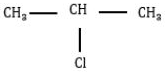
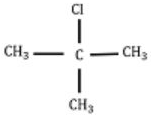
Arrange the following alkyl halides in order of increasing reactivity towards reaction.
(A)
(B)
(C)
(D)
Arrange the following alkyl halides in order of increasing reactivity towards reaction.
(A)
(B)
(C)
(D)
Solution
In an reaction the rate-determining step is the breaking of the C-X bond to form the carbocation. All four compounds give the same carbocation, so reactivity depends only on how easily the halide leaves.
Bond strength decreases down the group, and larger halide ions are better leaving groups (I is the weakest base and the best leaving group). So reactivity increases in the order F < Cl < Br < I.
(B) (strongest bond, least reactive)
(D)
(C)
(A) (weakest bond, most reactive)
Option 2 and Option 4: the order is not based on the electronegativity or polarity of the C-X bond. C-F is the most polar bond, but it is also the strongest, so it breaks the least readily.
Related questions:
2026: 20 May Shift 2
2025: 21 May Shift 2
2026: 21 May Shift 1
2025: 14 May Shift 1
2026: 12 May Shift 2