Skip to main contentSkip to solution

Amines are considered as derivatives of ammonia obtained by replacement of hydrogen atoms with alkyl or aryl groups. In nature they occur among proteins, vitamins, alkaloids and hormones. These can be primary, secondary or tertiary depending on the number of hydrogen groups replaced. They can be prepared from nitro compounds, alkyl halides, nitriles , amides etc. Due to unshared pair of electrons they behave as Lewis bases. Influence of the number of hydrogen atoms at nitrogen atom is displayed in physical properties such as solubility, boiling point and chemical reactions including basicity. Basic character of amines is expressed in terms of their KbK_b and pKbpK_b values. Three classes of amines can be distinguished with p-toluene sulphonyl chloride which reacts with primary and secondary amines. Amino group when attached to benzene ring behaves as an activating and ortho para directing group.

Give the IUPAC name of the compound
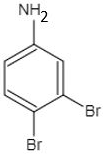
Figure

Solution

✅ Correct Option: 4

In IUPAC naming, aniline (benzenamine) is the parent name, so the carbon bearing the NH2 group is numbered C-1. The two Br atoms then sit at the meta and para positions, which are C-3 and C-4 (lowest locant set). The name is 3,4-dibromoaniline.


Option 1: the amine is the principal group here, so it must be part of the parent name (aniline) and take C-1. It cannot be written as a "4-amino" substituent.

Options 2 and 3: these number the Br atoms as 1,2, which ignores that the NH2-bearing carbon is C-1 in aniline. Putting Br at 1,2 would place NH2 at a different position than shown.

Keyboard Shortcuts

  • Left arrow: Previous question
  • Right arrow: Next question
  • S key: Jump to solution
  • Q key: Jump to question