Skip to main contentSkip to solution

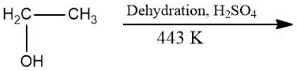
Alcohols and phenols are obtained when a hydrogen atom in aliphatic and aromatic hydrocarbons respectively, is replaced by –OH group. These compounds find wide applications in industry as well as in our daily life. You may notice that ordinary spirit is used for polishing wooden furniture which is chiefly a compound containing hydroxyl group. An alcohol contains one or more hydroxyl (OH) group(s) directly attached to carbon atom(s), of an aliphatic system (CH3OH\mathrm{CH_3OH}) while a phenol contains –OH group(s) directly attached to carbon atom(s) of an aromatic system (C6H5OH\mathrm{C_6H_5OH}). Alcohols are prepared by the hydration of alkenes, fermentation of glucose, and reduction of carbonyl compounds. Alcohols produce alkenes upon dehydration whereas alkenes on acid catalyzed hydration convert into alcohols.

An alkyl halide can be converted into alcohol through

Solution

✅ Correct Option: 3

Treating an alkyl halide with aqueous KOH (or moist Ag2O\mathrm{Ag_2O}) replaces the halogen with the -OH group, a nucleophilic substitution: R−X+OH−→R−OH+X−\mathrm{R{-}X + OH^- \rightarrow R{-}OH + X^-}


Options 2 and 4: elimination (dehydrohalogenation) of an alkyl halide with alcoholic KOH removes HX and gives an alkene, not an alcohol.

Option 1: addition happens to alkenes (for example, hydration of an alkene gives an alcohol), not to saturated alkyl halides.

Aqueous KOH gives substitution (alcohol), while alcoholic KOH gives elimination (alkene).

Keyboard Shortcuts

  • Left arrow: Previous question
  • Right arrow: Next question
  • S key: Jump to solution
  • Q key: Jump to question