
What is the major product of the following reaction ?
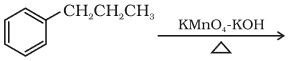
What is the major product of the following reaction ?
Solution
Vigorous oxidation with hot alkaline KMnO4 oxidises any alkyl side chain on a benzene ring to a -COOH group, provided the benzylic carbon has at least one hydrogen. The entire side chain is cleaved except for the benzylic carbon, which becomes the carboxyl carbon. So propylbenzene gives benzoic acid, and the other two carbons of the propyl group are lost as CO2 and water.
Options 1 and 3: these keep part of the side chain, but strong oxidation cuts the chain right at the ring, so only the benzylic carbon remains.
Option 4: a ketone is not the final product, because strong oxidation continues until the chain is cleaved.
Every alkylbenzene with a benzylic hydrogen gives benzoic acid, whatever the chain length. Tert-butylbenzene has no benzylic hydrogen and is not oxidised.
Related questions:
2025: 13 May Shift 2
2026: 26 May Shift 2
2026: 12 May Shift 2
2025: 14 May Shift 1
2026: 30 May Shift 2