
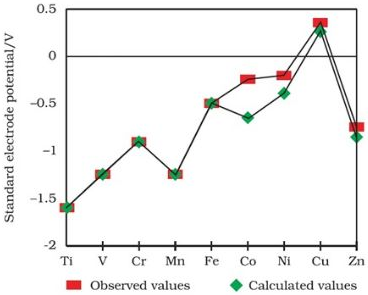
Observed and calculated values for the standard electrode potentials (M M) are shown in the figure above. Based on the data shown, which of the following statements are true?
(A) Cu is not able to liberate H from acid.
(B) Zn is not able to liberate H from acid.
(C) An increase in the sum of the first and second ionization enthalpies leads to less negative E° values.
(D) Only oxidising acids react with Cu
Solution
Cu has a positive (about V) in the figure, so it cannot reduce H to H. Statement (A) is true.
Across the series, generally becomes less negative as the sum of the first and second ionisation enthalpies increases. Statement (C) is true.
Since Cu cannot displace hydrogen from non-oxidising acids like dilute HCl, it reacts only with oxidising acids such as HNO and hot concentrated HSO. Statement (D) is true.
(B): Zn has a negative (about V), so it is a stronger reducing agent than H and does liberate H from acids. This statement is false.
Related questions:
2026: 7 June Shift 2
2025: 15 May Shift 2
2026: 14 May Shift 2
2025: 28 May Shift 2
2025: 14 May Shift 1