
The molar conductivity of a solution at any given concentration is the conductance of the volume of solution containing one mole of electrolyte kept between two platinum electrodes with unit area of cross-section and at a distance of unit length. Both conductivity and molar conductivity change with the concentration of the electrolyte. Kohlrausch examined values for a number of strong electrolytes and observed certain regularities. He noted that the difference in of the electrolytes NaX and KX for any X is nearly constant. On the basis of the above observations, he enunciated the Kohlrausch law of independent migration of ions.
Solution
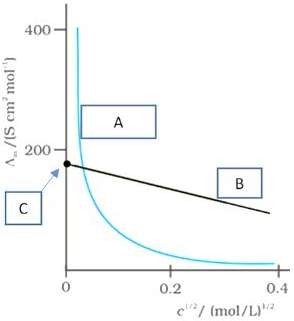
Point C is where the straight line (strong electrolyte, B) meets the axis at . This corresponds to infinite dilution, and the value there is the limiting molar conductivity, .
The passage's own term for this quantity is , the molar conductivity at zero concentration. Extrapolating the line to the axis gives it.
Option 2: equivalent conductance is a different quantity from molar conductivity, and the graph plots .
Option 3: conductance (in S) depends on the cell dimensions. The graph plots molar conductivity (in S cm mol).