
The molar conductivity of a solution at any given concentration is the conductance of the volume of solution containing one mole of electrolyte kept between two platinum electrodes with unit area of cross-section and at a distance of unit length. Both conductivity and molar conductivity change with the concentration of the electrolyte. Kohlrausch examined values for a number of strong electrolytes and observed certain regularities. He noted that the difference in of the electrolytes NaX and KX for any X is nearly constant. On the basis of the above observations, he enunciated the Kohlrausch law of independent migration of ions.
Solution
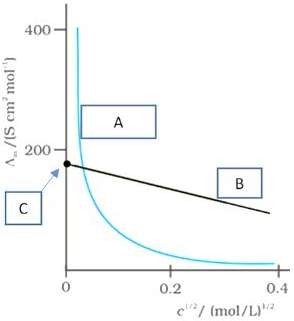
For a weak electrolyte, , so molar conductivity depends on the degree of dissociation . On dilution, increases, more ions are present per mole of electrolyte, and rises. The reverse also holds: as concentration increases, falls and decreases. This is why Option 1 is correct.
Option 2: increases on dilution, it does not decrease.
Options 3 and 4: the dissociation constant depends only on temperature, not on concentration.
More from this set:
Question 42