Skip to main contentSkip to solution

Alcohols and phenols are obtained when a hydrogen atom in aliphatic and aromatic hydrocarbons respectively, is replaced by –OH group. These compounds find wide applications in industry as well as in our daily life. You may notice that ordinary spirit is used for polishing wooden furniture which is chiefly a compound containing hydroxyl group. An alcohol contains one or more hydroxyl (OH) group(s) directly attached to carbon atom(s), of an aliphatic system (CH3OH\mathrm{CH_3OH}) while a phenol contains –OH group(s) directly attached to carbon atom(s) of an aromatic system (C6H5OH\mathrm{C_6H_5OH}). Alcohols are prepared by the hydration of alkenes, fermentation of glucose, and reduction of carbonyl compounds. Alcohols produce alkenes upon dehydration whereas alkenes on acid catalyzed hydration convert into alcohols.

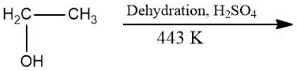
Product of the following reaction is
Figure

Solution

✅ Correct Option: 2

The passage states that alcohols give alkenes on dehydration. Ethanol heated with conc. H2SO4\mathrm{H_2SO_4} at 443 K loses a molecule of water (the -OH and a hydrogen from the adjacent carbon) to form ethene.

CH3CH2OH→conc. H2SO4, 443 KH2C=CH2+H2O\mathrm{CH_3CH_2OH} \xrightarrow{\text{conc. } H_2SO_4,\ 443\ K} \boxed{\mathrm{H_2C{=}CH_2}} + \mathrm{H_2O}


Options 1, 3 and 4: these still contain -OH groups, so they are not dehydration products. Dehydration removes the -OH as water and leaves a plain alkene.

At 413 K, ethanol with excess alcohol gives diethyl ether instead, and at 443 K it gives ethene. The temperature decides the product.

Keyboard Shortcuts

  • Left arrow: Previous question
  • Right arrow: Next question
  • S key: Jump to solution
  • Q key: Jump to question