Skip to main contentSkip to solution

Alcohols and phenols are obtained when a hydrogen atom in aliphatic and aromatic hydrocarbons respectively, is replaced by –OH group. These compounds find wide applications in industry as well as in our daily life. You may notice that ordinary spirit is used for polishing wooden furniture which is chiefly a compound containing hydroxyl group. An alcohol contains one or more hydroxyl (OH) group(s) directly attached to carbon atom(s), of an aliphatic system (CH3OH\mathrm{CH_3OH}) while a phenol contains –OH group(s) directly attached to carbon atom(s) of an aromatic system (C6H5OH\mathrm{C_6H_5OH}). Alcohols are prepared by the hydration of alkenes, fermentation of glucose, and reduction of carbonyl compounds. Alcohols produce alkenes upon dehydration whereas alkenes on acid catalyzed hydration convert into alcohols.

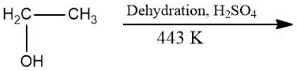
The product of the following reaction is

Figure

Solution

✅ Correct Option: 3

Acid-catalysed hydration of propene follows Markovnikov's rule. H+\mathrm{H^+} adds to the double-bond carbon carrying more hydrogens (CH2\mathrm{CH_2}), giving the more stable secondary carbocation CH3−CH+−CH3\mathrm{CH_3-CH^+-CH_3}.

Water then attacks this carbocation, and loss of H+\mathrm{H^+} gives propan-2-ol, CH3−CH(OH)−CH3\mathrm{CH_3-CH(OH)-CH_3}.


Options 1, 2 and 4: each still contains a C=C\mathrm{C=C} bond. Hydration is an addition reaction across the double bond, so the product must be saturated, and these cannot be formed.
Keyboard Shortcuts

  • Left arrow: Previous question
  • Right arrow: Next question
  • S key: Jump to solution
  • Q key: Jump to question