
Match List-I with List-II
List-I List-II Name Reaction Reaction (A) Stephen Reaction (I) 
(B) Gatterman-Koch Reaction (II) (C) Etard Reaction (III) 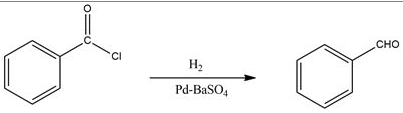
(D) Rosenmund reduction (IV) 
Match List-I with List-II
| List-I | List-II |
|---|---|
| Name Reaction | Reaction |
| (A) Stephen Reaction | (I) |
| (B) Gatterman-Koch Reaction | (II) |
| (C) Etard Reaction | (III) |
| (D) Rosenmund reduction | (IV) |
Solution
✅ Correct Option: 1
| List I | List II |
|---|---|
| (A) Stephen Reaction | (II) |
| (B) Gatterman-Koch Reaction | (I) Benzene with CO, HCl and anhydrous /CuCl gives benzaldehyde |
| (C) Etard Reaction | (IV) Toluene with in gives a chromium complex, which on gives benzaldehyde |
| (D) Rosenmund reduction | (III) Benzoyl chloride with and Pd- gives benzaldehyde |
Memory tricks:
- Stephen starts from a nitrile (RCN), reduced by /HCl.
- Rosenmund starts from an acyl chloride, and poisons the Pd so the aldehyde is not reduced further to an alcohol.
- Etard uses (chromyl chloride), and Gatterman-Koch uses CO and HCl.
Related questions:
2026: 11 May Shift 1
2025: 21 May Shift 2
2025: 30 May Shift 2
2026: 29 May Shift 2
2026: 15 May Shift 1