
The product in the following reaction is
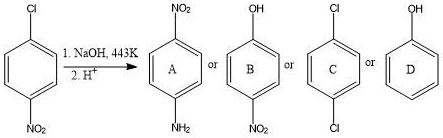
The product in the following reaction is
Solution
Chlorobenzene normally resists nucleophilic substitution, but the group para to Cl is strongly electron-withdrawing. It stabilises the negatively charged intermediate formed when attacks, so substitution happens at the mild temperature of 443 K. Cl is replaced by OH, giving sodium 4-nitrophenoxide, and acidification with gives 4-nitrophenol.
Option 4 (phenol): plain chlorobenzene needs about 623 K and 300 atm to give phenol. Here the nitro group is retained, so the product is 4-nitrophenol, not phenol.
Option 1: an amino group would need , but the reagent is NaOH.
Option 3: no chlorine source is present, and Cl is the group being replaced.
An group at the ortho or para position makes the replacement of Cl by OH easier. At the meta position it has almost no such effect.
Related questions:
2025: 26 May Shift 2
2025: 19 May Shift 2
2025: 26 May Shift 2
2025: 26 May Shift 2
2025: 21 May Shift 1
2025: 27 May Shift 2