
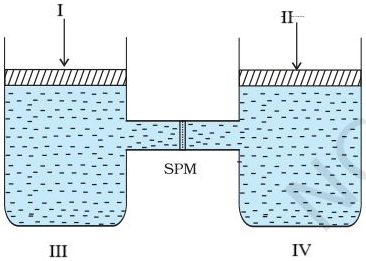
In the following diagram, to prevent osmosis, if excess pressure is applied on one side of the semipermeable membrane (SPM), then I, II, III and IV are, respectively,
(A) Solution
(B)
(C)
(D) Solvent
In the following diagram, to prevent osmosis, if excess pressure is applied on one side of the semipermeable membrane (SPM), then I, II, III and IV are, respectively,
(A) Solution
(B)
(C)
(D) Solvent
Solution
Solvent tends to flow through the SPM into the solution. To stop this, an excess pressure equal to the osmotic pressure must be applied on the solution side.
So the solution is in compartment III, with piston I pressing on it at . The pure solvent is in compartment IV, with piston II at .
I = (C), II = (B), III = (A), IV = (D)
Options 2 and 3: they put the solvent or the plain solution under the raised pressure. The extra pressure must be on the solution side, the side that would otherwise gain solvent.
If the pressure applied on the solution side were more than , the flow would reverse (reverse osmosis).
Related questions:
2026: 14 May Shift 2
2026: 19 May Shift 1