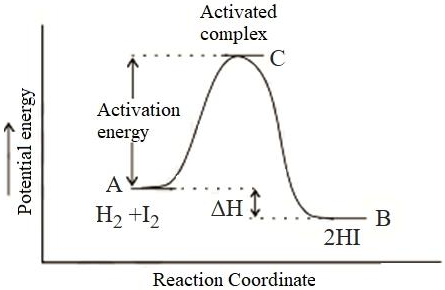
The following statements predict the temperature dependence on the rate of reaction:
(A) Increase in temperature increases the rate of reaction.
(B) Increase in temperature decreases the rate of reaction.
(C) Increase in temperature by 10 °C doubles the reaction rate.
(D) An increase in temperature by 10 °C triples the rate of reaction.
Solution
Rate constant increases with temperature, as given by the Arrhenius equation , so more molecules have energy equal to or above the activation energy. Statement (A) is correct.
For most reactions near room temperature, a 10 degrees C rise roughly doubles the rate, so the temperature coefficient is . Statement (C) is correct.
(B): The opposite of the Arrhenius trend. Rate falls with temperature only in special cases such as enzyme denaturation, not as a general rule.
(D): The temperature coefficient lies between 2 and 3 depending on the reaction, but the standard statement is doubling, not tripling.
Related questions:
2025: 13 May Shift 1
2026: 25 May Shift 2
2026: 21 May Shift 2
2026: 19 May Shift 1
2026: 19 May Shift 2
2026: 30 May Shift 1