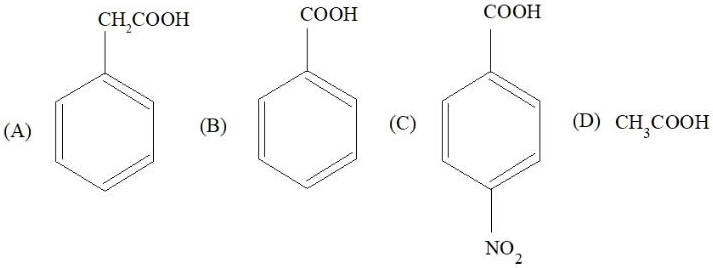
Identify A and B in the following reaction.
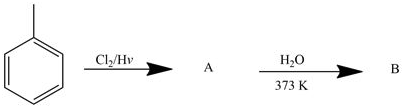
Identify A and B in the following reaction.
Solution
Under light (Cl/h), toluene reacts by a free radical mechanism at the side chain, not the ring. Two hydrogens of the group are replaced, giving benzal chloride, (A).
Benzal chloride on hydrolysis with water at 373 K converts the group to through an unstable gem-diol, which loses water. This gives benzaldehyde (B).
Options 3 and 4: ring chlorination to give o- and p-chlorotoluene needs a Lewis acid (Fe or FeCl) in the dark, not light.
Option 2: benzyl chloride is only the first stage of side-chain chlorination, and it hydrolyses to benzyl alcohol. With Cl/h, substitution continues to the stage.
Remember the series: gives benzyl alcohol, gives benzaldehyde, gives benzoic acid on hydrolysis.
Related questions:
2026: 11 May Shift 1
2025: 15 May Shift 1
2025: 19 May Shift 2
2025: 3 June Shift 2
2025: 21 May Shift 1

2026: 25 May Shift 1