
Match List-I with List-II
List-I List-II (Name reaction.) (Reaction) (A) Williamson ether synthesis (I) 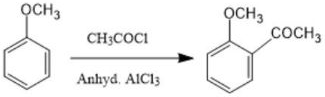
(B) Hydroboration oxidation (II) 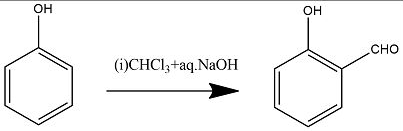
(C) Reimer-Tiemann reaction (III) 
(D) Friedel Craft Acylation reaction (IV) 
Match List-I with List-II
| List-I | List-II |
|---|---|
| (Name reaction.) | (Reaction) |
| (A) Williamson ether synthesis | (I) |
| (B) Hydroboration oxidation | (II) |
| (C) Reimer-Tiemann reaction | (III) |
| (D) Friedel Craft Acylation reaction | (IV) |
Solution
✅ Correct Option: 3
| List I | List II |
|---|---|
| (A) Williamson ether synthesis | (IV) sodium isopropoxide + gives isopropyl methyl ether |
| (B) Hydroboration oxidation | (III) 1-butene with , then , gives 1-butanol |
| (C) Reimer-Tiemann reaction | (II) phenol + + aq. NaOH gives salicylaldehyde (o-hydroxybenzaldehyde) |
| (D) Friedel-Crafts acylation | (I) anisole + / anhydrous gives o-methoxyacetophenone |
Williamson: an alkoxide attacks an alkyl halide by to form an ether.
Hydroboration-oxidation adds water across a double bond in anti-Markovnikov fashion, so a terminal alkene gives a primary alcohol.
Reimer-Tiemann: with NaOH generates dichlorocarbene, which adds a group ortho to the of phenol.
Related questions:
2026: 19 May Shift 1
2026: 7 June Shift 2
2026: 18 May Shift 2
2026: 19 May Shift 1
2026: 25 May Shift 2