
Match List-I with List-II
List-I List-II Test Identification (A) Hinsberg's Test (I) Primary, Secondary and tertiary Amines (B) Isocyanide test (II) Aliphatic and Aromatic primary amines (C) Azo dye test (III) Primary Aromatic amines (D) Tollen's Test (IV) Reducing sugars
Match List-I with List-II
| List-I | List-II |
|---|---|
| Test | Identification |
| (A) Hinsberg's Test | (I) Primary, Secondary and tertiary Amines |
| (B) Isocyanide test | (II) Aliphatic and Aromatic primary amines |
| (C) Azo dye test | (III) Primary Aromatic amines |
| (D) Tollen's Test | (IV) Reducing sugars |
Solution
| List I | List II |
|---|---|
| (A) Hinsberg's Test | (I) Primary, Secondary and tertiary Amines |
| (B) Isocyanide test | (II) Aliphatic and Aromatic primary amines |
| (C) Azo dye test | (III) Primary Aromatic amines |
| (D) Tollen's Test | (IV) Reducing sugars |
Hinsberg's reagent (benzenesulfonyl chloride) distinguishes the three classes of amines: the product from a primary amine dissolves in alkali, that from a secondary amine does not, and a tertiary amine does not react.
The isocyanide (carbylamine) test is given by all primary amines, aliphatic and aromatic, which form a foul-smelling isocyanide with CHCl and alcoholic KOH.
The azo dye test works only for primary aromatic amines, because only they give a stable diazonium salt that couples with phenol or naphthol to form a coloured dye.
Tollen's test detects reducing sugars (and aldehydes) through the silver mirror.
Related questions:
2025: 19 May Shift 2
2025: 24 May Shift 2
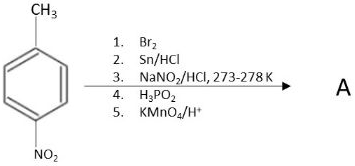
2025: 21 May Shift 1
2025: 28 May Shift 2
2026: 20 May Shift 2
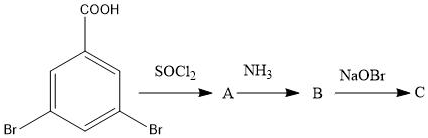
2025: 3 June Shift 2