Skip to main contentSkip to solution

Aldehydes and ketones are important organic compounds prepared mainly by oxidation of alcohols. Primary alcohols give aldehyde and secondary alcohols yield ketones. Aldehydes can also be formed by partial reduction of acid chlorides, reduction of esters or by Gattermann-Koch reaction. Ketones are prepared via Friedel-Craft's acylation, hydration of alkyne and reaction of Grignard's reagent with nitriles. Chemically, aldehydes and ketones are reactive in nature due to the carbonyl group and undergo nucleophilic addition reactions. Aldehydes are more reactive than ketones and can be oxidized to carboxylic acids, while both can be reduced to alcohols or hydrocarbons and exhibit condensation reaction.

Predict the end product (D) of the following reaction sequence;
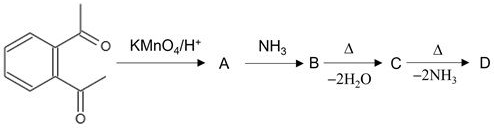
Figure

Solution

✅ Correct Option: 3

KMnO4/H+ oxidises both acetyl groups on the ring to -COOH, so A is phthalic acid. With NH3 it forms the ammonium salt (B), which on heating loses 2 H2O to give phthalamide (C). Heating phthalamide further expels ammonia and closes the five-membered ring, giving phthalimide (D), which has the cyclic -CO-NH-CO- unit.


Option 1: this is A, the first oxidation product.

Option 2: this is C, the intermediate before ring closure.

Option 4: benzamide has only one amide group and cannot form from this sequence.

Keyboard Shortcuts

  • Left arrow: Previous question
  • Right arrow: Next question
  • S key: Jump to solution
  • Q key: Jump to question