Skip to main contentSkip to solution

Many halogen containing organic compounds are present in nature and some of them are clinically useful. These classes of organic compounds find a wide range of applications in our daily life as well as in industries. Many of the polyhalogen compounds are useful too in agriculture. However, some of these compounds cannot be easily decomposed are thus considered to be environmental hazards. These halo compounds are prepared via different synthetic routes where a variety of organic compounds can be used as substrates such as amines, hydrocarbons etc. They are used as solvents for relatively non-polar compounds. These compounds exhibit substitution and elimination reactions, in addition to their reactions with different metals, which leads to the formation of a versatile starting material for others organic compounds.

Write the product in the following reaction.
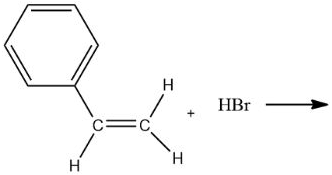
Figure

Solution

✅ Correct Option: 3

HBr adds across the C=C double bond of styrene by electrophilic addition, following Markovnikov's rule. H+H^+ attacks the terminal CH2CH_2 carbon, which gives the more stable benzylic carbocation C6H5−C+H−CH3C_6H_5-\overset{+}{C}H-CH_3. This carbocation is stabilised by resonance with the benzene ring.

Br−Br^- then attacks this carbocation, giving C6H5−CHBr−CH3C_6H_5-CHBr-CH_3 (1-bromo-1-phenylethane), the structure in Option 3.


Option 1: ethylbenzene would form by adding H2H_2 (reduction), not HBr.

Option 2: a dibromo alkene would need Br2Br_2 addition followed by elimination, not HBr.

Option 4: HBr does not brominate the ring, since ring substitution needs Br2Br_2 with a Lewis acid, and the double bond is far more reactive toward HBr.

Keyboard Shortcuts

  • Left arrow: Previous question
  • Right arrow: Next question
  • S key: Jump to solution
  • Q key: Jump to question