Skip to main contentSkip to solution

Alcohols and phenols are formed when a hydrogen atom in a hydrocarbon, aliphatic and aromatic respectively is replaced by -OH group. These are further classified on the basis of number of hydroxy groups and according to the hybridization of the carbon atom sp2^2 or sp3^3 to which the -OH group is attached. They find applications in industry as well as in day-to-day life. One of the most commercially obtained alcohol also known as wood spirit is obtained by destructive distillation of wood. Both alcohols and phenols are acidic in nature. The acidity of alcohols and phenols vary according to the nature of substituent(s) attached to them. Alcohols and phenols react with carboxylic acids, acid chlorides and acid anhydrides to form esters. Introduction of acetyl group in alcohols and phenols is called acetylation. Phenol undergo electrophilic aromatic substitution reaction because the -OH activates the benzene ring. It undergoes nitration, halogenation and sulphonation reactions.

The final product of the following reaction is:
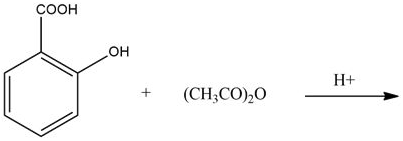
Figure

Solution

✅ Correct Option: 3

The passage states that introducing an acetyl group into an alcohol or phenol is called acetylation. Here, the phenolic -OH of salicylic acid reacts with acetic anhydride in the presence of an acid catalyst. This gives acetylsalicylic acid (2-acetoxybenzoic acid), which is aspirin, along with acetic acid as the by-product.

C6H4(OH)COOH+(CH3CO)2O→H+C6H4(OCOCH3)COOH+CH3COOH\text{C}_6\text{H}_4(\text{OH})\text{COOH} + (\text{CH}_3\text{CO})_2\text{O} \xrightarrow{H^+} \text{C}_6\text{H}_4(\text{OCOCH}_3)\text{COOH} + \text{CH}_3\text{COOH}


Paracetamol: this is 4-hydroxyacetanilide, made by acetylating the -NH2_2 of p-aminophenol, not salicylic acid.

Salicylaldehyde: this is made from phenol by the Reimer-Tiemann reaction, not by acetylation.

Keyboard Shortcuts

  • Left arrow: Previous question
  • Right arrow: Next question
  • S key: Jump to solution
  • Q key: Jump to question