Skip to main contentSkip to solution

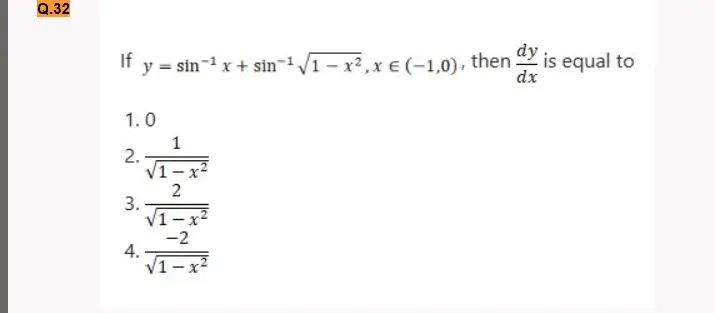
If y=sin⁡−1x+sin⁡−11−x2,x∈(−1,0)y = \sin^{-1} x + \sin^{-1} \sqrt{1-x^2}, x \in (-1, 0), then dydx\frac{dy}{dx} is equal to

Solution

✅ Correct Option: 3

Given y=sin⁡−1x+sin⁡−11−x2y = \sin^{-1} x + \sin^{-1} \sqrt{1-x^2} where x∈(−1,0)x \in (-1, 0).

The derivative formula for inverse sine is:

ddx[sin⁡−1u]=11−u2×dudx\frac{d}{dx}[\sin^{-1} u] = \frac{1}{\sqrt{1-u^2}} \times \frac{du}{dx}


For the first term:

ddx[sin⁡−1x]=11−x2\frac{d}{dx}[\sin^{-1} x] = \frac{1}{\sqrt{1-x^2}}


For the second term sin⁡−11−x2\sin^{-1} \sqrt{1-x^2}, let u=1−x2u = \sqrt{1-x^2}.

u=(1−x2)1/2u = (1-x^2)^{1/2}

dudx=12(1−x2)−1/2×(−2x)\frac{du}{dx} = \frac{1}{2}(1-x^2)^{-1/2} \times (-2x)

dudx=−x1−x2\frac{du}{dx} = \frac{-x}{\sqrt{1-x^2}}

Applying the chain rule:

ddx[sin⁡−11−x2]=11−(1−x2)2×−x1−x2\frac{d}{dx}[\sin^{-1} \sqrt{1-x^2}] = \frac{1}{\sqrt{1-(\sqrt{1-x^2})^2}} \times \frac{-x}{\sqrt{1-x^2}}


Simplifying the denominator:

1−(1−x2)2=1−(1−x2)\sqrt{1-(\sqrt{1-x^2})^2} = \sqrt{1-(1-x^2)}

=x2= \sqrt{x^2}

=∣x∣= |x|

Since x∈(−1,0)x \in (-1, 0), we have ∣x∣=−x|x| = -x.


Continuing the simplification:

ddx[sin⁡−11−x2]=1−x×−x1−x2\frac{d}{dx}[\sin^{-1} \sqrt{1-x^2}] = \frac{1}{-x} \times \frac{-x}{\sqrt{1-x^2}}

=−x−x⋅1−x2= \frac{-x}{-x \cdot \sqrt{1-x^2}}

=11−x2= \frac{1}{\sqrt{1-x^2}}


Combining both derivatives:

dydx=11−x2+11−x2\frac{dy}{dx} = \frac{1}{\sqrt{1-x^2}} + \frac{1}{\sqrt{1-x^2}}

dydx=21−x2\frac{dy}{dx} = \frac{2}{\sqrt{1-x^2}}


Solution figure for CUET Mathematics 2025 22 May Shift 1 question 32 (Calculus) Solution figure for CUET Mathematics 2025 22 May Shift 1 question 32 (Calculus)

This is what NTA has marked right in the final answer key.

Keyboard Shortcuts

  • Left arrow: Previous question
  • Right arrow: Next question
  • S key: Jump to solution
  • Q key: Jump to question