Skip to main contentSkip to solution

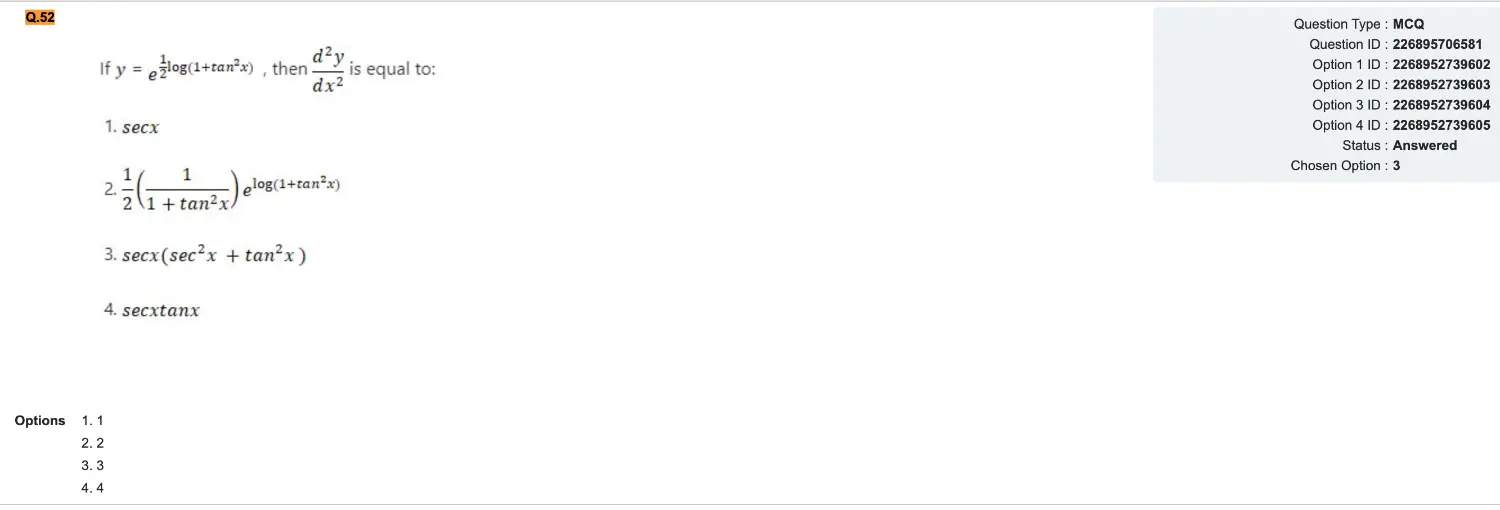
If y=e12log⁡(1+tan⁡2x)y = e^{\frac{1}{2}\log(1+ \tan^2 x)}, then d2ydx2\frac{d^2y}{dx^2} is equal to:

Solution

✅ Correct Option: 3

Given: y=e12log⁡(1+tan⁡2x)y = e^{\frac{1}{2}\log(1+\tan^2 x)}

Using the power rule of logarithms: 12log⁡(1+tan⁡2x)=log⁡(1+tan⁡2x)1/2\frac{1}{2}\log(1+\tan^2 x) = \log(1+\tan^2 x)^{1/2}

Therefore:

y=elog⁡(1+tan⁡2x)1/2y = e^{\log(1+\tan^2 x)^{1/2}}

y=(1+tan⁡2x)1/2y = (1+\tan^2 x)^{1/2}


Using the trigonometric identity 1+tan⁡2x=sec⁡2x1 + \tan^2 x = \sec^2 x:

y=(sec⁡2x)1/2y = (\sec^2 x)^{1/2}

y=sec⁡xy = \sec x


The first derivative:

dydx=sec⁡xtan⁡x\frac{dy}{dx} = \sec x \tan x


The second derivative using the product rule with u=sec⁡xu = \sec x and v=tan⁡xv = \tan x:

d2ydx2=(sec⁡x)′⋅tan⁡x+sec⁡x⋅(tan⁡x)′\frac{d^2y}{dx^2} = (\sec x)' \cdot \tan x + \sec x \cdot (\tan x)'

d2ydx2=(sec⁡xtan⁡x)⋅tan⁡x+sec⁡x⋅(sec⁡2x)\frac{d^2y}{dx^2} = (\sec x \tan x) \cdot \tan x + \sec x \cdot (\sec^2 x)

d2ydx2=sec⁡xtan⁡2x+sec⁡3x\frac{d^2y}{dx^2} = \sec x \tan^2 x + \sec^3 x

d2ydx2=sec⁡x(tan⁡2x+sec⁡2x)\frac{d^2y}{dx^2} = \sec x(\tan^2 x + \sec^2 x)

Therefore, d2ydx2=sec⁡x(sec⁡2x+tan⁡2x)\frac{d^2y}{dx^2} = \sec x(\sec^2 x + \tan^2 x)


Solution figure for CUET Mathematics 2025 2 June Shift 1 question 52 (Applied Mathematics)

This is a past-year question by NTA. It has trigonometry, yes. However, it was asked in the Applied Math section.

Keyboard Shortcuts

  • Left arrow: Previous question
  • Right arrow: Next question
  • S key: Jump to solution
  • Q key: Jump to question