
The feasible region corresponding to the linear constraints of a Linear Programming Problem (LPP) is represented by the shaded region in the given figure. Which of the following is not a constraint to the given LPP?
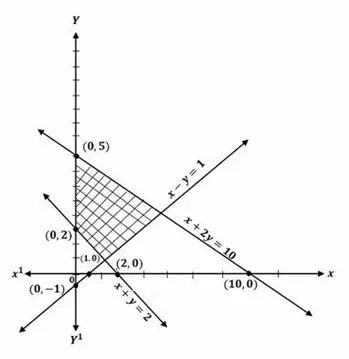
The feasible region corresponding to the linear constraints of a Linear Programming Problem (LPP) is represented by the shaded region in the given figure. Which of the following is not a constraint to the given LPP?
Solution
The feasible region shows the area where all constraints are satisfied. The task is to find which option is not a constraint, meaning it doesn't form a boundary of this shaded region.
Each constraint creates a boundary line. If a constraint is part of the LPP, the shaded region will be on the correct side of that line.
Testing :
This forms the upper boundary of the feasible region. Points in the shaded region satisfy this inequality (they're below or on this line). This is a constraint.
Testing :
This forms the lower-left boundary of the feasible region. Points in the shaded region satisfy this inequality (they're above or on this line). This is a constraint.
Testing :
This forms another boundary of the feasible region. Points in the shaded region satisfy this inequality. This is a constraint.
Testing :
This is the opposite of . If the feasible region satisfies , it cannot also satisfy . These two constraints contradict each other.
The line forms a boundary, but the feasible region is on the side where , not where .
Since the feasible region cannot be on both sides of the same line, only one of these can be a constraint. From the graph, the feasible region satisfies , not .
Therefore, is not a constraint to the given LPP.
Related questions:
2022: 16 July Shift 2
2026: 21 May Shift 2
2025: 15 May Shift 1
2025: 30 May Shift 1
2025: 15 May Shift 1