Skip to main contentSkip to solution

In △ABC,∠B=90∘,BC=5 cm,AC−AB=1 cm\triangle \mathrm{ABC}, \angle \mathrm{B}=90^{\circ}, \mathrm{BC}=5 \ \mathrm{cm}, \mathrm{AC}-\mathrm{AB}=1 \mathrm{~cm}, then 1+sin⁡(C)1+cos⁡(C)\frac{1+\sin (\mathrm{C})}{1+\cos (\mathrm{C})} is

Solution

✅ Correct Option: 4
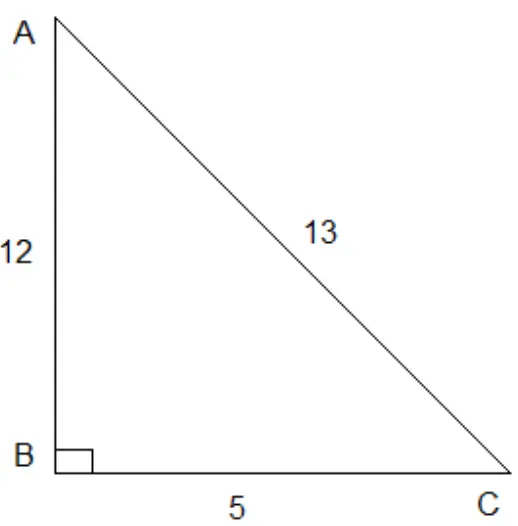
Solution figure for JIPMAT 2023 QA question 22 (Geometry)

Knowing the Pythagorean triplets comes in handy: 5,12,135, 12, 13 (when we know the difference between two sides is 11 cm).

You can also find it using the Pythagorean theorem:

AB2+BC2=AC2AB^2 + BC^2 = AC^2

Let's say AB=xAB = x, then AC=x+1AC = x + 1 (since AC−AB=1AC - AB = 1)

Using Pythagorean theorem:

x2+25=(x+1)2x^2 + 25 = (x + 1)^2

x2+25=x2+2x+1x^2 + 25 = x^2 + 2x + 1

25=2x+125 = 2x + 1

24=2x24 = 2x

x=12x = 12

Therefore:

AB=12AB = 12 cm

AC=13AC = 13 cm

BC=5BC = 5 cm


Find sin⁡(C)\sin(C) and cos⁡(C)\cos(C):

sin⁡(C)=ABAC=1213\sin(C) = \frac{AB}{AC} = \frac{12}{13}

cos⁡(C)=BCAC=513\cos(C) = \frac{BC}{AC} = \frac{5}{13}

Substituting into the expression:

1+sin⁡(C)1+cos⁡(C)=1+12131+513=13+1213+5=2518\dfrac{1 + \sin(C)}{1 + \cos(C)} = \dfrac{1 + \frac{12}{13}}{1 + \frac{5}{13}}= \dfrac{13 +12}{13 + 5}= \dfrac{25}{18}

Keyboard Shortcuts

  • Left arrow: Previous question
  • Right arrow: Next question
  • S key: Jump to solution
  • Q key: Jump to question