
A boy was playing with a rectangular cardboard of dimensions 13 cm x 6 cm. While playing, he sliced off identical triangles from the corners of the cardboard in such a manner that a figure having all its sides equal was generated (as shown in the adjoining figure). The area of this six-sided figure is:
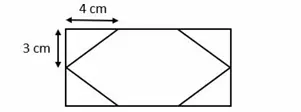
A boy was playing with a rectangular cardboard of dimensions 13 cm x 6 cm. While playing, he sliced off identical triangles from the corners of the cardboard in such a manner that a figure having all its sides equal was generated (as shown in the adjoining figure). The area of this six-sided figure is:
Solution
Setting up the equations:
Let each right triangle have horizontal leg = and vertical leg = .
After cutting all four corners, the hexagon will have:
- Top and bottom edges: (we remove from each end)
- Left and right edges: (we remove from top and bottom)
- Slanted edges (hypotenuse):
Since all sides of the hexagon are equal, let this common length be .
Solving for a and b:
From equations (1) and (2):
From equation (3):
From equation (1):
From equation (2):
Substituting into :
Using the quadratic formula:
Taking the positive value: cm
Therefore: cm and cm
Calculating the area:
The area is 54 cm².
Related questions:
2022: 17 Aug Shift 1
2026: 29 May Shift 1
2022: 6 Aug Shift 1
2026: 12 May Shift 2
2025: 15 May Shift 1