
Select the figures which, when fitted with each other, will form a complete square.
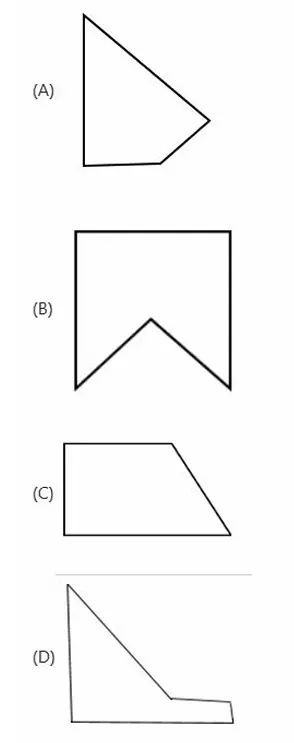
Select the figures which, when fitted with each other, will form a complete square.
Solution
✅ Correct Option: 2
To form a complete square, look at how the contours, angles, and sides of the individual shapes fit together perfectly like jigsaw puzzle pieces:
- Figure (B) forms the large foundational upper body of the square. It has a flat top, flat parallel vertical sides, and a triangular, roof-like wedge cut out of its bottom edge.
- Figure (A) and Figure (C) fit together perfectly to fill in that large bottom wedge cavity:
- Figure (C) is a right-angled trapezoid. Its flat vertical left side lines up with the outer boundary of the square, and its slanted right side angles upward.
- Figure (A) has a matching diagonal slant that sits flush right next to Figure (C), extending outwards to seamlessly complete the right corner and bottom edge.
When (A) and (C) combine, they create a perfect triangular peak pointing upward that slots directly into the inverted triangular cutout at the bottom of (B), locking all three together into a perfect, uniform square.
Figure (D) has an irregular, L-shaped stepped baseline hook at its bottom-right that doesn't structurally fit into any of the smooth diagonal cutouts of the other pieces.
Related questions:
2025: 16 May Shift 1
2025: 19 May Shift 1
2026: 19 May Shift 1
2026: 20 May Shift 1