
Select the figure from the options that can replace the question mark:
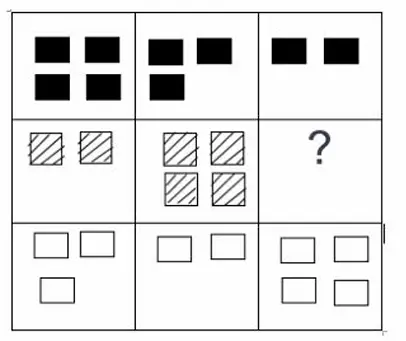
Select the figure from the options that can replace the question mark:
Solution
✅ Correct Option: 1
Step-by-Step Solution:
The matrix operates on a row-by-row mathematical pattern based on the total number of small squares within each cell.
1. Analyze Row 1 (Solid Black Squares):
- Box 1: squares
- Box 2: squares
- Box 3: squares
- Total for Row 1:
2. Analyze Row 3 (Empty/Outline Squares):
Let's look at the third row to confirm the target constant:
- Box 1: squares
- Box 2: squares
- Box 3: squares
- Total for Row 3:
3. Apply the Pattern to Row 2 (Lined/Shaded Squares):
Since the total number of small squares in every horizontal row must equal 9:
- Box 1: squares
- Box 2: squares
- Box 3 (?): Must contain squares
Looking closely at the options for a box with exactly 3 lined squares, Option 1 matches this requirement perfectly.
Related questions:
2023: 15 June Shift 2
2026: 30 May Shift 1
2022: 20 Aug Shift 1
2025: 22 May Shift 1