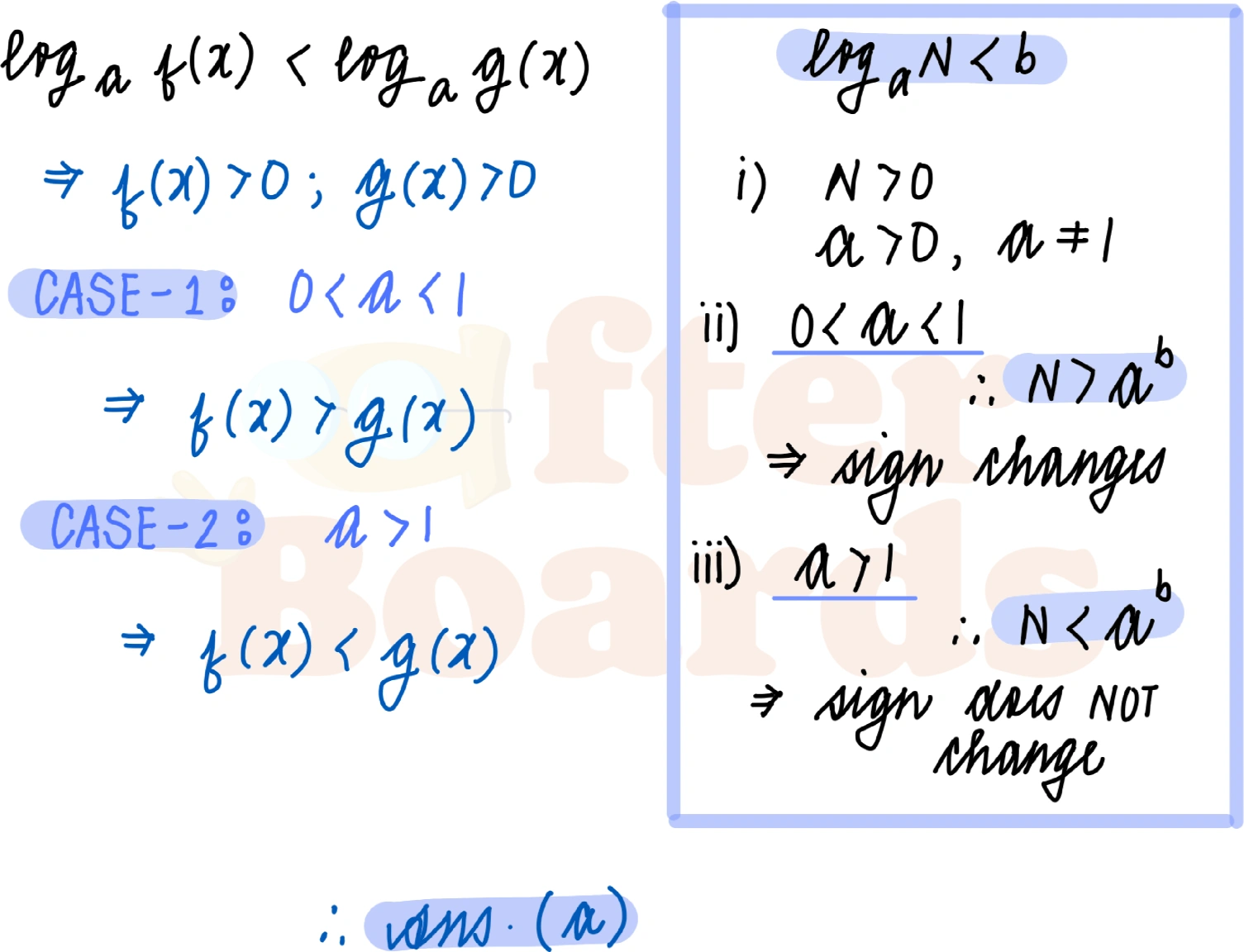
IPMAT IndoreModern Math > Mediumf(x)>g(x)>0f(x) > g(x) > 0f(x)>g(x)>0 for 0<a<10 < a < 10<a<1 and g(x)>f(x)>0g(x) > f(x) > 0g(x)>f(x)>0 for a>1a > 1a>1g(x)>f(x)>0g(x) > f(x) > 0g(x)>f(x)>0 for 0<a<10 < a < 10<a<1 and f(x)>g(x)>0f(x) > g(x) > 0f(x)>g(x)>0 for a>1a > 1a>1f(x)>g(x)>0f(x) > g(x) > 0f(x)>g(x)>0 for a>0a > 0a>0g(x)>f(x)>0g(x) > f(x) > 0g(x)>f(x)>0 for a>0a > 0a>0✅ Correct Option: 1Related questions:IPMAT Indore 2025The set of all values of xxx satisfying the inequality log(x+1x)[log2(x−1x+2)]>0\log _{\left(x+\frac{1}{x}\right)}\left[\log _{2}\left(\frac{x-1}{x+2}\right)\right]>0log(x+x1)[log2(x+2x−1)]>0 isIPMAT Indore 2020The value of (0.04log5(14+18+116+...))(0.04^{log_{\sqrt{5}}(\frac{1}{4} + \frac{1}{8} + \frac{1}{16} + ...)})(0.04log5(41+81+161+...)) is __________.IPMAT Indore 2023Let a,b,ca, b, ca,b,c be real numbers greater than 1, and nnn be a positive real number not equal to 1. If logn(log2a)=1;logn(log2b)=2log_n(log_2a) = 1; log_n(log_2b) = 2logn(log2a)=1;logn(log2b)=2 and logn(log2c)=3log_n(log_2c) = 3logn(log2c)=3 then which of the following is true?