Q1:

International Organisations

Medium

Match List-I with List-II

List-IList-II
(International Organisation)(Year of establishment)
(A) WTO(I) 1945
(B) IAEA(II) 1944
(C) UN(III) 1995
(D) World Bank(IV) 1957
Answer options
Option 4
Correct Answer
Explanation for 2025: 22 May Shift 1 POL question 1

Q2:

Centres of Power

Medium

Which of the following ASEAN organization carries out coordination of security and foreign policy?

Answer options
Option 1
Correct Answer
Explanation for 2025: 22 May Shift 1 POL question 2

Q3:

Recent Issues & Challenges

Easy

Which of the following organizations led to the formation of the Bhartiya Janata Party in 1980?

Answer options
Option 3
Correct Answer
Explanation for 2025: 22 May Shift 1 POL question 3

Q4:

Recent Issues & Challenges

Medium

Which political party was in power in Uttar Pradesh in December 1992?

Answer options
Option 3
Correct Answer
Explanation for 2025: 22 May Shift 1 POL question 4

Q5:

Congress System

Easy

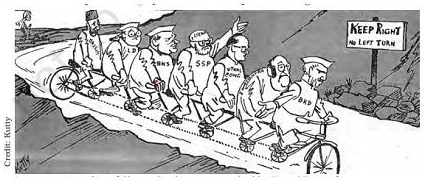
Who among the following was not the leader of the Congress Syndicate?

Answer options
Option 2
Correct Answer
Explanation for 2025: 22 May Shift 1 POL question 5

Q6:

International Organisations

Easy

Match List-I with List-II

List-IList-II
(UN Secretary-General)(Name of their country)
(A) Trygve Lie(I) Egypt
(B) Dag Hammarskjöld(II) Ghana
(C) Boutros Boutros-Ghali(III) Norway
(D) Kofi A. Annan(IV) Sweden
Answer options
Option 4
Correct Answer
Explanation for 2025: 22 May Shift 1 POL question 6

Q7:

Regional Aspirations

Hard

Arrange the following events in chronological order.

(A) Self-Respect Movement

(B) Creation of the state of Punjab and Haryana

(C) Formation of Akali Dal

(D) Assassination of Indira Gandhi

Answer options
Option 2
Correct Answer
Explanation for 2025: 22 May Shift 1 POL question 7

Q8:

Planned Development

Medium

What was the goal of the Second Five Year Plan?

Answer options
Option 4
Correct Answer
Explanation for 2025: 22 May Shift 1 POL question 8

Q9:

Nation-Building

Easy

Who among the following political leaders gave the famous speech "Tryst with Destiny" ?

Answer options
Option 4
Correct Answer
Explanation for 2025: 22 May Shift 1 POL question 9

Q10:

Crisis of Democratic Order

Medium

Which among the following statements is correct about Emergency in 1975?

(A) Emergency was imposed for eighteen months.

(B) The opposition fought the Lok Sabha election in 1977 on the slogan of 'Save Democracy'.

(C) The experience of 1975-77 ended up strengthening the foundations of democracy in India.

(D) In 1977 the Janata Party lost the national elections.

Answer options

Q11:

Globalisation

Medium

Which of the following statements are correct about globalisation?

(A) Globalisation is about the flow of ideas, capital, commodities, and people.

(B) Globalisation is a multi-dimensional concept. It has political, economic and cultural manifestations, and these must be adequately distinguished.

(C) Globalisation is not caused by any single factor; technology remains a critical element.

(D) Globalisation has a strong historical basis and it is important to view contemporary flows in this backdrop.

Answer options

Q13:

Recent Issues & Challenges

Medium

Which Commission was constituted by the central government in 1978 to look into and recommend ways to improve the conditions of the backward classes?

Answer options

Q15:

International Organisations

Medium

Which US President proposed "Atoms for Peace" ?

Answer options

Q16:

International Organisations

Easy

Which among the following statements is correct about India's support for restructuring the UN?

(A) It believes in enhanced role of the UN in strengthening cooperation among states.

(B) It believes that development is not a central concern for the UN.

(C) It believes in the hegemony of the Security Council members.

(D) It believes in increasing the number of both permanent and non-permanent members.

Answer options

Q17:

Nation-Building

Medium

Match List-I with List-II

List-IList-II
(A) Instrument of Accession(I) 565
(B) Formation of a separate Andhra State(II) 1956
(C) State Reorganisation Act(III) December 1952
(D) Number of Princely States in British India(IV) Integration of princely states
Answer options

Q18:

South Asia

Medium

Which of the following factors contributed to Pakistan's failure in building a stable democracy?

(A) The social dominance of the military, clergy and landowning aristocracy

(B) Removal of Zia-ul-Haq

(C) The lack of genuine international support

(D) The United States' threat perception about global Islamic terrorism

Answer options

Q19:

Congress System

Easy

Who among the following political leaders advocated the strategy of "non-Congressism"?

Answer options

Q20:

End of Bipolarity

Medium

Which of the following was the first state to declare its independence from the Soviet Union?

Answer options

Q21:

Globalisation

Easy

The first meeting of World Social Forum was held in _______________ in 2001.

Answer options

Q22:

One-Party Dominance

Medium

Who among the following was the founding president of the Congress Socialist Party?

Answer options

Q23:

Congress System

Medium

What was the portfolio of Lal Bahadur Shastri in Jawharlal Nehru's cabinet before accepting the Prime Ministership?

Answer options

Q24:

South Asia

Easy

Which country tried to bring back the warring groups to negotiate for the peace during the Sri Lankan crisis?

Answer options

Q25:

Crisis of Democratic Order

Easy

Who led the protest of students in Bihar in March 1974?

Answer options

Q26:

Recent Issues & Challenges

Medium

What was the former name of Bahujan Samaj Party?

Answer options

Q27:

External Relations

Easy

Which among the following was not the objective of Jawaharlal Nehru's foreign policy?

Answer options

Q28:

External Relations

Easy

Who was India's Defence Minister during the Chinese invasion in 1962?

Answer options

Q29:

Crisis of Democratic Order

Medium

Who among the following judges passed a judgment declaring Indira Gandhi's election to the Lok Sabha invalid?

Answer options

Q30:

Nation-Building

Hard

Match List-I with List-II

List-IList-II
(Name of State)(Their year of formation)
(A) Maharashtra(I) 1972
(B) Himachal Pradesh(II) 1963
(C) Manipur(III) 1960
(D) Nagaland(IV) 1966
Answer options

Q31:

Planned Development

Medium

Who among the following economists drafted the First Five-Year Plan of independent India?

Answer options

Q32:

Environment & Resources

Medium

Which of the following statements are correct about international concern for global environment?

(A) Awareness of the environmental consequences of economic growth acquired an increasingly political character from the 1960s onwards.

(B) The Club of Rome, a global think tank, published a book titled 'Limits to Growth' in 1972.

(C) United Nations Conference on Environment and Development held in Rio de Janeiro, Brazil in June 1994.

(D) United Nations Environment Programme(UNEP) began holding international conferences and promoting detailed studies to get a more coordinated and effective response to environment problems.

Answer options

Q34:

End of Bipolarity

Medium

Arrange the following events related to disintegration of Soviet Union in choronological order:-

(A) Soviet Union invasion of Afghanistan

(B) USSR came into being

(C) Russian parliament declares its independence from the Soviet Union

(D) Fall of the Berlin Wall

Answer options

Q35:

One-Party Dominance

Medium

Match List-I with List-II

List-IList-II
(Political Party)(Leaders's associated)
(A) Socialist Party(I) A.K. Gopalan
(B) Communist Party of India(II) Acharya Narendra Dev
(C) Bhartiya Jana Sangha(III) C.Rajagopalachari
(D) Swantantra Party(IV) Deen Dayal Upadhyaya
Answer options

Q36:

Security

Easy

Which among the following is not part of India's security strategy?

Answer options

Q37:

Coalition Politics

Easy

In the elections of 2004, which of the following alliances formed the government in the Centre?

Answer options

Q38:

Globalisation

Medium

Which of the following statements is correct about India's trade policy ?

(A) After Independence, because of the colonial trade experience with the British, India decided to make things on its own rather than relying on others.

(B) In the immediate post Independence period, India decided to allow others to export to it so that its own producers could learn to make things.

(C) In the initial years, sectors like health, primary education and housing did not receive much attention.

(D) In 1991, the financial crisis paved the way for a programme of economic reforms that deregulated various sectors including trade and foreign investment.

Answer options

Q39:

Regional Aspirations

Medium

Who among from the following was the founder of Sikkim Praja Mandal?

Answer options

Q40:

Centres of Power

Medium

Which among the following is not a component of the 'four modernisations' proposed by Premier Zhou Enlai?

Answer options

Q41:

Congress System

Easy

Answer the following questions based on the picture:

Figure

The elections of ......... led to the phenomenon of coalition governments in Indian states.

Answer options

Q42:

Congress System

Easy

Answer the following questions based on the picture:

Figure

The expression "aya ram, gaya ram" in Indian politcs is associated with?

Answer options

Q43:

Congress System

Medium

Answer the following questions based on the picture:

Figure

What was "Kamaraj Plan" of 1963?

Answer options

Q44:

Congress System

Medium

Answer the following questions based on the picture:

Figure

Which of the following statements is correct about the Grand Alliance of 1971?

Answer options

Q45:

Congress System

Medium

Answer the following questions based on the picture:

Figure

Who was Congress syndicate candidate for 1969 presdential election?

Answer options

Q46:

Centres of Power

Easy

ASEAN was established in 1967 by five countries when they signed the Bangkok Declaration. The objectives of ASEAN were primarily to accelerate economic growth as well as promoting social progress and cultural development. Another objective was to promote regional peace and stability based on the rule of law and the principles of the United Nations Charter. Over the years, Brunei Darussalam, Vietnam, Lao PDR, Myanmar and Combodia joined ASEAN taking its strength to ten.

Unlike the EU, there is little desire in ASEAN for supranational structures and institutions. ASEAN countries have celebrated what has become known as the 'ASEAN Way', a form of interaction that is informal, non-confrontationist and cooperative. The respect for national sovereignty is critical to the functioning of ASEAN.

With some of the fastest growing economies in the world as its members, ASEAN broadened its objectives beyond the economic and social spheres. In 2003, ASEAN moved along the path of the EU by agreeing to establish an ASEAN Community, comprising three pillars, namely, the ASEAN security Community, the ASEAN Economic Community and the ASEAN Socio-Cultural Community.

Which one of the following objectives is not correct behind the formation of ASEAN?

Answer options

Q47:

Centres of Power

Easy

ASEAN was established in 1967 by five countries when they signed the Bangkok Declaration. The objectives of ASEAN were primarily to accelerate economic growth as well as promoting social progress and cultural development. Another objective was to promote regional peace and stability based on the rule of law and the principles of the United Nations Charter. Over the years, Brunei Darussalam, Vietnam, Lao PDR, Myanmar and Combodia joined ASEAN taking its strength to ten.

Unlike the EU, there is little desire in ASEAN for supranational structures and institutions. ASEAN countries have celebrated what has become known as the 'ASEAN Way', a form of interaction that is informal, non-confrontationist and cooperative. The respect for national sovereignty is critical to the functioning of ASEAN.

With some of the fastest growing economies in the world as its members, ASEAN broadened its objectives beyond the economic and social spheres. In 2003, ASEAN moved along the path of the EU by agreeing to establish an ASEAN Community, comprising three pillars, namely, the ASEAN security Community, the ASEAN Economic Community and the ASEAN Socio-Cultural Community.

Which one of the following is not a regional organisation?

Answer options

Q48:

Centres of Power

Medium

ASEAN was established in 1967 by five countries when they signed the Bangkok Declaration. The objectives of ASEAN were primarily to accelerate economic growth as well as promoting social progress and cultural development. Another objective was to promote regional peace and stability based on the rule of law and the principles of the United Nations Charter. Over the years, Brunei Darussalam, Vietnam, Lao PDR, Myanmar and Combodia joined ASEAN taking its strength to ten.

Unlike the EU, there is little desire in ASEAN for supranational structures and institutions. ASEAN countries have celebrated what has become known as the 'ASEAN Way', a form of interaction that is informal, non-confrontationist and cooperative. The respect for national sovereignty is critical to the functioning of ASEAN.

With some of the fastest growing economies in the world as its members, ASEAN broadened its objectives beyond the economic and social spheres. In 2003, ASEAN moved along the path of the EU by agreeing to establish an ASEAN Community, comprising three pillars, namely, the ASEAN security Community, the ASEAN Economic Community and the ASEAN Socio-Cultural Community.

Which one of the following principles of ASEAN is related to the liberal global powers?

Answer options
Option 2,4
Correct Answer
Explanation for 2025: 22 May Shift 1 POL question 48

Q49:

Centres of Power

Easy

ASEAN was established in 1967 by five countries when they signed the Bangkok Declaration. The objectives of ASEAN were primarily to accelerate economic growth as well as promoting social progress and cultural development. Another objective was to promote regional peace and stability based on the rule of law and the principles of the United Nations Charter. Over the years, Brunei Darussalam, Vietnam, Lao PDR, Myanmar and Combodia joined ASEAN taking its strength to ten.

Unlike the EU, there is little desire in ASEAN for supranational structures and institutions. ASEAN countries have celebrated what has become known as the 'ASEAN Way', a form of interaction that is informal, non-confrontationist and cooperative. The respect for national sovereignty is critical to the functioning of ASEAN.

With some of the fastest growing economies in the world as its members, ASEAN broadened its objectives beyond the economic and social spheres. In 2003, ASEAN moved along the path of the EU by agreeing to establish an ASEAN Community, comprising three pillars, namely, the ASEAN security Community, the ASEAN Economic Community and the ASEAN Socio-Cultural Community.

How many countries are members of ASEAN presently?

Answer options

Q50:

Centres of Power

Easy

ASEAN was established in 1967 by five countries when they signed the Bangkok Declaration. The objectives of ASEAN were primarily to accelerate economic growth as well as promoting social progress and cultural development. Another objective was to promote regional peace and stability based on the rule of law and the principles of the United Nations Charter. Over the years, Brunei Darussalam, Vietnam, Lao PDR, Myanmar and Combodia joined ASEAN taking its strength to ten.

Unlike the EU, there is little desire in ASEAN for supranational structures and institutions. ASEAN countries have celebrated what has become known as the 'ASEAN Way', a form of interaction that is informal, non-confrontationist and cooperative. The respect for national sovereignty is critical to the functioning of ASEAN.

With some of the fastest growing economies in the world as its members, ASEAN broadened its objectives beyond the economic and social spheres. In 2003, ASEAN moved along the path of the EU by agreeing to establish an ASEAN Community, comprising three pillars, namely, the ASEAN security Community, the ASEAN Economic Community and the ASEAN Socio-Cultural Community.

Which one of the following pillars is not a part of ASEAN Community?

Answer options

CUET Political Science 2025 22 May Shift 1 Past Year Question Paper

Every question from the CUET Political Science 2025 22 May Shift 1 paper is here in full, with the correct answer and a step by step solution for each one. It is completely free, there is no login and no paywall, and you can read the whole paper online or download it to revise offline.

You can also attempt it instead of only reading it. Take the paper as a full length mock under exam conditions, or filter it by topic and attempt just that topic as a topic test. Both are free, and you get a breakdown of your accuracy, your timing and your weak areas once you submit.

CUET Political Science past year questions (PYQs) are the closest thing to the real exam, so working through them is the quickest way to learn the paper pattern, the marking scheme and the level of difficulty to expect on the day.