Q1:

Coalition Politics

Easy

Match List-I with List-II

List-IList-II
(Prime Minister)(Tenure)
(A) H.D.Deve Gowda(I) June 1991-May 1996
(B) Chandra Shekhar(II) June1996-April 1997
(C) P.V. Narasimha Rao(III) May2004-May2014
(D) Manmohan Singh(IV) Novemeber1990-June 1991
Answer options
Option 3
Correct Answer
Explanation for 2025: 29 May Shift 1 POL question 1

Q2:

Nation-Building

Easy

Which was not one of the challenges before newly Independent India?

(A) Establishing a theocratic state

(B) Instituionalising democracy

(C) Defending the territorial integrity of India

(D) Evolving policies for economic development and eradication of poverty.

Answer options
Option 4
Correct Answer
Explanation for 2025: 29 May Shift 1 POL question 2

Q3:

End of Bipolarity

Easy

What do you understand by the term "the largest garage sale' in the history of the USSR?

Answer options
Option 3
Correct Answer
Explanation for 2025: 29 May Shift 1 POL question 3

Q4:

International Organisations

Medium

Which among the following statements are correct about the UN Security Council?

(A) In the UN Security Council, there are five permanent members and ten non-permanent members.

(B) The permanent members in the UN Security Council have a right to veto only in certain matters like trade policy and environment issues.

(C) The non-permanent members in the UN Security Council serve for only one year at a time.

(D) The UN Charter gave the permanent members a privileged position to bring about stability in the post-World War II world.

Answer options
Option 3
Correct Answer
Explanation for 2025: 29 May Shift 1 POL question 4

Q5:

Globalisation

Medium

Which among the following statements are correct about the economic consequences of globalization?

(A) The economic flows among different nations of the world are involuntary and are all forced by international organizations.

(B) Globalization has reduced the restrictions on movement of capital across countries.

(C) Globalization has led to the adoption of similar economic policies by governments in different parts of the world and generated the same outcomes in all countries.

(D) Globalization has led to greater interdependence and integration between governments, businesses and ordinary people in different parts of the world.

Answer options
Option 3
Correct Answer
Explanation for 2025: 29 May Shift 1 POL question 5

Q6:

Recent Issues & Challenges

Medium

Which among the following is a development around 1986 that became central to the politics of BJP?

Answer options
Option 2
Correct Answer
Explanation for 2025: 29 May Shift 1 POL question 6

Q7:

One-Party Dominance

Medium

Which among the following statements are correct about the first general elections of India?

(A) The first general elections spanned from October 1951 to February 1952.

(B) It took six months for the campaigning, polling and counting to be completed.

(C) On an average, more than four candidates for each seat fought elections.

(D) Only one-fourth of the eligible voters turned out to vote on the day of elections.

Answer options
Option 2
Correct Answer
Explanation for 2025: 29 May Shift 1 POL question 7

Q8:

Centres of Power

Medium

Match List-I with List-II

List-IList-II
OrganisationsYear of establishment
(A) Organization for European Economic Cooperation(I) 1992
(B) The Council of Europe(II) 1957
(C) European Union(III) 1948
(D) European Economic Community(IV) 1949
Answer options
Option 2
Correct Answer
Explanation for 2025: 29 May Shift 1 POL question 8

Q9:

South Asia

Medium

Arrange the following events in the correct chronological order :

(A) India and Pakistan sign the Indus Waters Treaty

(B) Sri Lanka gains Independence

(C) Proclamation of Independence by leaders of Bangladesh

(D) India conducts the first nuclear test

Answer options
Option 3
Correct Answer
Explanation for 2025: 29 May Shift 1 POL question 9

Q10:

External Relations

Easy

Which among the following was not an objective of Nehru's Foreign Policy?

Answer options

Q11:

Security

Easy

Which among the following is not a component of the traditional concept of security?

Answer options

Q14:

Regional Aspirations

Medium

Match List-I with List-II

List-IList-II
StatesYear of creation
(A) Sikkim(I) 1963
(B) Nagaland(II) 1987
(C) Manipur and Tripura(III) 1975
(D) Arunachal Pradesh(IV) 1972
Answer options

Q15:

Centres of Power

Medium

Which of the following statement is correct about ASEAN?

(A)The ASEAN security community was based on the principle that territorial disputes should escalate into armed confrontation.

(B) By 2003, ASEAN had several agreements with member states to uphold peace, neutrality, cooperation and non-interference.

(C) ASEAN is principally a social organisation.

(D) Its vision 2020 has defined an outward looking role for ASEAN in the international community.

Answer options

Q16:

End of Bipolarity

Easy

Who became the General Secretary of the Communist Party of the Soviet Union in 1985?

Answer options

Q17:

Congress System

Medium

In which general election, all the major non-communist non-Congress opposition parties formed Grand Alliance against Indira Gandhi?

Answer options

Q18:

Nation-Building

Easy

Which among the following is a Muslim majority province of British India that had large areas where the non-Muslims were in majority?

Answer options

Q20:

Recent Issues & Challenges

Medium

Which of the following statement is correct about the politics of BJP in the 1980s?

Answer options

Q21:

International Organisations

Easy

In the context of the UN in a unipolar world, the power of US cannot be easily checked because-

Answer options

Q22:

End of Bipolarity

Easy

Arrange the following events in the correct chronological order:

(A) The Soviet Invasion of Afghanistan

(B) Fall of the Berlin wall

(C) The adminstration of 'shock therapy' in post-communist regimes

(D)The Russian Revolution

Answer options

Q24:

Congress System

Medium

Which among the following statements is correct about Presidential elections, 1969?

(A) The factional rivalry between the Syndicate and Indira Gandhi came into the open in 1967.

(B) The official Congress candidate for the Presidential elections was V.V. Giri.

(C) The then Congress President issued a whip asking all Congress MPs and MLAs to vote in favor of its official candidate in Presidential elections.

(D) The Presidential elections resulted in the victory of V.V. Giri.

Answer options

Q25:

Environment & Resources

Medium

Match List-I with List-II

List-IList-II
(A) Brundtland Report(I) Traditional patterns of economic growth were not sustainable in the long term.
(B) Kyoto Protocol(II) India pointed out that per capita emission rates of the developing countries are a tiny fraction of those in the developed world.
(C) United Nations Framework Convention on Climate Change(III) Set targets for industrialized countries to cut their greenhouse gas emissions
(D) G-8 Meeting in 2005(IV) Parties should act to protect the climate system on the basis of equity and in accordance with their common but differentiated responsibilities and respective capabilities.
Answer options

Q26:

Coalition Politics

Easy

Who led the first non- Congress government after the 1989 general elections in India?

Answer options

Q27:

Recent Issues & Challenges

Medium

Which among the following is a feature of post-2019 political development in India?

Answer options

Q28:

Crisis of Democratic Order

Easy

Who was the leader of Naxalbari Uprising?

Answer options

Q29:

One-Party Dominance

Medium

Match List-I with List-II

List-IList-II
(A) The entire country shifted to the EVM(I) 1964
(B) CPI went through a major split following the ideological rift between Soviet Union and China(II) 1950
(C) Bharatiya Jana Sangh was formed(III) 2004
(D) Shyama Prasad Mukherjee resigned due to differences over India's relations with Pakistan(IV)1951
Answer options

Q30:

Congress System

Easy

In which year was Indira Gandhi expelled from the Congress party by then Congress President S. Nijalingappa for ignoring the 'whip' in the Presidential election?

Answer options

Q31:

Crisis of Democratic Order

Medium

Arrange the following events in the correct sequence of occurance.

(A) Under Article 352 of the Constitution, the government declared that there was a threat of internal disturbances.

(B)The constitution bench of the Supreme Court decided during Emergency the government could take away the citizen's right to life and liberty.

(C) After eighteen months of Emergency, the government decided to hold elections.

(D) The Supreme Court decided the Keshavananda Bharati case

Answer options

Q32:

Crisis of Democratic Order

Medium

Which Kannada writer returned his Padma Bhushan award in protest against the suspension of democracy due to the imposition of Emergency in 1975 ?

Answer options

Q33:

Nation-Building

Easy

Who was the first Minister of Health in independent India's first Ministry?

Answer options

Q37:

Congress System

Medium

Which among the following statements are correct about the restoration of the Congress system by Indira Gandhi?

(A) Indira Gandhi reinvented the Congress party in terms of popularity as in the past.

(B) The Congress party never relied on the popularity and charisma of the supreme leader.

(C) The Congress party depended only on one social group, namely, industrialists.

(D) Indira Gandhi restored the Congress system by changing the nature of the Congress system itself.

Answer options

Q38:

Security

Medium

Non-traditional conceptions of security vary according to local contexts. An example is-

Answer options

Q39:

External Relations

Hard

Match List-I with List-II

List-IList-II
(Tibet)(year)
(A) Armed uprising in Tibet against China's occupation(I) 1956
(B) Dalai Lama accompanied Zhou Enlai during the official Chinese visit to India(II) 1959
(C) Dalai Lama crossed over into the Indian border and sought asylum(III) 1950
(D) China took control over Tibet(IV)1958
Answer options

Q40:

International Organisations

Medium

Which of the following UN Secretary General is associated with the report 'An Agenda for Peace'?

Answer options

Q41:

Crisis of Democratic Order

Easy

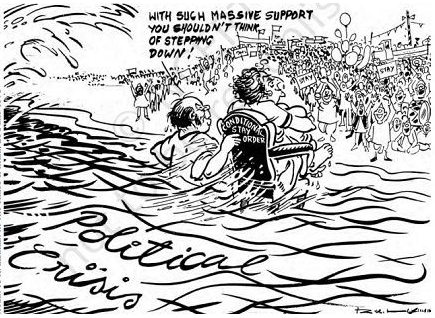
Answer the questions based on the image :

Figure

What does the above picture depict ?

Answer options

Q42:

Crisis of Democratic Order

Medium

Answer the questions based on the image :

Figure

Who was the Congress President at the time of crisis, depicted in the picture to be standing behind the chair?

Answer options

Q43:

Crisis of Democratic Order

Easy

Answer the questions based on the image :

Figure

Who is the political leader sitting on the chair as depicted in the above picture?

Answer options

Q44:

Crisis of Democratic Order

Easy

Answer the questions based on the image :

Figure

What is the context of this cartoon?

Answer options

Q45:

Crisis of Democratic Order

Easy

Answer the questions based on the image :

Figure

In which year was Article 352 of the Constitution invoked by the government ?

Answer options

Q46:

Recent Issues & Challenges

Easy

The 1980s also saw the rise of political organisation of the Dalits. In 1978 the Backward and Minority Communities Employees Federation (BAMCEF) was formed. This organisation was not an ordinary trade union of government employees. It took a strong position in favour of political power to the ‘bahujan’ – the SC, ST, OBC and minorities. It was out of this that the subsequent Dalit Shoshit Samaj Sangharsh Samiti and later the Bahujan Samaj Party (BSP) emerged under the leadership of Kanshi Ram. The BSP began as a small party supported largely by Dalit voters in Punjab, Haryana and Uttar Pradesh. But in 1989 and the 1991 elections, it achieved a breakthrough in Uttar Pradesh. This was the first time in independent India that a political party supported mainly by Dalit voters had achieved this kind of political success.

In the context of the passage, who are included as 'bahujan'?

Answer options

Q47:

Recent Issues & Challenges

Easy

The 1980s also saw the rise of political organisation of the Dalits. In 1978 the Backward and Minority Communities Employees Federation (BAMCEF) was formed. This organisation was not an ordinary trade union of government employees. It took a strong position in favour of political power to the ‘bahujan’ – the SC, ST, OBC and minorities. It was out of this that the subsequent Dalit Shoshit Samaj Sangharsh Samiti and later the Bahujan Samaj Party (BSP) emerged under the leadership of Kanshi Ram. The BSP began as a small party supported largely by Dalit voters in Punjab, Haryana and Uttar Pradesh. But in 1989 and the 1991 elections, it achieved a breakthrough in Uttar Pradesh. This was the first time in independent India that a political party supported mainly by Dalit voters had achieved this kind of political success.

In which states did Bahujan Samajan Party (BSP) start its political activities ?

Answer options

Q48:

Recent Issues & Challenges

Easy

The 1980s also saw the rise of political organisation of the Dalits. In 1978 the Backward and Minority Communities Employees Federation (BAMCEF) was formed. This organisation was not an ordinary trade union of government employees. It took a strong position in favour of political power to the ‘bahujan’ – the SC, ST, OBC and minorities. It was out of this that the subsequent Dalit Shoshit Samaj Sangharsh Samiti and later the Bahujan Samaj Party (BSP) emerged under the leadership of Kanshi Ram. The BSP began as a small party supported largely by Dalit voters in Punjab, Haryana and Uttar Pradesh. But in 1989 and the 1991 elections, it achieved a breakthrough in Uttar Pradesh. This was the first time in independent India that a political party supported mainly by Dalit voters had achieved this kind of political success.

In which year was the BAMCEF founded ?

Answer options

Q49:

Recent Issues & Challenges

Easy

The 1980s also saw the rise of political organisation of the Dalits. In 1978 the Backward and Minority Communities Employees Federation (BAMCEF) was formed. This organisation was not an ordinary trade union of government employees. It took a strong position in favour of political power to the ‘bahujan’ – the SC, ST, OBC and minorities. It was out of this that the subsequent Dalit Shoshit Samaj Sangharsh Samiti and later the Bahujan Samaj Party (BSP) emerged under the leadership of Kanshi Ram. The BSP began as a small party supported largely by Dalit voters in Punjab, Haryana and Uttar Pradesh. But in 1989 and the 1991 elections, it achieved a breakthrough in Uttar Pradesh. This was the first time in independent India that a political party supported mainly by Dalit voters had achieved this kind of political success.

Who was the founder of Bahujan Samaj Party (BSP)?

Answer options

Q50:

Recent Issues & Challenges

Easy

The 1980s also saw the rise of political organisation of the Dalits. In 1978 the Backward and Minority Communities Employees Federation (BAMCEF) was formed. This organisation was not an ordinary trade union of government employees. It took a strong position in favour of political power to the ‘bahujan’ – the SC, ST, OBC and minorities. It was out of this that the subsequent Dalit Shoshit Samaj Sangharsh Samiti and later the Bahujan Samaj Party (BSP) emerged under the leadership of Kanshi Ram. The BSP began as a small party supported largely by Dalit voters in Punjab, Haryana and Uttar Pradesh. But in 1989 and the 1991 elections, it achieved a breakthrough in Uttar Pradesh. This was the first time in independent India that a political party supported mainly by Dalit voters had achieved this kind of political success.

In which state did BSP get a breakthrough for the first time in 1989 and 1991 ?

Answer options

CUET Political Science 2025 29 May Shift 1 Past Year Question Paper

Every question from the CUET Political Science 2025 29 May Shift 1 paper is here in full, with the correct answer and a step by step solution for each one. It is completely free, there is no login and no paywall, and you can read the whole paper online or download it to revise offline.

You can also attempt it instead of only reading it. Take the paper as a full length mock under exam conditions, or filter it by topic and attempt just that topic as a topic test. Both are free, and you get a breakdown of your accuracy, your timing and your weak areas once you submit.

CUET Political Science past year questions (PYQs) are the closest thing to the real exam, so working through them is the quickest way to learn the paper pattern, the marking scheme and the level of difficulty to expect on the day.