Q1:

Security

Hard

Chronologically arrange the following organizations/conventions/Treaties according to the year of establishment :

(A) International Atomic Energy Agency

(B) The Nuclear Non-Proliferation Treaty

(C) Chemical Weapons Convention

(D) Biological Weapons Convention

Answer options
Option 2
Correct Answer
Explanation for 2025: 15 May Shift 2 POL question 1

Q2:

Coalition Politics

Easy

Who among the following were the leaders of the United Front government that was formed in June1996?

Answer options
Option 1
Correct Answer
Explanation for 2025: 15 May Shift 2 POL question 2

Q3:

South Asia

Medium

Which of the following statements are correct about the ethnic conflict in Sri Lanka?

(A) Sinhala nationalists were hostile to the Tamils and believed that Sri Lanka belongs to the Sinhala people only.

(B) India refused to intervene in the conflict, claiming that it was an internal matter of Sri Lanka.

(C) The Indian Peace Keeping Force sent to Sri Lanka in 1967 achieved its objective of establishing peace and stability.

(D) LTTE demanded a separate country for the Tamils of Sri Lanka.

Answer options
Option 4
Correct Answer
Explanation for 2025: 15 May Shift 2 POL question 3

Q4:

Crisis of Democratic Order

Easy

Which commission of inquiry was appointed by the Janata Party government to inquire into several aspects of allegations of abuse of authority during the Emergency?

Answer options
Option 1
Correct Answer
Explanation for 2025: 15 May Shift 2 POL question 4

Q6:

External Relations

Medium

Which of the following statements about India's Nuclear Policy are correct?

(A) India opposed the Non-Proliferation Treaty (NPT) but supported the Comprehensive Test Ban Treaty (CTBT).

(B) India is committed to verifiable and non-discriminatory nuclear disarmament.

(C) India's nuclear doctrine of credible minimum nuclear deterrence professes "no first use."

(D) India conducted its first nuclear test in 1952 under the guidance of Homi J. Bhabha.

Answer options
Option 4
Correct Answer
Explanation for 2025: 15 May Shift 2 POL question 6

Q8:

Recent Issues & Challenges

Medium

In August 1990, the National Front government decided to implement one of the recommendations of the Mandal Commission pertaining to reservations for the OBCs in jobs in the central government and its undertakings. Who among the following challenged this decision in the Supreme Court?

Answer options
Option 3
Correct Answer
Explanation for 2025: 15 May Shift 2 POL question 8

Q9:

Congress System

Medium

Which of the following statements about the Congress Party are correct?

(A) Syndicate was the name given to junior leaders in the Congress party.

(B) Syndicate was the informal name given to a group of powerful Congress leaders who were in control of the party's organsiation.

(C) The Syndicate was led by K.Kamraj, S.K. Patil,S. Nijalingappa, N. Sanjeeva Reddy and Atulya Ghosh.

(D) The Syndicate never influenced policy formulation and implementation.

Answer options
Option 4
Correct Answer
Explanation for 2025: 15 May Shift 2 POL question 9

Q10:

Centres of Power

Easy

Which one of the following is not a part of the 'ASEAN Way'?

Answer options

Q11:

Nation-Building

Easy

When did the Constitution of India come into effect?

Answer options

Q12:

Regional Aspirations

Medium

Match List-I with List-II

List-IList-II
(A) Laldenga(I) Sikkim
(B) Angami Zapu Phizo(II) Mizoram
(C) AASU(III) Nagaland
(D) Kazi Lhendup Dorji Khangsarpa(IV) Assam
Answer options

Q13:

One-Party Dominance

Easy

During which period did the Congress dominance reflect both at the national and the state level?

Answer options

Q14:

International Organisations

Easy

'This organ of the United Nations no longer represents contemporary political realities, lacks equitable representation, its decisions reflect only western values and interests, and decision-making is dominated by a few powers.'

Identify the organ of the United Nations.

Answer options

Q15:

South Asia

Easy

The Shimla agreement was signed between which of the following two countries?

Answer options

Q16:

Coalition Politics

Medium

Consider the following statements about electoral politics in India.

(A) The period after 1989 is characterised as a period of one party dominance.

(B) The period after 1989 saw the decline of the Congress and the rise of the BJP.

(C) In the elections of 2004, the Congress party formed a pre-election coalition.

(D) In the 2004 elections, the BJP led NDA failed to win a majority of seats in the Lok Sabha.

Answer options

Q17:

Coalition Politics

Easy

Which one of the following is not related to the beginning of an era of coalition government?

Answer options

Q18:

Centres of Power

Medium

Which of the following were not the alternative centers of political and economic power that emerged after disintegration of USSR?

(A) European Union

(B) African Union

(C) Association of South East Asian Nations

(D) South East Asian Treaty Organisation

Answer options

Q19:

Environment & Resources

Easy

The United Nations Conference on Environment and Development was held in June 1992. This was also called the Earth Summit. In which city was it organized ?

Answer options

Q20:

Crisis of Democratic Order

Medium

In 1973, who among the following was appointed as the Chief Justice of the Supreme Court of India by the then central government superseding three senior judges?

Answer options

Q21:

Environment & Resources

Easy

In 1972, a global think tank published a book that cautioned about the potential depletion of the Earth's resources against the backdrop of a rapidly growing world population. What is the name of the think tank and the title of the book?

Answer options

Q22:

Congress System

Easy

From 1964 to 1966 the country faced two major challenges, namely the war with China and failed monsoons. In this context, which of the following slogans symbolized the country's resolve to face both these challenges?

Answer options

Q23:

Security

Medium

Which of the following statements about health epidemics as a non-traditional concept of security are correct?

(A) There is no difference in how advanced, industrialised countries and poor, backward countries respond to health challenges.

(B) Epidemics demonstrate the need for international cooperation due to interdependence of states.

(C) One country's success or failure in limiting the spread of diseases does not affect infections in other countries.

(D) Health epidemics spread rapidly across countries through migration, business, tourism and military operations.

Answer options

Q24:

Security

Easy

Which of the following statements are correct regarding military conflict?

(A) Only soldiers are injured or killed during a war.

(B) In the traditional conception of security, the greatest danger to a country's security is from military threats.

(C) Threatening military action endangers the core values of sovereignty, independence and territorial integrity.

(D) Military action also endangers the lives of ordinary citizens.

Answer options

Q25:

International Organisations

Medium

Match List-I with List-II

List-IList-II
(UN Body)(Composition )
(A) SecurityCouncil(I) International staff servicing the other principal organs, headed by the Secretary- General, who is appointed by the General Assembly on the recommendation of the Security Council.
(B) General Assembly(II) Member states elected by the General Assembly for overlapping three-year terms- 54 seats based on geographical representation.
(C) Secretariat(III) Fifteen members - five permanent (with veto rights), ten elected by the General Assembly for two year terms. Decision binding on all UN members.
(D) Economic and Social Council(IV) Representatives of all 193 Member States, each with one vote. Major decisions require a two thirds majority; otherwise a simple majority. Decision not binding on UN members.
Answer options

Q26:

Planned Development

Easy

In politics, parties or groups are often identified as Left or Right. A party which believes that free competition and market economy alone ensures progress, and opposes unnecessary government intervention in the economy can be categorised as -

Answer options

Q27:

Recent Issues & Challenges

Medium

Which of the following is correct regarding the Muslim Women (Protection of Rights on Divorce) Act of 1986?

Answer options

Q28:

Nation-Building

Easy

The welfare goals that democratic politics must achieve is set out in which of the following provisions of the Indian constitution?

Answer options

Q29:

International Organisations

Medium

Which of the following statements are correct about the International Atomic Energy Agency (IAEA)?

(A) IAEA was established in 1957

(B) IAEA came into being to implement the 'Atoms for Peace' proposal

(C) IAEA does not inspect nuclear facilities all over the world to prevent the use of nuclear energy for military purposes.

(D) IAEA came into being to implement President Dwight Eisenhower's diplomacy.

Answer options

Q30:

External Relations

Easy

On the Indian side of the Line of Control, several points in Mashkoh, Dras, Kaksar and Batalik areas were occupied by forces claiming to be Mujahideen. Suspecting the involvement of the Pakistan Army, Indian forces reacted to this occupation. Name the event.

Answer options

Q31:

End of Bipolarity

Medium

The United Nations Conference on Trade and Development (UNCTAD) Report in 1972 deals with:

Answer options

Q32:

Nation-Building

Medium

Match List-I with List-II

List-IList-II
(A) First Health Minister(I) Jawaharlal Nehru
(B) First Minister of Communication(II) Rajkumari Amrit Kaur
(C) First Indian to be the Governor General of India(III) Rafi Ahmed Kidwai
(D) First Foreign Minister(IV) C. Rajagopalachari
Answer options

Q33:

Nation-Building

Easy

Which one of the following leaders is known as 'Frontier Gandhi'?

Answer options

Q34:

South Asia

Easy

Which one of the following is a Treaty/Agreement not signed by India and Pakistan ?

(A) The Farakka Treaty.

(B) The Indus Water Treaty

(C) The Shimla Agreement

(D) The Tashkent Agreement

Answer options

Q35:

Coalition Politics

Medium

Chronologically, arrange the following Prime Ministers in the order of their tenure.

(A) Chandra Shekhar

(B) P.V. Narsimha Rao

(C) A.B. Vajpayee

(D) V.P. Singh

Answer options

Q36:

Security

Easy

In 1994, a civil war broke out in __________ during which nearly five lakh members of the Tutsi tribe were killed by the rival Hutu tribe.

Answer options

Q39:

Planned Development

Easy

In 1944 a group of big industrialists drafted a joint proposal for setting up a planned economy in India. Name the Plan.

Answer options

Q40:

Globalisation

Easy

Which plant was patented by American and European firms and generated considerable opposition from those resisting the entry of multinationals into India?

Answer options

Q41:

Nation-Building

Easy

British India was divided into what were called the British Indian Provinces and the Princely States. The British Indian Provinces were directly under the control of the British government. On the other hand, several large and small states ruled by princes, called the Princely States, enjoyed some form of control over their internal affairs as long as they accepted British supremacy. This was called paramountcy or suzerainty of the British crown. Princely States covered one-third of the land area of the British Indian Empire and one out of four Indians lived under princely rule. Just before Independence it was announced by the British that with the end of their rule over India, paramountcy of the British crown over Princely States would also lapse. This meant that all these states, as many as 565 in all, would become legally independent. The British government took the view that all these states were free to join either India or Pakistan or remain independent if they so wished. This decision was left not to the people but to the princely rulers of these states. This was a very serious problem and could threaten the very existence of a united India.

What does the term 'Suzerainty' meant in the context of relation between the British Crown and the Princeley States?

Answer options

Q42:

Nation-Building

Easy

British India was divided into what were called the British Indian Provinces and the Princely States. The British Indian Provinces were directly under the control of the British government. On the other hand, several large and small states ruled by princes, called the Princely States, enjoyed some form of control over their internal affairs as long as they accepted British supremacy. This was called paramountcy or suzerainty of the British crown. Princely States covered one-third of the land area of the British Indian Empire and one out of four Indians lived under princely rule. Just before Independence it was announced by the British that with the end of their rule over India, paramountcy of the British crown over Princely States would also lapse. This meant that all these states, as many as 565 in all, would become legally independent. The British government took the view that all these states were free to join either India or Pakistan or remain independent if they so wished. This decision was left not to the people but to the princely rulers of these states. This was a very serious problem and could threaten the very existence of a united India.

With the end of the British rule in India, the Princely States had which of the following options?

Answer options

Q43:

Nation-Building

Easy

British India was divided into what were called the British Indian Provinces and the Princely States. The British Indian Provinces were directly under the control of the British government. On the other hand, several large and small states ruled by princes, called the Princely States, enjoyed some form of control over their internal affairs as long as they accepted British supremacy. This was called paramountcy or suzerainty of the British crown. Princely States covered one-third of the land area of the British Indian Empire and one out of four Indians lived under princely rule. Just before Independence it was announced by the British that with the end of their rule over India, paramountcy of the British crown over Princely States would also lapse. This meant that all these states, as many as 565 in all, would become legally independent. The British government took the view that all these states were free to join either India or Pakistan or remain independent if they so wished. This decision was left not to the people but to the princely rulers of these states. This was a very serious problem and could threaten the very existence of a united India.

Which of the following statements is correct with regard to the Princely States?

Answer options

Q44:

Nation-Building

Easy

British India was divided into what were called the British Indian Provinces and the Princely States. The British Indian Provinces were directly under the control of the British government. On the other hand, several large and small states ruled by princes, called the Princely States, enjoyed some form of control over their internal affairs as long as they accepted British supremacy. This was called paramountcy or suzerainty of the British crown. Princely States covered one-third of the land area of the British Indian Empire and one out of four Indians lived under princely rule. Just before Independence it was announced by the British that with the end of their rule over India, paramountcy of the British crown over Princely States would also lapse. This meant that all these states, as many as 565 in all, would become legally independent. The British government took the view that all these states were free to join either India or Pakistan or remain independent if they so wished. This decision was left not to the people but to the princely rulers of these states. This was a very serious problem and could threaten the very existence of a united India.

The above passage talks about which of the following issue faced by the newly independent India?

Answer options

Q45:

Nation-Building

Easy

British India was divided into what were called the British Indian Provinces and the Princely States. The British Indian Provinces were directly under the control of the British government. On the other hand, several large and small states ruled by princes, called the Princely States, enjoyed some form of control over their internal affairs as long as they accepted British supremacy. This was called paramountcy or suzerainty of the British crown. Princely States covered one-third of the land area of the British Indian Empire and one out of four Indians lived under princely rule. Just before Independence it was announced by the British that with the end of their rule over India, paramountcy of the British crown over Princely States would also lapse. This meant that all these states, as many as 565 in all, would become legally independent. The British government took the view that all these states were free to join either India or Pakistan or remain independent if they so wished. This decision was left not to the people but to the princely rulers of these states. This was a very serious problem and could threaten the very existence of a united India.

The political status of the Princely States after the end of British Rule was to be decided by-

Answer options

Q46:

Congress System

Hard

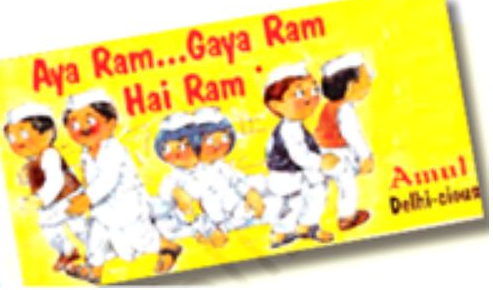
Answer questions based on the picture given.

Figure

The expression “Gaya Ram was now Aya Ram” is attributed to -

Answer options

Q47:

Congress System

Easy

Answer questions based on the picture given.

Figure

When an elected representative leaves the party on whose symbol he/she was elected and joins another party this action is known as -

Answer options

Q48:

Congress System

Medium

Answer questions based on the picture given.

Figure

The expression 'aaya ram gaya ram' originated due to the action of which politcal leader in 1967?

Answer options

Q49:

Congress System

Easy

Answer questions based on the picture given.

Figure

What does the country learn from incidents like Aaya Ram Gaya Ram?

Answer options

Q50:

Congress System

Easy

Answer questions based on the picture given.

Figure

What was done later to deal with 'aaya ram ,gaya ram' phenomena?

Answer options

CUET Political Science 2025 15 May Shift 2 Past Year Question Paper

Every question from the CUET Political Science 2025 15 May Shift 2 paper is here in full, with the correct answer and a step by step solution for each one. It is completely free, there is no login and no paywall, and you can read the whole paper online or download it to revise offline.

You can also attempt it instead of only reading it. Take the paper as a full length mock under exam conditions, or filter it by topic and attempt just that topic as a topic test. Both are free, and you get a breakdown of your accuracy, your timing and your weak areas once you submit.

CUET Political Science past year questions (PYQs) are the closest thing to the real exam, so working through them is the quickest way to learn the paper pattern, the marking scheme and the level of difficulty to expect on the day.