Q1:

Centres of Power

Medium

Arrange the following events related to the timeline of European Integration according to the chronological order.

(A) The Lisbon Treaty came into being

(B) European Atomic Energy Community was established

(C) First direct elections to the European Parliament.

(D) Euro currency was introduced in 12 EU countries.

Answer options
Option 3
Correct Answer
Explanation for 2025: 16 May Shift 1 POL question 1

Q3:

Globalisation

Medium

Which of the following statements are correct about globalisation?

(A) Globalisation deals with worldwide interconnectedness due to flows of ideas, capital and technology.

(B) Those on the left argue that contemporary globalisation represents a particualar phase of global capitalism that makes the rich richer and the poor poorer.

(C) Critics of globalisation from the political right express anxiety only with respect to cultural effects of globalisation.

(D) Many anti-globalisation movements are not opposed to the idea of globalization per se as much as they are opposed to a specific programme of globalization, which they see as a form of imperialism.

Answer options
Option 4
Correct Answer
Explanation for 2025: 16 May Shift 1 POL question 3

Q4:

Coalition Politics

Easy

Which of the following issues led the Left parties to withdraw their support from the Congress-led UPA government in July 2008?

Answer options
Option 1
Correct Answer
Explanation for 2025: 16 May Shift 1 POL question 4

Q5:

Planned Development

Easy

Which Five-Year Plan reflected the Congress party's goal of a 'socialist pattern of society'?

Answer options
Option 2
Correct Answer
Explanation for 2025: 16 May Shift 1 POL question 5

Q7:

Crisis of Democratic Order

Easy

Who was the President of India when the Emergency was proclaimed in 1975?

Answer options
Option 4
Correct Answer
Explanation for 2025: 16 May Shift 1 POL question 7

Q9:

International Organisations

Easy

Which among the following bodies/organisations campaign for the protection of human rights all over the world?

Answer options
Option 1
Correct Answer
Explanation for 2025: 16 May Shift 1 POL question 9

Q10:

Recent Issues & Challenges

Easy

Who was the founder of Bahujan Samaj Party (BSP)?

Answer options

Q11:

Centres of Power

Easy

Which of the following treaties was instrumental in establishing the European Union (EU)?

Answer options

Q12:

Nation-Building

Easy

Who among the following leaders is known as 'Frontier Gandhi'?

Answer options

Q13:

One-Party Dominance

Medium

Which among the following statements are correct about elections in India?

(A) In the first general election, it was decided to place inside each polling booth a box for each candidate with the election symbol of that candidate.

(B) After the first two elections, the polling method was changed. Now the ballot paper carried the names and symbols of all the candidates and voter was required to put a stamp on the name of the candidate they want to vote for.

(C) Towards the end of the 1990s, the Election Commission started using the EVM.

(D) By 2004 the entire country had shifted to the EVM.

Answer options

Q14:

Globalisation

Easy

Which among the following is not a cultural consequence of globalisation?

Answer options

Q15:

Environment & Resources

Easy

UNEP Stands for:

Answer options

Q16:

End of Bipolarity

Medium

Which of the following statements are correct about post-Cold War politics?

(A) The collapse of Soviet Union and the socialist systems in Eastern Europe had profound consequences for world politics

(B) It meant the end of Cold War confrontations

(C) The end of Cold War demanded a push to arms race

(D) Power relations in world politics changed and, therefore, the relative influence of ideas and institutions also changed

Answer options

Q17:

Nation-Building

Medium

The Nizam of Hyderabad entered into the Standstill Agreement with India on:

Answer options

Q18:

International Organisations

Medium

Which of the following Secretary General of the United Nations said, "The United Nations was not created to take humanity to heaven, but to save it from hell"?

Answer options

Q21:

International Organisations

Easy

The World Trade Organization is the successor of _______________.

Answer options

Q22:

External Relations

Medium

In light of the given statements, choose the correct answer from the options given below:

(A) The Janata Party Government that came to power in 1977 announced that it would follow genuine non-alignment.

(B) This implied that the pro-Soviet tilt in the foreign policy will be strengthened.

(C) India's foreign policy shifted to a more pro-US strategy after 1990s.

(D) In the period after 1990, Russia lost its global pre-eminence.

Answer options

Q24:

Coalition Politics

Medium

The Lok Sabha elections of 1989 led to:

Answer options

Q25:

External Relations

Easy

Which of the following Directive Principles of State Policy is mentioned in Article 51 of the Constitution of India?

Answer options

Q26:

Regional Aspirations

Easy

The Anandpur Sahib Resolution in 1973 asserted:

Answer options

Q27:

Crisis of Democratic Order

Easy

Which political party was formed after the break-up of the Janata Party in 1980?

Answer options

Q28:

South Asia

Easy

Which of the following political systems was in place in Nepal till 2006 ?

Answer options

Q29:

South Asia

Easy

Who among the following led the popular struggle against West Pakistani domination over the eastern region of Pakistan?

Answer options

Q30:

Planned Development

Easy

Who among the following is a Gandhian economist who proposed an alternative blueprint that put greater emphasis on rural industrialisation?

Answer options

Q31:

Crisis of Democratic Order

Medium

Match List-I with List-II

List-IList-II
(Judge/Leader)(Appointment/Judgement/movement)
(A) Justice A.N. Ray(I) A retired Chief Justice of the Supreme Court of India, who inquired into several aspects of allegations of abuse of authority, excesses and malpractices committed and action taken in the wake of the emergency
(B) Justice Jagmohan Lal Sinha(II) A leader who called for a nationwide strike by all employees of the railways in 1974
(C) Justice J.C. Shah(III) Chief Justice of India in 1973
(D) George Fernandes(IV) A Judge of Allahabad High Court who passed a judgement declaring Indira Gandhi's election to the Lok Sabha invalid.
Answer options

Q32:

Security

Medium

Which of the following statements are correct about Security policy?

(A) In responding to the threat of war, a government has three basic choices: to surrender; to prevent the other side from attacking by promising to raise the costs of war to an unacceptable level; and to defend itself when war actually breaks out.

(B) Security policy contains elements of both deterrence and defence.

(C) Economic and technological power is not important for mainatining balance of power as military power alone counts.

(D) Alliance building, which is a coalition of states that coordinate their actions to deter or defend against military attack, is an important component of security policy.

Answer options

Q33:

Congress System

Easy

Which policy initiative of Indira Gandhi was criticised as "breach of faith with the princes"?

Answer options

Q34:

Regional Aspirations

Easy

In 1947, the 'Instrument of Accession' related to Kashmir Valley was signed between ___________ and Government of India.

Answer options

Q35:

Globalisation

Easy

The popularity of a burger or blue jeans, has a lot to do with the powerful influence of the American way of life. It means:

Answer options

Q36:

Congress System

Easy

Which of the following leaders gave the famous slogan 'Jai Jawan Jai Kisan'?

Answer options

Q37:

Congress System

Medium

Match List-I with List-II

List-IList-II
(Name of leader)(Their achievements/movements)
(A) Ram Manohar Lohia(I) Contested as independent candidate for Presidential election in 1969
(B) C. Annadurai(II) Abolition of Privy Purse
(C) V.V. Giri(III) Strategy of Non-Congressism
(D) Indira Gandhi(IV) Formed DMK as a political party in 1964
Answer options

Q38:

Recent Issues & Challenges

Easy

Which of the following government decided to implement the recommendations of Mandal Commission in 1990?

Answer options

Q39:

One-Party Dominance

Easy

Under which provision of the Indian Constitution, the Congress government at the centre dismissed the Communist government in Kerala in 1959?

Answer options

Q40:

End of Bipolarity

Easy

Match List-I with List-II

List-IList-II
(Leaders of the Soviet Union)(Achievements/movements)
(A) Vladimir Lenin(I) The last leader of the Soviet Union , introduced economic and political reform policies of Perestroika (reconstructuring) and Glasnost (openness).
(B) Joseph Stalin(II) The first elected President of Russia
(C) Mikhail Gorbachev(III) Founder of the Bolshevik Communist Party
(D) Boris Yeltsin(IV) Successor to Lenin and led the Soviet Union during its consolidation
Answer options

Q41:

Environment & Resources

Easy

The 1992 UNFCCC provides that the parties should act to protect the climate system “on the basis of equity and in accordance with their common but differentiated responsibilities and respective capabilities.”The parties to the Convention agreed that the largest share of historical and current global emissions of greenhouse gases has originated in developed countries. It was also acknowledged that per capita emissions in developing countries are still relatively low. China, India, and other developing countries were, therefore, exempted from the requirements of the Kyoto Protocol. The Kyoto Protocol is an international agreement setting targets for industrialised countries to cut their greenhouse gas emissions. Certain gases like carbon dioxide, methane, hydro-fluoro carbons etc. are considered at least partly responsible for global warming - the rise in global temperature which may have catastrophic consequences for life on Earth. The protocol was agreed to in 1997 in Kyoto in Japan, based on principles set out in UNFCCC.

What is the full form of the UNFCCC?

Answer options

Q42:

Environment & Resources

Easy

The 1992 UNFCCC provides that the parties should act to protect the climate system “on the basis of equity and in accordance with their common but differentiated responsibilities and respective capabilities.”The parties to the Convention agreed that the largest share of historical and current global emissions of greenhouse gases has originated in developed countries. It was also acknowledged that per capita emissions in developing countries are still relatively low. China, India, and other developing countries were, therefore, exempted from the requirements of the Kyoto Protocol. The Kyoto Protocol is an international agreement setting targets for industrialised countries to cut their greenhouse gas emissions. Certain gases like carbon dioxide, methane, hydro-fluoro carbons etc. are considered at least partly responsible for global warming - the rise in global temperature which may have catastrophic consequences for life on Earth. The protocol was agreed to in 1997 in Kyoto in Japan, based on principles set out in UNFCCC.

The UNFCCC decided the parties should act to protect the climate system on the basis of:

Answer options

Q43:

Environment & Resources

Easy

The 1992 UNFCCC provides that the parties should act to protect the climate system “on the basis of equity and in accordance with their common but differentiated responsibilities and respective capabilities.”The parties to the Convention agreed that the largest share of historical and current global emissions of greenhouse gases has originated in developed countries. It was also acknowledged that per capita emissions in developing countries are still relatively low. China, India, and other developing countries were, therefore, exempted from the requirements of the Kyoto Protocol. The Kyoto Protocol is an international agreement setting targets for industrialised countries to cut their greenhouse gas emissions. Certain gases like carbon dioxide, methane, hydro-fluoro carbons etc. are considered at least partly responsible for global warming - the rise in global temperature which may have catastrophic consequences for life on Earth. The protocol was agreed to in 1997 in Kyoto in Japan, based on principles set out in UNFCCC.

What was the objective of Kyoto Protocol?

Answer options

Q44:

Environment & Resources

Easy

The 1992 UNFCCC provides that the parties should act to protect the climate system “on the basis of equity and in accordance with their common but differentiated responsibilities and respective capabilities.”The parties to the Convention agreed that the largest share of historical and current global emissions of greenhouse gases has originated in developed countries. It was also acknowledged that per capita emissions in developing countries are still relatively low. China, India, and other developing countries were, therefore, exempted from the requirements of the Kyoto Protocol. The Kyoto Protocol is an international agreement setting targets for industrialised countries to cut their greenhouse gas emissions. Certain gases like carbon dioxide, methane, hydro-fluoro carbons etc. are considered at least partly responsible for global warming - the rise in global temperature which may have catastrophic consequences for life on Earth. The protocol was agreed to in 1997 in Kyoto in Japan, based on principles set out in UNFCCC.

Which of the following is true about global warming ?

Answer options

Q45:

Environment & Resources

Easy

The 1992 UNFCCC provides that the parties should act to protect the climate system “on the basis of equity and in accordance with their common but differentiated responsibilities and respective capabilities.”The parties to the Convention agreed that the largest share of historical and current global emissions of greenhouse gases has originated in developed countries. It was also acknowledged that per capita emissions in developing countries are still relatively low. China, India, and other developing countries were, therefore, exempted from the requirements of the Kyoto Protocol. The Kyoto Protocol is an international agreement setting targets for industrialised countries to cut their greenhouse gas emissions. Certain gases like carbon dioxide, methane, hydro-fluoro carbons etc. are considered at least partly responsible for global warming - the rise in global temperature which may have catastrophic consequences for life on Earth. The protocol was agreed to in 1997 in Kyoto in Japan, based on principles set out in UNFCCC.

Which of the following is the correct measure to contain global warming?

Answer options

Q46:

Nation-Building

Easy

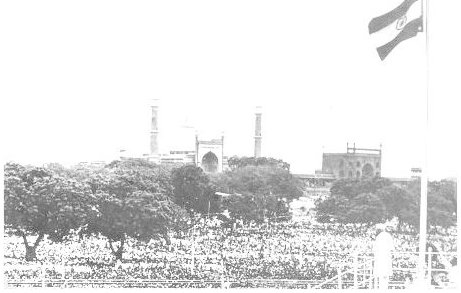
Answer the following questions based on the given image:

Figure

Identify the person in the picture addressing the masses?

Answer options

Q47:

Nation-Building

Easy

Answer the following questions based on the given image:

Figure

Name the historical place from where the speaker is addressing the gathering?

Answer options

Q48:

Nation-Building

Easy

Answer the following questions based on the given image:

Figure

Identify the person in the picture addressing the audience?

Answer options

Q49:

Nation-Building

Easy

Answer the following questions based on the given image:

Figure

On which date the speech was given from the historic monument?

Answer options

Q50:

Nation-Building

Easy

Answer the following questions based on the given image:

Figure

What is the name of the historical monument shown in the picture?

Answer options

CUET Political Science 2025 16 May Shift 1 Past Year Question Paper

Every question from the CUET Political Science 2025 16 May Shift 1 paper is here in full, with the correct answer and a step by step solution for each one. It is completely free, there is no login and no paywall, and you can read the whole paper online or download it to revise offline.

You can also attempt it instead of only reading it. Take the paper as a full length mock under exam conditions, or filter it by topic and attempt just that topic as a topic test. Both are free, and you get a breakdown of your accuracy, your timing and your weak areas once you submit.

CUET Political Science past year questions (PYQs) are the closest thing to the real exam, so working through them is the quickest way to learn the paper pattern, the marking scheme and the level of difficulty to expect on the day.