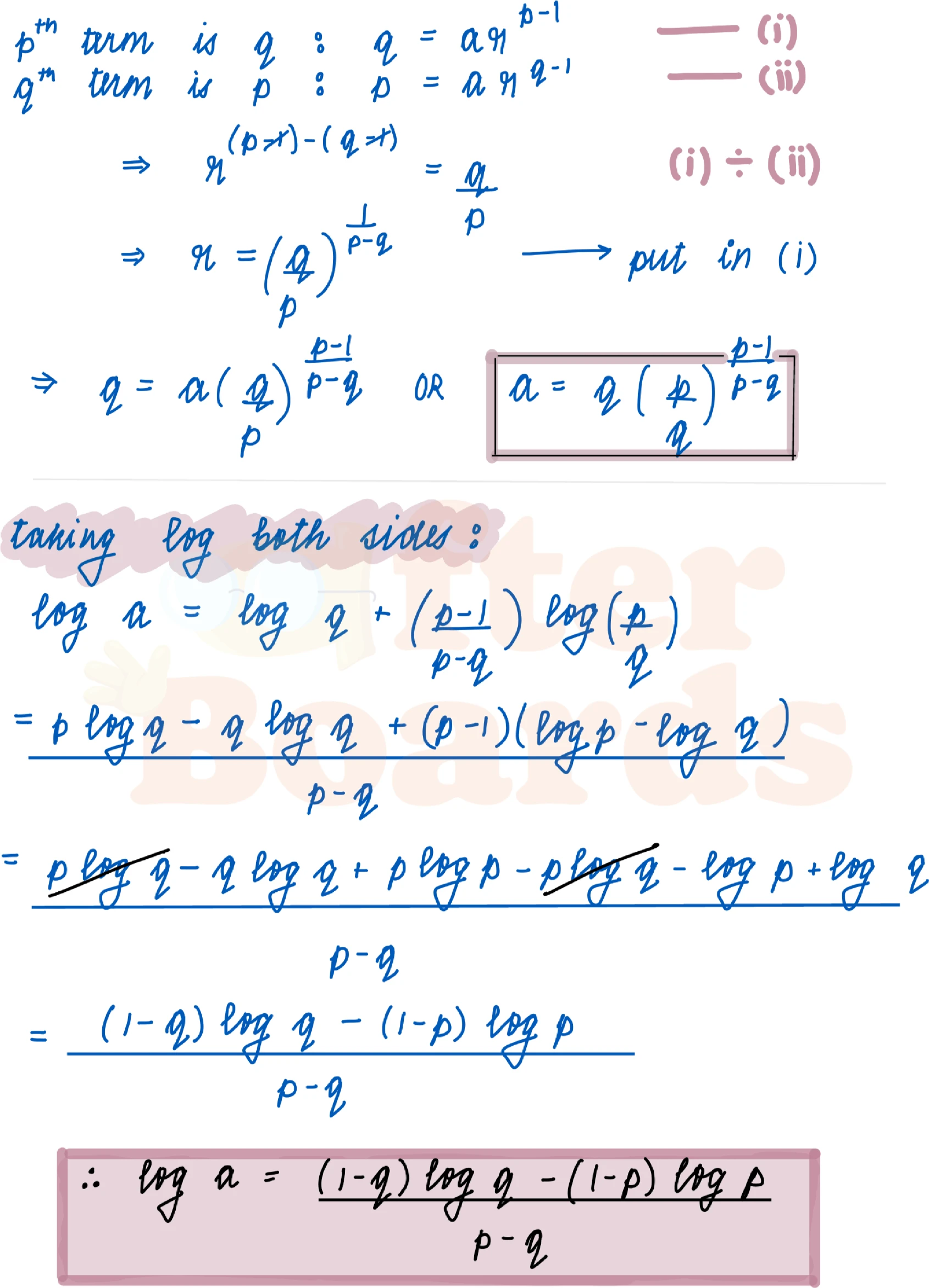
IPMAT IndoreAlgebra > Hard(1−q)log(p)−(1−p)log(q)p−q\dfrac{(1-q)\log(p)-(1-p)\log(q)}{p-q}p−q(1−q)log(p)−(1−p)log(q)(1−q)log(q)−(1−p)log(p)p−q\dfrac{(1-q)\log(q)-(1-p)\log(p)}{p-q}p−q(1−q)log(q)−(1−p)log(p)(1−q)log(p)+(1−p)log(q)p−q\dfrac{(1-q)\log(p)+(1-p)\log(q)}{p-q}p−q(1−q)log(p)+(1−p)log(q)(1−q)log(q)+(1−p)log(p)p−q\dfrac{(1-q)\log(q)+(1-p)\log(p)}{p-q}p−q(1−q)log(q)+(1−p)log(p)✅ Correct Option: 2Related questions:IPMAT Indore 2022The numbers −16,2x+3−22x−1−16,22x−1+16-16,2^{x+3}-2^{2 x-1}-16,2^{2 x-1}+16−16,2x+3−22x−1−16,22x−1+16 are in an arithmetic progression. Then xxx equals ________.IPMAT Indore 2019If (1+x−2x2)6=A0+∑r=112Arxr(1 + x - 2x^2)^6 = A_0 + \sum_{r=1}^{12} A_r x^r(1+x−2x2)6=A0+∑r=112Arxr, then the value of A2+A4+A6+⋯+A12A_2 + A_4 + A_6 + \cdots + A_{12}A2+A4+A6+⋯+A12 isIPMAT Indore 2022A new sequence is obtained from the sequence of positive integers (1,2,3,…)(1,2,3, \ldots)(1,2,3,…) by deleting all the perfect squares. Then the 2022nd 2022^{\text {nd }}2022nd term of the new sequence is ________.