Q1:

2026: 19 May Shift 2

Amines

Medium

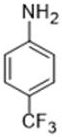
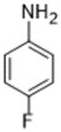
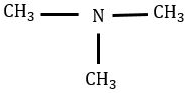
Rank the following amines in increasing order of tendency for ease of formation of cation by accepting a proton from acid.

A. Figure
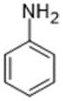
B. Figure

C. Figure

D. Figure

Answer options
Option 3
Correct Answer
Explanation for 2026: 19 May Shift 2 CHE question 1

Q2:

2026: 19 May Shift 1

Amines

Easy

Preparation & Chemical reactions of amines

Preparation:

Nitro compounds are reduced to amines by passing hydrogen gas in the presence of finely divided nickel, palladium, or platinum as catalyst. Nitriles on reduction with lithium aluminum hydride or catalytic hydrogenation produce primary amines. The Gabriel synthesis is used for the preparation of primary amines. Phthalimide on treatment with ethanolic potassium hydroxide forms potassium salt of phthalimide.

Chemical reactions:

Aliphatic and aromatic primary and secondary amines react with acid chlorides, anhydrides, and esters by nucleophilic substitution reaction. This reaction is known as acylation. Both aliphatic and aromatic primary amines on heating with chloroform and ethanolic potassium hydroxide gives corresponding isocyanide. Benzenesulphonyl chloride also known as Hinsberg's reagent reacts with primary and secondary amines to form sulphonamide. Aniline reacts with bromine water at room temperature to give a white precipitate of 2,4,6-tribromoaniline. Aniline reacts with HNO3HNO_3 in the presence of H2SO4H_2SO_4 to give nitro derivatives. Aniline reacts with concentrated sulphuric acid to form anilinium hydrogensulphate which on heating with sulphuric acid at 453-473K produces p-aminobenzene sulphonic acid or sulphanilic acid.

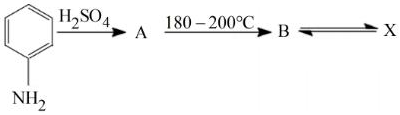
Which of the following will not respond to carbylamine test ?

Answer options
Option 2
Correct Answer
Explanation for 2026: 19 May Shift 1 CHE question 2

Q3:

2026: 19 May Shift 1

Amines

Medium

Preparation & Chemical reactions of amines

Preparation:

Nitro compounds are reduced to amines by passing hydrogen gas in the presence of finely divided nickel, palladium, or platinum as catalyst. Nitriles on reduction with lithium aluminum hydride or catalytic hydrogenation produce primary amines. The Gabriel synthesis is used for the preparation of primary amines. Phthalimide on treatment with ethanolic potassium hydroxide forms potassium salt of phthalimide.

Chemical reactions:

Aliphatic and aromatic primary and secondary amines react with acid chlorides, anhydrides, and esters by nucleophilic substitution reaction. This reaction is known as acylation. Both aliphatic and aromatic primary amines on heating with chloroform and ethanolic potassium hydroxide gives corresponding isocyanide. Benzenesulphonyl chloride also known as Hinsberg's reagent reacts with primary and secondary amines to form sulphonamide. Aniline reacts with bromine water at room temperature to give a white precipitate of 2,4,6-tribromoaniline. Aniline reacts with HNO3HNO_3 in the presence of H2SO4H_2SO_4 to give nitro derivatives. Aniline reacts with concentrated sulphuric acid to form anilinium hydrogensulphate which on heating with sulphuric acid at 453-473K produces p-aminobenzene sulphonic acid or sulphanilic acid.

Identify the compound which can be obtained from Gabriel phthalimide synthesis.

Answer options
Option 3
Correct Answer
Explanation for 2026: 19 May Shift 1 CHE question 3

Q4:

2026: 19 May Shift 1

Amines

Medium

Preparation & Chemical reactions of amines

Preparation:

Nitro compounds are reduced to amines by passing hydrogen gas in the presence of finely divided nickel, palladium, or platinum as catalyst. Nitriles on reduction with lithium aluminum hydride or catalytic hydrogenation produce primary amines. The Gabriel synthesis is used for the preparation of primary amines. Phthalimide on treatment with ethanolic potassium hydroxide forms potassium salt of phthalimide.

Chemical reactions:

Aliphatic and aromatic primary and secondary amines react with acid chlorides, anhydrides, and esters by nucleophilic substitution reaction. This reaction is known as acylation. Both aliphatic and aromatic primary amines on heating with chloroform and ethanolic potassium hydroxide gives corresponding isocyanide. Benzenesulphonyl chloride also known as Hinsberg's reagent reacts with primary and secondary amines to form sulphonamide. Aniline reacts with bromine water at room temperature to give a white precipitate of 2,4,6-tribromoaniline. Aniline reacts with HNO3HNO_3 in the presence of H2SO4H_2SO_4 to give nitro derivatives. Aniline reacts with concentrated sulphuric acid to form anilinium hydrogensulphate which on heating with sulphuric acid at 453-473K produces p-aminobenzene sulphonic acid or sulphanilic acid.

Which reducing agent is preferred for converting nitrobenzene into aniline?

Answer options
Option 2
Correct Answer
Explanation for 2026: 19 May Shift 1 CHE question 4

Q5:

2026: 19 May Shift 1

Amines

Medium

Preparation & Chemical reactions of amines

Preparation:

Nitro compounds are reduced to amines by passing hydrogen gas in the presence of finely divided nickel, palladium, or platinum as catalyst. Nitriles on reduction with lithium aluminum hydride or catalytic hydrogenation produce primary amines. The Gabriel synthesis is used for the preparation of primary amines. Phthalimide on treatment with ethanolic potassium hydroxide forms potassium salt of phthalimide.

Chemical reactions:

Aliphatic and aromatic primary and secondary amines react with acid chlorides, anhydrides, and esters by nucleophilic substitution reaction. This reaction is known as acylation. Both aliphatic and aromatic primary amines on heating with chloroform and ethanolic potassium hydroxide gives corresponding isocyanide. Benzenesulphonyl chloride also known as Hinsberg's reagent reacts with primary and secondary amines to form sulphonamide. Aniline reacts with bromine water at room temperature to give a white precipitate of 2,4,6-tribromoaniline. Aniline reacts with HNO3HNO_3 in the presence of H2SO4H_2SO_4 to give nitro derivatives. Aniline reacts with concentrated sulphuric acid to form anilinium hydrogensulphate which on heating with sulphuric acid at 453-473K produces p-aminobenzene sulphonic acid or sulphanilic acid.

Which of the following reactions will not give primary amine?

Answer options
Option 4
Correct Answer
Explanation for 2026: 19 May Shift 1 CHE question 5

Q6:

2026: 19 May Shift 1

Amines

Medium

Preparation & Chemical reactions of amines

Preparation:

Nitro compounds are reduced to amines by passing hydrogen gas in the presence of finely divided nickel, palladium, or platinum as catalyst. Nitriles on reduction with lithium aluminum hydride or catalytic hydrogenation produce primary amines. The Gabriel synthesis is used for the preparation of primary amines. Phthalimide on treatment with ethanolic potassium hydroxide forms potassium salt of phthalimide.

Chemical reactions:

Aliphatic and aromatic primary and secondary amines react with acid chlorides, anhydrides, and esters by nucleophilic substitution reaction. This reaction is known as acylation. Both aliphatic and aromatic primary amines on heating with chloroform and ethanolic potassium hydroxide gives corresponding isocyanide. Benzenesulphonyl chloride also known as Hinsberg's reagent reacts with primary and secondary amines to form sulphonamide. Aniline reacts with bromine water at room temperature to give a white precipitate of 2,4,6-tribromoaniline. Aniline reacts with HNO3HNO_3 in the presence of H2SO4H_2SO_4 to give nitro derivatives. Aniline reacts with concentrated sulphuric acid to form anilinium hydrogensulphate which on heating with sulphuric acid at 453-473K produces p-aminobenzene sulphonic acid or sulphanilic acid.

Identify the major product (P) in the following chemical reaction.
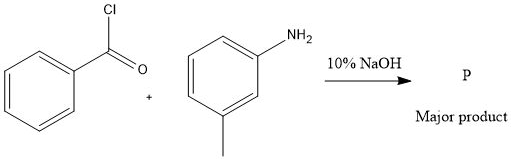
Figure

Answer options
Option 2
Correct Answer
Explanation for 2026: 19 May Shift 1 CHE question 6

Q7:

2026: 18 May Shift 2

Amines

Easy

Match the LIST-I with LIST-II.

LIST-I (Reaction)LIST-I (Name )
A.Benzonitrile →Na(Hg)/C2H5OH\xrightarrow{Na(Hg)/C_2H_5OH} PhenylmethanamineI.Reduction
B.Aniline + Chloroform + Sodium hydroxide →Δ\xrightarrow{\Delta} IsocyanobenzeneII.Benzoylation reaction
C.Aniline + Benzoyl chloride →NaOH\xrightarrow{NaOH} N-PhenylbenzamideIII.Hinsberg' test
D.Benzenesulphonyl chloride + N,N diethylamine ⟶\longrightarrow N,N-DiethylbenzenesulphonamideIV.Carbylamine reaction
Answer options
Option 1
Correct Answer
Explanation for 2026: 18 May Shift 2 CHE question 7

Q8:

2026: 18 May Shift 2

Amines

Easy

In Hoffmann bromamide degradation reaction:

Answer options
Option 1
Correct Answer
Explanation for 2026: 18 May Shift 2 CHE question 8

Q9:

2026: 18 May Shift 2

Amines

Medium

Which of the following is FALSE in relation to the basicity of amines in aqueous solution?

Answer options
Option 2
Correct Answer
Explanation for 2026: 18 May Shift 2 CHE question 9

Q10:

2026: 18 May Shift 2

Amines

Easy

Amongst the given compounds, which will give Carbylamine reaction?

A. Aniline

B. pp-toluidine

C. Ethylamine

D. Diphenylamine

Answer options

Q12:

2026: 18 May Shift 1

Amines

Easy

Match List-I with List-II

Name reactionChemical reaction
(A) Hinsberg's reaction(I) R−NH2+CHCl3+3KOH→HeatR−NC+3KCl+3H2OR-NH_2 + CHCl_3 + 3KOH \xrightarrow{Heat} R-NC + 3KCl + 3H_2O
(B) Gabriel phthalimide(II) Ph−SO2Cl+C2H5−NH2→PhSO2NH−C2H5Ph-SO_2Cl + C_2H_5-NH_2 \rightarrow PhSO_2NH-C_2H_5
(C) Hoffman bromamide degradation(III) Figure
(D) Carbylamine reaction(IV) R−CONH2+Br2+4NaOH→R−NH2+Na2CO3+H2O+2NaBrR-CONH_2 + Br_2 + 4NaOH \rightarrow R-NH_2 + Na_2CO_3 + H_2O + 2NaBr
Answer options

Q13:

2026: 18 May Shift 1

Amines

Medium

Match List-I (reagents) with List-II (transformation)

List-IList-II
ReagentsTransformation
(A) NaNO2+HCl+H2ONaNO_2 + HCl + H_2O (273-278 K)(I) RCN→RCH2NH2RCN \rightarrow RCH_2NH_2
(B) H2/Ni+C2H5OHH_2/Ni + C_2H_5OH(II) C6H5NH2→C_6H_5NH_2 \rightarrow p- Nitroaniline (major)
(C) LiAlH4LiAlH_4(III) C6H5−NH2→C6H5N2+Cl−C_6H_5-NH_2 \rightarrow C_6H_5N_2^+Cl^-
(D) HNO3+H2SO4HNO_3 + H_2SO_4, 288K(IV) RCONH2→RCH2NH2RCONH_2 \rightarrow RCH_2NH_2
Answer options

Q14:

2026: 18 May Shift 1

Amines

Easy

The final product of the following reaction is

R−CO−NH2+Br2+4NaOH⟶?R-CO-NH_2 + Br_2 + 4NaOH \longrightarrow ?

Answer options

Q17:

2026: 15 May Shift 1

Amines

Easy

Which of the following reactions/tests can be used to distinguish between primary, secondary and tertiary amines?

Answer options

Q19:

2026: 15 May Shift 1

Amines

Medium

Read the following statements and identify the correct ones:

A. Gabriel phthalimide synthesis is preferred for secondary amines only.

B. Aniline doesn't undergo Friedel-Craft's reaction.

C. Methylamine in water doesn't precipitate ferric ions from ferric chloride.

D. Azo dyes are formed as a result of a coupling reaction of aryl dizaonium salts with phenols and arylamines.

Answer options

Q20:

2026: 15 May Shift 1

Amines

Medium

Arrange the following amines in the decreasing order of their basicity in aqueous phase.

A. C2H5NH2\mathrm{C_2H_5NH_2}

B. C6H5NHCH3\mathrm{C_6H_5NHCH_3}

C. (C2H5)2NH\mathrm{(C_2H_5)_2NH}

D. C6H5NH2\mathrm{C_6H_5NH_2}

Answer options

Q22:

2026: 14 May Shift 2

Amines

Easy

Organic chemistry (Amines)

An organic compound (A) with the molecular formula C8H9NOC_8H_9NO when treated with bromine in aqueous solution of sodium hydroxide gives a new compound (B) having the molecular formula C7H9NC_7H_9N. The compound (B) on heating with chloroform and ethanolic potassium hydroxide forms a compound (C ) having foul-smelling. Further, the compound (B) gives an alkali soluble sulphonamide on reacting with benzenesulfonyl chloride.

Moreover, a thermally unstable compound (D) is obtained when the compound (B) reacts with sodium nitrite in concentrated hydrochloric acid at very low temperature. Further, the compound (D) on heating with water yields a compound which gives colour with neutral ferric chloride solution.

Answer the following questions on the basis of this passage.

The name of the reaction converting compound A to B is

Answer options

Q23:

2026: 14 May Shift 2

Amines

Easy

Organic chemistry (Amines)

An organic compound (A) with the molecular formula C8H9NOC_8H_9NO when treated with bromine in aqueous solution of sodium hydroxide gives a new compound (B) having the molecular formula C7H9NC_7H_9N. The compound (B) on heating with chloroform and ethanolic potassium hydroxide forms a compound (C ) having foul-smelling. Further, the compound (B) gives an alkali soluble sulphonamide on reacting with benzenesulfonyl chloride.

Moreover, a thermally unstable compound (D) is obtained when the compound (B) reacts with sodium nitrite in concentrated hydrochloric acid at very low temperature. Further, the compound (D) on heating with water yields a compound which gives colour with neutral ferric chloride solution.

Answer the following questions on the basis of this passage.

The foul-smelling compound obtained by heating compound B with CHCl3CHCl_3 and ethanolic KOH is a

Answer options

Q24:

2026: 14 May Shift 2

Amines

Easy

Organic chemistry (Amines)

An organic compound (A) with the molecular formula C8H9NOC_8H_9NO when treated with bromine in aqueous solution of sodium hydroxide gives a new compound (B) having the molecular formula C7H9NC_7H_9N. The compound (B) on heating with chloroform and ethanolic potassium hydroxide forms a compound (C ) having foul-smelling. Further, the compound (B) gives an alkali soluble sulphonamide on reacting with benzenesulfonyl chloride.

Moreover, a thermally unstable compound (D) is obtained when the compound (B) reacts with sodium nitrite in concentrated hydrochloric acid at very low temperature. Further, the compound (D) on heating with water yields a compound which gives colour with neutral ferric chloride solution.

Answer the following questions on the basis of this passage.

The name of the test that yields an alkali-soluble sulfonamide upon heating with compound B is

Answer options

Q25:

2026: 14 May Shift 2

Amines

Medium

Organic chemistry (Amines)

An organic compound (A) with the molecular formula C8H9NOC_8H_9NO when treated with bromine in aqueous solution of sodium hydroxide gives a new compound (B) having the molecular formula C7H9NC_7H_9N. The compound (B) on heating with chloroform and ethanolic potassium hydroxide forms a compound (C ) having foul-smelling. Further, the compound (B) gives an alkali soluble sulphonamide on reacting with benzenesulfonyl chloride.

Moreover, a thermally unstable compound (D) is obtained when the compound (B) reacts with sodium nitrite in concentrated hydrochloric acid at very low temperature. Further, the compound (D) on heating with water yields a compound which gives colour with neutral ferric chloride solution.

Answer the following questions on the basis of this passage.

Identify the compound (D):

Answer options

Q26:

2026: 14 May Shift 2

Amines

Medium

Organic chemistry (Amines)

An organic compound (A) with the molecular formula C8H9NOC_8H_9NO when treated with bromine in aqueous solution of sodium hydroxide gives a new compound (B) having the molecular formula C7H9NC_7H_9N. The compound (B) on heating with chloroform and ethanolic potassium hydroxide forms a compound (C ) having foul-smelling. Further, the compound (B) gives an alkali soluble sulphonamide on reacting with benzenesulfonyl chloride.

Moreover, a thermally unstable compound (D) is obtained when the compound (B) reacts with sodium nitrite in concentrated hydrochloric acid at very low temperature. Further, the compound (D) on heating with water yields a compound which gives colour with neutral ferric chloride solution.

Answer the following questions on the basis of this passage.

When compound (D) is heated with water, it gives:

Answer options

Q27:

2026: 12 May Shift 2

Amines

Easy

What will be the product of the following reaction?

R−C∥O−NH2→(ii) H2O(i) LiAlH4?\mathrm{R{-}\overset{O}{\overset{\Vert}{C}}{-}NH_2 \xrightarrow[\text{(ii) } H_2O]{\text{(i) } LiAlH_4} ?}

Answer options

Q29:

2026: 12 May Shift 2

Amines

Easy

What is the end product of Hoffmann bromamide degradation reaction?

Answer options

Q30:

2026: 12 May Shift 2

Amines

Medium

Aliphatic and aromatic amines are basic in nature. The following amines are in aqueous state.What is the decreasing order of their basic strength?

(A) NH3\mathrm{NH_3}

(B) (C2H5)2NH\mathrm{(C_2H_5)_2NH}

(C) C2H5NH2\mathrm{C_2H_5NH_2}

(D) (C2H5)3N\mathrm{(C_2H_5)_3N}

Answer options