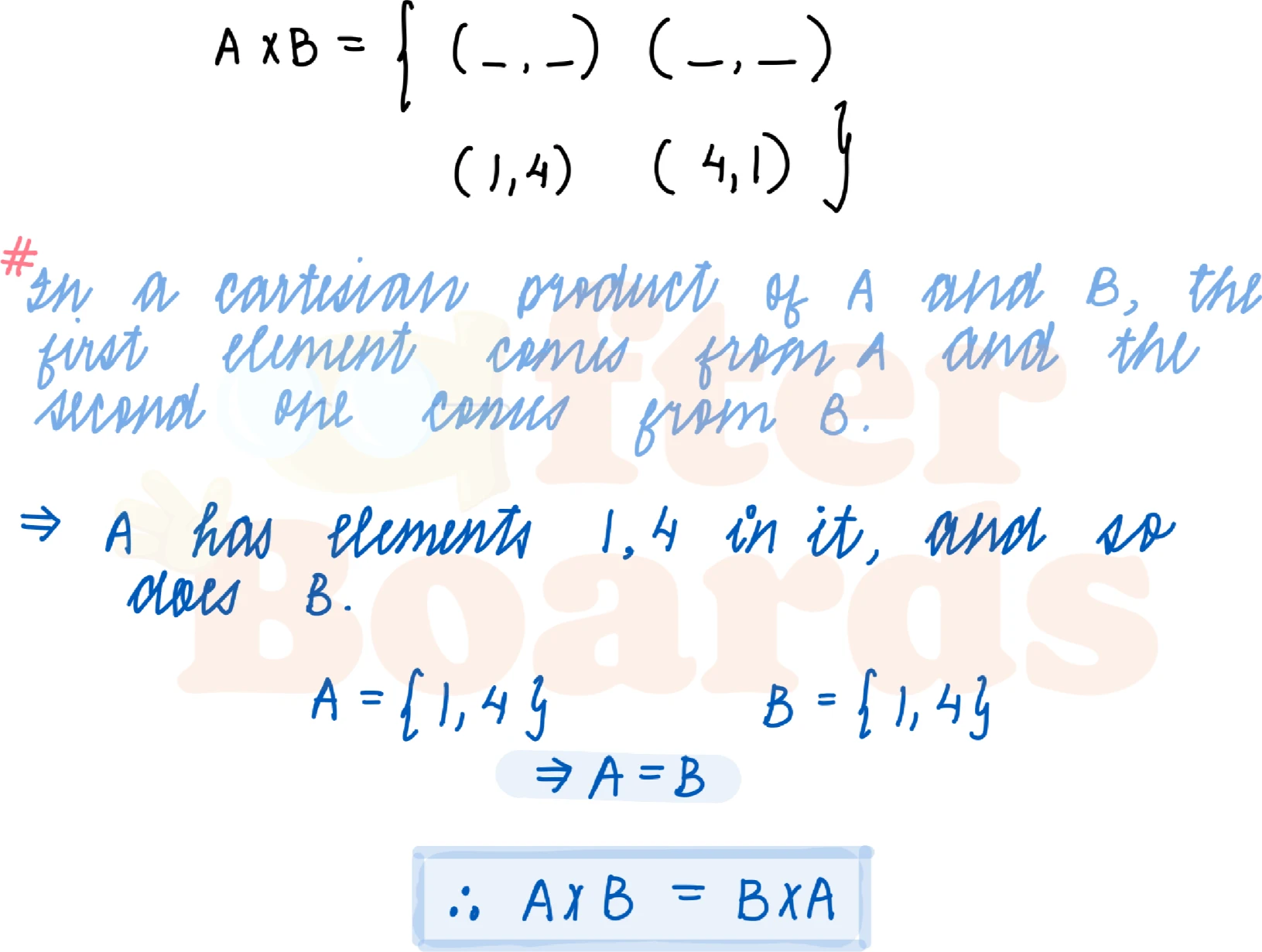
IPMAT IndoreModern Math > EasyNone of theseA×B≠B×AA \times B \neq B \times AA×B=B×A∅∈A×B\emptyset \in A \times B∅∈A×BA×B=B×AA \times B=B \times AA×B=B×A✅ Correct Option: 4Related questions:IPMAT Indore 2021In a city, 50% of the population can speak in exactly one language among Hindi, English and Tamil, while 40% of the population can speak in at least two of these three languages. Moreover, the number of people who cannot speak in any of these three languages is twice the number of people who can speak in all these three languages. If 52% of the population can speak in Hindi and 25% of the population can speak exactly in one language among English and Tamil, then the percentage of the population who can speak in Hindi and in exactly one more language among English and Tamil isIPMAT Indore 2026Let S={1,2,…,180}S = \{1, 2, \ldots, 180\}S={1,2,…,180}. Define AAA as the set of all multiples of 4 in SSS, BBB as the set of all multiples of 6 in SSS, and CCC as the set of all multiples of 9 in SSS. The number of elements in SSS that belong to exactly one of A,B,CA, B, CA,B,C isIPMAT Indore 2025Let A and B be two finite sets such that n(A−B)n(A - B)n(A−B), n(A∩B)n(A\cap B)n(A∩B), n(B−A)n(B - A)n(B−A) are in an arithmetic progression. Here n(X)n(X)n(X) denotes the number of elements in a finite set XXX. If n(A∪B)=18n(A\cup B) = 18n(A∪B)=18, then n(A)+n(B)n(A) + n(B)n(A)+n(B) is ____