CUET Chemistry: ChemistryChemical Kinetics. Free, no login required.

Q1:

2026: 19 May Shift 2

Chemical Kinetics

Easy

Arrange the following rate expressions in decreasing order of their overall order of reaction:

A. Rate = k [A]3/2[A]^{3/2} [B]1/2[B]^{1/2}

B. Rate = k [A]−1[A]^{-1} [B]3/2[B]^{3/2}

C. Rate = k [A]1/2[A]^{1/2} [B]1/2[B]^{1/2}

D. Rate = k [A]1/2[A]^{1/2} [B]

Answer options
Option 4
Correct Answer
Explanation for 2026: 19 May Shift 2 CHE question 1

Q2:

2026: 19 May Shift 1

Chemical Kinetics

Easy

Chemical Kinetics

Some reactions such as ionic reactions occur very fast, for example, precipitation of silver chloride occurs instantaneously by mixing of aqueous solutions of silver nitrate and sodium chloride. On the other hand, some reactions are very slow, for example, rusting of iron in the presence of air and moisture. The sum of powers of the concentration of the reactants in the rate law expression is called the order of that chemical reaction. Another property of a reaction called molecularity helps in understanding its mechanism. The number of reacting species (atoms, ions or molecules) taking part in an elementary reaction, which must collide simultaneously in order to bring about a chemical reaction is called molecularity of a reaction. The half-life (t1/2t_{1/2}) of a reaction is the time in which the concentration of a reactant is reduced to one-half of its initial concentration.

In the following graph for first order reaction the slope is
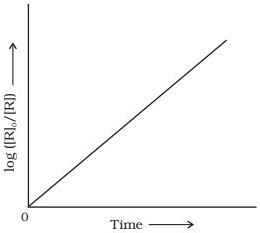
Figure

Answer options
Option 1
Correct Answer
Explanation for 2026: 19 May Shift 1 CHE question 2

Q3:

2026: 19 May Shift 1

Chemical Kinetics

Easy

Chemical Kinetics

Some reactions such as ionic reactions occur very fast, for example, precipitation of silver chloride occurs instantaneously by mixing of aqueous solutions of silver nitrate and sodium chloride. On the other hand, some reactions are very slow, for example, rusting of iron in the presence of air and moisture. The sum of powers of the concentration of the reactants in the rate law expression is called the order of that chemical reaction. Another property of a reaction called molecularity helps in understanding its mechanism. The number of reacting species (atoms, ions or molecules) taking part in an elementary reaction, which must collide simultaneously in order to bring about a chemical reaction is called molecularity of a reaction. The half-life (t1/2t_{1/2}) of a reaction is the time in which the concentration of a reactant is reduced to one-half of its initial concentration.

In a chemical reaction, which is the rate-determining step?

Answer options
Option 3
Correct Answer
Explanation for 2026: 19 May Shift 1 CHE question 3

Q4:

2026: 19 May Shift 1

Chemical Kinetics

Easy

Chemical Kinetics

Some reactions such as ionic reactions occur very fast, for example, precipitation of silver chloride occurs instantaneously by mixing of aqueous solutions of silver nitrate and sodium chloride. On the other hand, some reactions are very slow, for example, rusting of iron in the presence of air and moisture. The sum of powers of the concentration of the reactants in the rate law expression is called the order of that chemical reaction. Another property of a reaction called molecularity helps in understanding its mechanism. The number of reacting species (atoms, ions or molecules) taking part in an elementary reaction, which must collide simultaneously in order to bring about a chemical reaction is called molecularity of a reaction. The half-life (t1/2t_{1/2}) of a reaction is the time in which the concentration of a reactant is reduced to one-half of its initial concentration.

The half-life of a first order reaction:

Answer options
Option 3
Correct Answer
Explanation for 2026: 19 May Shift 1 CHE question 4

Q5:

2026: 19 May Shift 1

Chemical Kinetics

Easy

Chemical Kinetics

Some reactions such as ionic reactions occur very fast, for example, precipitation of silver chloride occurs instantaneously by mixing of aqueous solutions of silver nitrate and sodium chloride. On the other hand, some reactions are very slow, for example, rusting of iron in the presence of air and moisture. The sum of powers of the concentration of the reactants in the rate law expression is called the order of that chemical reaction. Another property of a reaction called molecularity helps in understanding its mechanism. The number of reacting species (atoms, ions or molecules) taking part in an elementary reaction, which must collide simultaneously in order to bring about a chemical reaction is called molecularity of a reaction. The half-life (t1/2t_{1/2}) of a reaction is the time in which the concentration of a reactant is reduced to one-half of its initial concentration.

The order of reaction P (k=2.3×10⁻⁵k = 2.3 \times 10^{-5} mol L−1L^{-1} s−1s^{-1}) and Q (k=4.1×10⁻⁵k = 4.1 \times 10^{-5} L mol−1mol^{-1} s−1s^{-1}) are respectively.

Answer options
Option 4
Correct Answer
Explanation for 2026: 19 May Shift 1 CHE question 5

Q6:

2026: 19 May Shift 1

Chemical Kinetics

Medium

Chemical Kinetics

Some reactions such as ionic reactions occur very fast, for example, precipitation of silver chloride occurs instantaneously by mixing of aqueous solutions of silver nitrate and sodium chloride. On the other hand, some reactions are very slow, for example, rusting of iron in the presence of air and moisture. The sum of powers of the concentration of the reactants in the rate law expression is called the order of that chemical reaction. Another property of a reaction called molecularity helps in understanding its mechanism. The number of reacting species (atoms, ions or molecules) taking part in an elementary reaction, which must collide simultaneously in order to bring about a chemical reaction is called molecularity of a reaction. The half-life (t1/2t_{1/2}) of a reaction is the time in which the concentration of a reactant is reduced to one-half of its initial concentration.

For reaction 3P→2Q3P \rightarrow 2Q, the expression for rate of formation of Q i.e. d[Q]dt\frac{d[Q]}{dt} is equal to:

Answer options
Option 4
Correct Answer
Explanation for 2026: 19 May Shift 1 CHE question 6

Q7:

2026: 18 May Shift 2

Chemical Kinetics

Easy

Rate of reaction

Consider a general reaction: aA + bB →\rightarrow cC + dD

where a, b, c and d are the stoichiometric coefficients of reactants and products. The rate expression for this reaction is Rate α\alpha [A]x[B]y[A]^x[B]^y

where exponents x and y may or may not be equal to the stoichiometric coefficients (a and b) of the reactants. Above equation can also be written as Rate = k [A]x[B]y[A]^x[B]^y

Sum of these exponents, i.e., x + y gives the overall order of a reaction whereas x and y represent the order with respect to the reactants A and B, respectively.

−d[R]dt=k[A]x[B]y-\frac{d[R]}{dt} = k[A]^x[B]^y

The above equation is known as differential rate equation, where k is a proportionality constant called rate constant. The equation, which relates the rate of a reaction to concentration of reactants is called rate law or rate expression.

In the rate law expression reaction rate is given in terms of molar concentration of reactants with each term raised to some power, which may or may not be same as the stoichiometric coefficient of the reacting species in a balanced chemical equation. For example:

2NO2(g)+O2(g)→2NO3(g)2NO_2(g) + O_2(g) \rightarrow 2NO_3(g)

The rate of this reaction is measured as a function of initial concentrations either by keeping the concentration of one of the reactants constant and changing the concentration of the other reactant or by changing the concentration of both the reactants.

The results obtained are tabulated in table below:

ExperimentInitial [NO2][NO_2]/mol L−1L^{-1}Initial [O2][O_2]/mol L−1L^{-1}Initial rate of formation of [NO3][NO_3] /mol L−1s−1L^{-1}s^{-1}
10.250.250.090
20.500.250.360
30.250.500.180
40.500.500.720

What is the order of the reaction with respect to NO2NO_2?

Answer options
Option 3
Correct Answer
Explanation for 2026: 18 May Shift 2 CHE question 7

Q8:

2026: 18 May Shift 2

Chemical Kinetics

Easy

Rate of reaction

Consider a general reaction: aA + bB →\rightarrow cC + dD

where a, b, c and d are the stoichiometric coefficients of reactants and products. The rate expression for this reaction is Rate α\alpha [A]x[B]y[A]^x[B]^y

where exponents x and y may or may not be equal to the stoichiometric coefficients (a and b) of the reactants. Above equation can also be written as Rate = k [A]x[B]y[A]^x[B]^y

Sum of these exponents, i.e., x + y gives the overall order of a reaction whereas x and y represent the order with respect to the reactants A and B, respectively.

−d[R]dt=k[A]x[B]y-\frac{d[R]}{dt} = k[A]^x[B]^y

The above equation is known as differential rate equation, where k is a proportionality constant called rate constant. The equation, which relates the rate of a reaction to concentration of reactants is called rate law or rate expression.

In the rate law expression reaction rate is given in terms of molar concentration of reactants with each term raised to some power, which may or may not be same as the stoichiometric coefficient of the reacting species in a balanced chemical equation. For example:

2NO2(g)+O2(g)→2NO3(g)2NO_2(g) + O_2(g) \rightarrow 2NO_3(g)

The rate of this reaction is measured as a function of initial concentrations either by keeping the concentration of one of the reactants constant and changing the concentration of the other reactant or by changing the concentration of both the reactants.

The results obtained are tabulated in table below:

ExperimentInitial [NO2][NO_2]/mol L−1L^{-1}Initial [O2][O_2]/mol L−1L^{-1}Initial rate of formation of [NO3][NO_3] /mol L−1s−1L^{-1}s^{-1}
10.250.250.090
20.500.250.360
30.250.500.180
40.500.500.720

The order with respect to O2O_2 is:

Answer options
Option 4
Correct Answer
Explanation for 2026: 18 May Shift 2 CHE question 8

Q9:

2026: 18 May Shift 2

Chemical Kinetics

Easy

Rate of reaction

Consider a general reaction: aA + bB →\rightarrow cC + dD

where a, b, c and d are the stoichiometric coefficients of reactants and products. The rate expression for this reaction is Rate α\alpha [A]x[B]y[A]^x[B]^y

where exponents x and y may or may not be equal to the stoichiometric coefficients (a and b) of the reactants. Above equation can also be written as Rate = k [A]x[B]y[A]^x[B]^y

Sum of these exponents, i.e., x + y gives the overall order of a reaction whereas x and y represent the order with respect to the reactants A and B, respectively.

−d[R]dt=k[A]x[B]y-\frac{d[R]}{dt} = k[A]^x[B]^y

The above equation is known as differential rate equation, where k is a proportionality constant called rate constant. The equation, which relates the rate of a reaction to concentration of reactants is called rate law or rate expression.

In the rate law expression reaction rate is given in terms of molar concentration of reactants with each term raised to some power, which may or may not be same as the stoichiometric coefficient of the reacting species in a balanced chemical equation. For example:

2NO2(g)+O2(g)→2NO3(g)2NO_2(g) + O_2(g) \rightarrow 2NO_3(g)

The rate of this reaction is measured as a function of initial concentrations either by keeping the concentration of one of the reactants constant and changing the concentration of the other reactant or by changing the concentration of both the reactants.

The results obtained are tabulated in table below:

ExperimentInitial [NO2][NO_2]/mol L−1L^{-1}Initial [O2][O_2]/mol L−1L^{-1}Initial rate of formation of [NO3][NO_3] /mol L−1s−1L^{-1}s^{-1}
10.250.250.090
20.500.250.360
30.250.500.180
40.500.500.720

The correct rate equation and overall order of the reactions respectively, is:

Answer options
Option 2
Correct Answer
Explanation for 2026: 18 May Shift 2 CHE question 9

Q10:

2026: 18 May Shift 2

Chemical Kinetics

Medium

Rate of reaction

Consider a general reaction: aA + bB →\rightarrow cC + dD

where a, b, c and d are the stoichiometric coefficients of reactants and products. The rate expression for this reaction is Rate α\alpha [A]x[B]y[A]^x[B]^y

where exponents x and y may or may not be equal to the stoichiometric coefficients (a and b) of the reactants. Above equation can also be written as Rate = k [A]x[B]y[A]^x[B]^y

Sum of these exponents, i.e., x + y gives the overall order of a reaction whereas x and y represent the order with respect to the reactants A and B, respectively.

−d[R]dt=k[A]x[B]y-\frac{d[R]}{dt} = k[A]^x[B]^y

The above equation is known as differential rate equation, where k is a proportionality constant called rate constant. The equation, which relates the rate of a reaction to concentration of reactants is called rate law or rate expression.

In the rate law expression reaction rate is given in terms of molar concentration of reactants with each term raised to some power, which may or may not be same as the stoichiometric coefficient of the reacting species in a balanced chemical equation. For example:

2NO2(g)+O2(g)→2NO3(g)2NO_2(g) + O_2(g) \rightarrow 2NO_3(g)

The rate of this reaction is measured as a function of initial concentrations either by keeping the concentration of one of the reactants constant and changing the concentration of the other reactant or by changing the concentration of both the reactants.

The results obtained are tabulated in table below:

ExperimentInitial [NO2][NO_2]/mol L−1L^{-1}Initial [O2][O_2]/mol L−1L^{-1}Initial rate of formation of [NO3][NO_3] /mol L−1s−1L^{-1}s^{-1}
10.250.250.090
20.500.250.360
30.250.500.180
40.500.500.720

Among the following, choose the CORRECT statement?

Answer options

Q11:

2026: 18 May Shift 2

Chemical Kinetics

Easy

Rate of reaction

Consider a general reaction: aA + bB →\rightarrow cC + dD

where a, b, c and d are the stoichiometric coefficients of reactants and products. The rate expression for this reaction is Rate α\alpha [A]x[B]y[A]^x[B]^y

where exponents x and y may or may not be equal to the stoichiometric coefficients (a and b) of the reactants. Above equation can also be written as Rate = k [A]x[B]y[A]^x[B]^y

Sum of these exponents, i.e., x + y gives the overall order of a reaction whereas x and y represent the order with respect to the reactants A and B, respectively.

−d[R]dt=k[A]x[B]y-\frac{d[R]}{dt} = k[A]^x[B]^y

The above equation is known as differential rate equation, where k is a proportionality constant called rate constant. The equation, which relates the rate of a reaction to concentration of reactants is called rate law or rate expression.

In the rate law expression reaction rate is given in terms of molar concentration of reactants with each term raised to some power, which may or may not be same as the stoichiometric coefficient of the reacting species in a balanced chemical equation. For example:

2NO2(g)+O2(g)→2NO3(g)2NO_2(g) + O_2(g) \rightarrow 2NO_3(g)

The rate of this reaction is measured as a function of initial concentrations either by keeping the concentration of one of the reactants constant and changing the concentration of the other reactant or by changing the concentration of both the reactants.

The results obtained are tabulated in table below:

ExperimentInitial [NO2][NO_2]/mol L−1L^{-1}Initial [O2][O_2]/mol L−1L^{-1}Initial rate of formation of [NO3][NO_3] /mol L−1s−1L^{-1}s^{-1}
10.250.250.090
20.500.250.360
30.250.500.180
40.500.500.720

Which of the following are the units of rate constant for second order reaction?

Answer options

Q13:

2026: 18 May Shift 1

Chemical Kinetics

Medium

A catalyst

(A) increases the rate of reaction.

(B) alters the equilibrium constant.

(C) does not alter the Gibbs energy.

(D) catalyses only spontaneous reactions.

Answer options

Q14:

2026: 18 May Shift 1

Chemical Kinetics

Easy

Match List-I with List-II

List-IList-II
Specific termsObservations
(A) Instantaneous rate(I) rate at a particular moment of time
(B) Rate law(II) sum of powers of the concentration of the reactants in the rate law expression
(C) Order of a reactiom(III) representation of rate of reaction in terms of concentration of the reactants
(D) Elementary reaction(IV) reactions taking place in one step
Answer options

Q15:

2026: 18 May Shift 1

Chemical Kinetics

Easy

A reaction is first order in A and second order in B. How is the rate affected on increasing the concentration of B three times?

Answer options

Q16:

2026: 18 May Shift 1

Chemical Kinetics

Easy

The order of a reaction with rate-constant, k=4×10⁻⁵ mol L−1 s−1k = 4\times10^{-5}\ mol\ L^{-1}\ s^{-1} is

Answer options

Q17:

2026: 15 May Shift 1

Chemical Kinetics

Medium

Rate of Chemical Reaction

Chemical reactions are the simplest way to convert one substance into the other substance. The feasibility of a chemical reaction is decided by the concepts of chemical thermodynamics under a defined set of conditions. The extent of a chemical reaction is determined by the principles of chemical equilibrium. But the information that remains undisclosed is the speed or rate of a chemical reaction, path or mechanism of a chemical reaction, time taken for a reaction to attain a state of equilibrium, factors controlling the rate of reaction etc. This information pertaining to the study of a chemical reaction is very pivotal, and it helps in understanding the nature (slow or fast nature) of a chemical reaction. The kinetics of a chemical reaction can be understood with the help of average rate of reaction or a differential rate law or an integrated rate law. There are various factors on which the rate of a chemical reaction depends viz. nature of reactants, temperature, catalyst, pressure and concentration of reactants and products (rate law expression).

Which of the following expressions correctly represents the rate of the following reaction?

5Br−(aq)+BrO3−(aq)+6H+(aq)⟶3Br2(l)+3H2O(l)5Br^-(aq) + BrO_3^-(aq) + 6H^+(aq) \longrightarrow 3Br_2(l) + 3H_2O(l)

Answer options

Q18:

2026: 15 May Shift 1

Chemical Kinetics

Easy

Rate of Chemical Reaction

Chemical reactions are the simplest way to convert one substance into the other substance. The feasibility of a chemical reaction is decided by the concepts of chemical thermodynamics under a defined set of conditions. The extent of a chemical reaction is determined by the principles of chemical equilibrium. But the information that remains undisclosed is the speed or rate of a chemical reaction, path or mechanism of a chemical reaction, time taken for a reaction to attain a state of equilibrium, factors controlling the rate of reaction etc. This information pertaining to the study of a chemical reaction is very pivotal, and it helps in understanding the nature (slow or fast nature) of a chemical reaction. The kinetics of a chemical reaction can be understood with the help of average rate of reaction or a differential rate law or an integrated rate law. There are various factors on which the rate of a chemical reaction depends viz. nature of reactants, temperature, catalyst, pressure and concentration of reactants and products (rate law expression).

What is the maximum possible value of molecularity for an elementary reaction?

Answer options

Q19:

2026: 15 May Shift 1

Chemical Kinetics

Easy

Rate of Chemical Reaction

Chemical reactions are the simplest way to convert one substance into the other substance. The feasibility of a chemical reaction is decided by the concepts of chemical thermodynamics under a defined set of conditions. The extent of a chemical reaction is determined by the principles of chemical equilibrium. But the information that remains undisclosed is the speed or rate of a chemical reaction, path or mechanism of a chemical reaction, time taken for a reaction to attain a state of equilibrium, factors controlling the rate of reaction etc. This information pertaining to the study of a chemical reaction is very pivotal, and it helps in understanding the nature (slow or fast nature) of a chemical reaction. The kinetics of a chemical reaction can be understood with the help of average rate of reaction or a differential rate law or an integrated rate law. There are various factors on which the rate of a chemical reaction depends viz. nature of reactants, temperature, catalyst, pressure and concentration of reactants and products (rate law expression).

The figure given below shows a plot of potential energy vs reaction coordinate. Which of the following option is true in regard to the reaction represented by the given diagram?
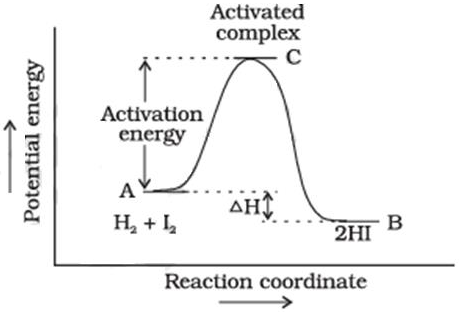
Figure

Answer options

Q20:

2026: 15 May Shift 1

Chemical Kinetics

Medium

Rate of Chemical Reaction

Chemical reactions are the simplest way to convert one substance into the other substance. The feasibility of a chemical reaction is decided by the concepts of chemical thermodynamics under a defined set of conditions. The extent of a chemical reaction is determined by the principles of chemical equilibrium. But the information that remains undisclosed is the speed or rate of a chemical reaction, path or mechanism of a chemical reaction, time taken for a reaction to attain a state of equilibrium, factors controlling the rate of reaction etc. This information pertaining to the study of a chemical reaction is very pivotal, and it helps in understanding the nature (slow or fast nature) of a chemical reaction. The kinetics of a chemical reaction can be understood with the help of average rate of reaction or a differential rate law or an integrated rate law. There are various factors on which the rate of a chemical reaction depends viz. nature of reactants, temperature, catalyst, pressure and concentration of reactants and products (rate law expression).

The rate constants of a reaction at 700 K and 500 K are 0.07 s−1\mathrm{s^{-1}} and 0.02 s−1\mathrm{s^{-1}} respectively. What is the value of activation energy of the reaction?

(Given: log 7 = 0.8451, log 2 = 0.3010)

Answer options

Q21:

2026: 15 May Shift 1

Chemical Kinetics

Easy

Rate of Chemical Reaction

Chemical reactions are the simplest way to convert one substance into the other substance. The feasibility of a chemical reaction is decided by the concepts of chemical thermodynamics under a defined set of conditions. The extent of a chemical reaction is determined by the principles of chemical equilibrium. But the information that remains undisclosed is the speed or rate of a chemical reaction, path or mechanism of a chemical reaction, time taken for a reaction to attain a state of equilibrium, factors controlling the rate of reaction etc. This information pertaining to the study of a chemical reaction is very pivotal, and it helps in understanding the nature (slow or fast nature) of a chemical reaction. The kinetics of a chemical reaction can be understood with the help of average rate of reaction or a differential rate law or an integrated rate law. There are various factors on which the rate of a chemical reaction depends viz. nature of reactants, temperature, catalyst, pressure and concentration of reactants and products (rate law expression).

Identify the incorrect statement from the following.

Answer options

Q22:

2026: 14 May Shift 2

Chemical Kinetics

Medium

Consider the given reaction: X+Y→ZX + Y \rightarrow Z; Rate = k[X]a[Y]bk[X]^a[Y]^b. The initial concentration of X and Y are given below:

[X]/ mol L−1L^{-1}[Y]/ mol L−1L^{-1}Rate of formation of Z/ mol L−1s−1L^{-1}s^{-1}
0.20.24.36×10−24.36 \times 10^{-2}
0.40.28.72×10−28.72 \times 10^{-2}
0.20.417.44×10−217.44 \times 10^{-2}

The overall order of reaction for the formation of product Z is:

Answer options

Q23:

2026: 14 May Shift 2

Chemical Kinetics

Hard

Two radioactive substances X and Y simultaneously undergo decay in a vessel. The 50% decay of both X and Y occurs in 20 and 10 minutes, respectively. If the initial concentration of Y is 8 times that of X, how much time will it take for the concentration of Y to be half of X ?

Answer options

Q24:

2026: 14 May Shift 2

Chemical Kinetics

Easy

For a reaction aA→bBaA \rightarrow bB, when [A] = 0.56 M, the rate was found to be 4.8 M s−1s^{-1}. On reducing the concentration of A to 50%, the rate changes to 1.2 M s−1s^{-1}. The order of reaction with respect to A is:

Answer options

Q25:

2026: 14 May Shift 2

Chemical Kinetics

Medium

If a first order reaction takes 15 minutes for 90% completion, then time required for 50% completion is:

Answer options

Q26:

2026: 14 May Shift 2

Chemical Kinetics

Medium

Which of the following statements are correct?

A. Order and the molecularity of a reaction can be fractional.

B. Catalyst affects the activation energy of reaction but not rate of reaction.

C. For complex reactions, order of reaction is determined by the slowest step.

D. The decomposition of gaseous ammonia on a hot platinum surface is a zero order reaction.

Answer options

Q27:

2026: 12 May Shift 2

Chemical Kinetics

Easy

Inversion or hydrolysis of cane sugar (in presence of excess of water) i.e.

C12H22O11+H2O→C6H12O6+C6H12O6\mathrm{C_{12}H_{22}O_{11} + H_2O \rightarrow C_6H_{12}O_6 + C_6H_{12}O_6}

Cane Sugar Glucose Fructose

is a pseudo first order reaction with Rate = k [C12H22O11][\mathrm{C_{12}H_{22}O_{11}}]

Which of the following statements is correct about this pseudo-first order reaction?

Answer options

Q28:

2026: 12 May Shift 2

Chemical Kinetics

Easy

Which of the following statement is incorrect in regards to variation of rate of reaction with respect to temperature?

Answer options

Q29:

2026: 12 May Shift 2

Chemical Kinetics

Easy

Which of the following can be the rate constant of a first order reaction?

Answer options

Q30:

2026: 12 May Shift 2

Chemical Kinetics

Medium

A first order reaction has the rate constant of 90 s−1^{-1}. How much time will it take to reduce the initial concentration of the reactant to its 1/20th value? (log 2 = 0.3010)

Answer options