Q1:
2026: 24 May Shift 1
Chemistry
Chemical Kinetics
Easy
The constant 'k' in a rate law expression of a reaction is
Correct Answer
Option 3
Correct Answer

2026: 24 May Shift 1
Chemistry
Chemical Kinetics
Easy
The constant 'k' in a rate law expression of a reaction is
2026: 22 May Shift 2
Chemistry
Chemical Kinetics
Easy
Which of the following is true for catalysts?
2026: 22 May Shift 2
Chemistry
Chemical Kinetics
Easy
The half-life of a reaction is the time in which the concentration of a reactant is reduced to one half of its initial concentration. Which of the following statements are correct?
(A) It is represented as .
(B). For a first order reaction, it is independent of the initial concentration of the reactant.
(C) The SI unit of half-life is second.
(D) For a zero-order reaction it is inversely proportional to the rate constant.
2026: 22 May Shift 2
Chemistry
Chemical Kinetics
Medium
and are the time required for 75% and 25% completion of the reaction respectively. The correct relationship between and of a first order reaction is
Given: log 2 = 0.3010 and log 3 = 0.4771
2026: 22 May Shift 2
Chemistry
Chemical Kinetics
Medium
Consider a first order reaction
Match List-I with List-II
| List-I | List-II |
|---|---|
| Plot of | Type of graph |
| (A) [R] vs t | (I) Straight line passing through origin with positive slope (k/2.303) |
| (B) ln [R] vs t | (II) Exponential decrease |
| (C) vs t | (III) Straight line with negative slope (-k) |
| (D) vs t | (IV) Straight line passing through origin with positive slope (k) |
2026: 22 May Shift 2
Chemistry
Chemical Kinetics
Easy
Arrange the following units of rate constant in the increasing arrangement of the order of reaction:
(A)
(B)
(C)
(D)
2026: 22 May Shift 1
Chemistry
Chemical Kinetics
Easy
The rate constant of a reaction is given as L . What is the order of the reaction?
2026: 22 May Shift 1
Chemistry
Chemical Kinetics
Easy
Consider the following first order reaction:
The values of the initial concentration of the reactant A are given below:
(A) 0.2 M
(B) 0.3 M
(C) 0.4 M
(D) 0.5 M
The initial rate of the given reaction in increasing order is
2026: 22 May Shift 1
Chemistry
Chemical Kinetics
Medium
Which of the following is true for complex reactions?
2026: 22 May Shift 1
Chemistry
Chemical Kinetics
Easy
A reaction is found to have a rate constant, . The half life of this reaction is:
2026: 22 May Shift 1
Chemistry
Chemical Kinetics
Easy
For a reaction, A + B Product; the rate law is given by, Rate = . What is the order of the reaction?
2026: 21 May Shift 2
Chemistry
Chemical Kinetics
Easy
The pre-exponential factor in Arrhenius equation is also known as :
A. Arrhenius constant.
B. Frequency factor.
C. Activation energy.
D. pre-exponential factor.
2026: 21 May Shift 2
Chemistry
Chemical Kinetics
Easy
The expression is valid for........order reaction.
2026: 21 May Shift 2
Chemistry
Chemical Kinetics
Easy
Which of the following are true for order of a reaction?
A. It can be a fractional number.
B. It is applicable to complex reactions only.
C. It can have zero value.
D. It is an experimentally determined quantity.
2026: 21 May Shift 2
Chemistry
Chemical Kinetics
Medium
A reaction between reactants A and B follows the rate law:
Rate =
Arrange, under the given conditions, the rate of the reaction in increasing order :
A. Concentration of only reactant A is doubled .
B. Concentration of only reactant B is doubled.
C. Concentration of reactant A is tripled and that of reactant B is halved.
D. Concentration of reactant A is halved and that of reactant B is doubled.
2026: 21 May Shift 2
Chemistry
Chemical Kinetics
Easy
Match the LIST-I with LIST-II.
| LIST-I Order of reaction | LIST-II Units of rate constant | ||
|---|---|---|---|
| A. | Zero | I. | |
| B. | First | II. | |
| C. | Second | III. | |
| D. | Third | IV. |
2026: 21 May Shift 1
Chemistry
Chemical Kinetics
Easy
The half life of the reaction having rate constant, is
2026: 21 May Shift 1
Chemistry
Chemical Kinetics
Medium
Find the correct statements for a complex reaction
(A) Molecularity has no meaning for a complex reaction
(B) Molecularity can be zero or non-integer
(C) Molecularity of the slowest step is same as the order of overall reaction
(D) Molecularity is an experimental quantity
2026: 21 May Shift 1
Chemistry
Chemical Kinetics
Easy
Which of the following graph correctly represents the Arrhenius equation ?
2026: 21 May Shift 1
Chemistry
Chemical Kinetics
Easy
Match List-I with List-II
| List-I Theory / Rate constant | List-II Expressions |
|---|---|
| (A) Collision Theory | (I) |
| (B) Arrhenius Equation | (II) |
| (C) Rate constant for zero order reaction | (III) |
| (D) Rate constant for first order reaction | (IV) |
2026: 21 May Shift 1
Chemistry
Chemical Kinetics
Medium
The elementary reaction is carried out taking different initial concentrations of reactant species. Arrange the following in decreasing order of initial rate of formation of in the reaction,
(A) In first experiment value of initial [NO]/mol is 0.40 and initial /mol is 0.40
(B) In second experiment value of initial [NO]/mol is 0.80 and initial /mol is 0.40
(C) In third experiment value of initial [NO]/mol is 0.40 and initial /mol is 0.80
(D) In fourth experiment value of initial [NO]/mol is 0.80 and initial /mol is 0.80
2026: 20 May Shift 2
Chemistry
Chemical Kinetics
Easy
A catalyst
2026: 20 May Shift 2
Chemistry
Chemical Kinetics
Medium
Which of the following are pseudo first order reactions ?
A.
B.
C.
D.
2026: 20 May Shift 2
Chemistry
Chemical Kinetics
Easy
Match the LIST-I with LIST-II.
| LIST-I Expression / unit | LIST-II Explanation | ||
|---|---|---|---|
| A. | I. | Half-life time of zero order reaction | |
| B. | II. | Units of activation energy | |
| C. | III. | Half-life time of first order reaction | |
| D. | IV. | Unit of rate constant for zero order reaction |
2026: 20 May Shift 2
Chemistry
Chemical Kinetics
Medium
Arrange the orders of the reactions, whose unit of rate constants are given below, in increasing arrangement.
A.
B.
C.
D.
2026: 20 May Shift 2
Chemistry
Chemical Kinetics
Easy
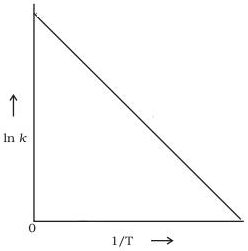
The figure below represents the graph between ln k vs 1/T. The slope of the straight line will be
2026: 19 May Shift 2
Chemistry
Chemical Kinetics
Easy
For a reaction A+B C; rate = k[A][B], on doubling the concentration of A and decreasing the concentration of B to half, by what factor the initial rate changes
2026: 19 May Shift 2
Chemistry
Chemical Kinetics
Easy
Find the order of reaction having rate constant L mol s.
2026: 19 May Shift 2
Chemistry
Chemical Kinetics
Easy
Match the LIST-I with LIST-II.
| LIST-I (Condition/ Reaction) | LIST-II (Possibility) | ||
|---|---|---|---|
| A. | Molecularity of reaction | I. | Can have fractional value |
| B. | Thermal decomposition of HI on gold surface | II. | Not meaningful for complex reaction. |
| C. | Order of reaction | III. | First order reaction |
| D. | Radioactive decay | IV. | Zero order reaction |
2026: 19 May Shift 2
Chemistry
Chemical Kinetics
Easy
For an equation A + 3B 4C + 2D ; if at time t, is M s, the value of at t will be: