Q1:
2026: 12 May Shift 2
Chemistry
Chemical Kinetics
Easy
Following is the Maxwell Boltzmann distribution curve (gaseous molecules)
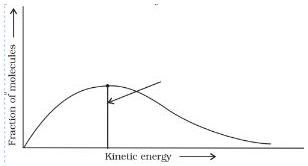
The peak of this curve corresponds to.
Correct Answer
Option 3
Correct Answer

2026: 12 May Shift 2
Chemistry
Chemical Kinetics
Easy
Following is the Maxwell Boltzmann distribution curve (gaseous molecules)
The peak of this curve corresponds to.
2026: 11 May Shift 1
Chemistry
Chemical Kinetics
Easy
Which of the following is correct in regard to the rate determining step of the reaction?
2026: 11 May Shift 1
Chemistry
Chemical Kinetics
Easy
What are the units of rate constant for a second order reaction?
2026: 11 May Shift 1
Chemistry
Chemical Kinetics
Easy
With a rise in temperature, the rate constant of a reaction
2026: 11 May Shift 1
Chemistry
Chemical Kinetics
Medium
The rate constants of a reaction at 500 K and 700 K are and , respectively. What is the value of ?
(Given: & )
2026: 11 May Shift 1
Chemistry
Chemical Kinetics
Easy
The half life period of a reaction does not depend upon the initial concentration of the reactant. The order of the reaction is
2025: 3 June Shift 2
Chemistry
Chemical Kinetics
Easy
2025: 3 June Shift 2
Chemistry
Chemical Kinetics
Easy
2025: 3 June Shift 2
Chemistry
Chemical Kinetics
Medium
2025: 3 June Shift 2
Chemistry
Chemical Kinetics
Easy
2025: 3 June Shift 2
Chemistry
Chemical Kinetics
Easy
2025: 2 June Shift 2
Chemistry
Chemical Kinetics
Medium
2025: 2 June Shift 2
Chemistry
Chemical Kinetics
Easy
2025: 2 June Shift 2
Chemistry
Chemical Kinetics
Easy
2025: 2 June Shift 2
Chemistry
Chemical Kinetics
Easy
2025: 2 June Shift 2
Chemistry
Chemical Kinetics
Medium
2025: 2 June Shift 1
Chemistry
Chemical Kinetics
Easy
Inversion of cane sugar is a pseudo first order reaction
Choose the correct reason from the statements given below
2025: 2 June Shift 1
Chemistry
Chemical Kinetics
Medium
Based on their rate laws, arrange the following reactions in the decreasing sequence of the reaction order.
(A) Rate = k
(B) Rate = k
(C) Rate = k
(D) ) Rate = k
2025: 2 June Shift 1
Chemistry
Chemical Kinetics
Easy
The unit of rate constant for first order reaction is
2025: 2 June Shift 1
Chemistry
Chemical Kinetics
Easy
For a chemical reaction
(A) The order of a reaction is the sum of powers of the concentration of the reactants.
(B) The order of a reaction may be zero, an integer or a fractional value.
(C) Molecularity of an elementary reaction is equal to the number of reacting species.
(D) The molecularity of a reaction may be zero or a fractional value.
2025: 2 June Shift 1
Chemistry
Chemical Kinetics
Medium
The rate constant, activation energy and the Arrhenius parameter at 27 °C are s, 100 kJ mol and s, respectively. The value of the rate constant at a very high temperature () approaches to:
2025: 30 May Shift 2
Chemistry
Chemical Kinetics
Medium
Consider the following statements for the order of a reaction and choose the correct statements.
(A). The order of a reaction is an experimental quantity.
(B). Order can be zero.
(C). Order can be fractional value.
(D). Order is applicable to elementary as well as complex reactions.
2025: 30 May Shift 2
Chemistry
Chemical Kinetics
Medium
Which one of the following statements is correct for a first order reaction?
2025: 30 May Shift 2
Chemistry
Chemical Kinetics
Easy
Select the correct relation of half life for a zero order reaction.
2025: 30 May Shift 2
Chemistry
Chemical Kinetics
Easy
All natural and artificial radioactive decay of unstable nuclei take place by
2025: 30 May Shift 2
Chemistry
Chemical Kinetics
Easy
The thermal decomposition of HI on gold surface is an example of
2025: 30 May Shift 1
Chemistry
Chemical Kinetics
Easy
What will be the order of a reaction if its rate is expressed as
Rate =
2025: 30 May Shift 1
Chemistry
Chemical Kinetics
Easy
Match List-I with List-II
| List-I | List-II |
|---|---|
| Order of reaction | Unit |
| (A). Zero order reaction | (I). |
| (B). First order reaction | (II). |
| (C). Second order reaction | (III). |
| (D). Third order reaction | (IV). |
2025: 30 May Shift 1
Chemistry
Chemical Kinetics
Easy
The rate of a chemical reaction doubled for every 10 °C rise in temperature. If the temperature is raised by 50 °C, the rate of reaction will be
2025: 30 May Shift 1
Chemistry
Chemical Kinetics
Easy
Which of the following statements is not correct with reference to a catalyst?