Please log in to comment and participate in discussions.
The correct answer would be B
Please report!
why not c? Pls tell
Because the sentence is written in simple present and not present perfect
Not really. The Verb (i.e the MCQ option) would determine the tense for the sentence.
Defaulting to Simple present is enticing, but in my experience (IPMAT 2024 151 VARC, IPMAT 2025 162 VARC, and gave many other exams) in IPMAT specifically they go with the "implied" tense from the context you can extrapolate
Here, since we're talking about budgets and proposals, it is safe to presume that a budget was presented to both FD and CEO, and they both rejected it. Proposals are not like plans of action, where it can be a continuous thing, they are more 'binary', as in either it is rejected in the past, or accepted in the past, or being worked on. You don't really have 'continued disagreement' with a proposal/proposed budget, you reject it outright (which would thus put it in the past).
If the sentence was "Neither the FD nor the CEO _____ on the MD's response strategy to the disaster", we would have a better case for a present tense argument (since response strategy is something that spans over a period of time rather than one singular moment)
Oh so, got your point! Thanks
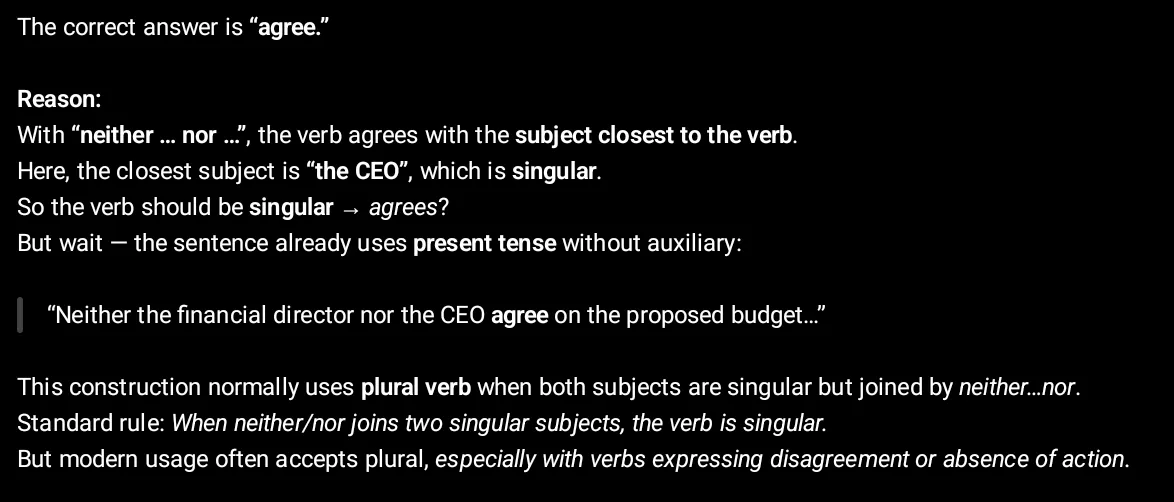
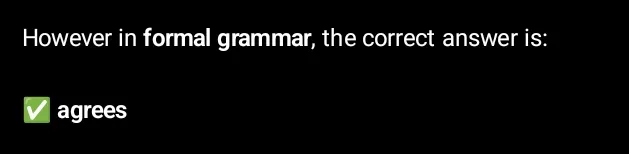 This is what chatgpt says!
shouldn't it be b?
why not c? Pls tell
Academic discussion and doubt solving for Verbal Ability: Comprehension, Grammar, Vocabulary and more!
Create an account to join our community and participate in discussions.

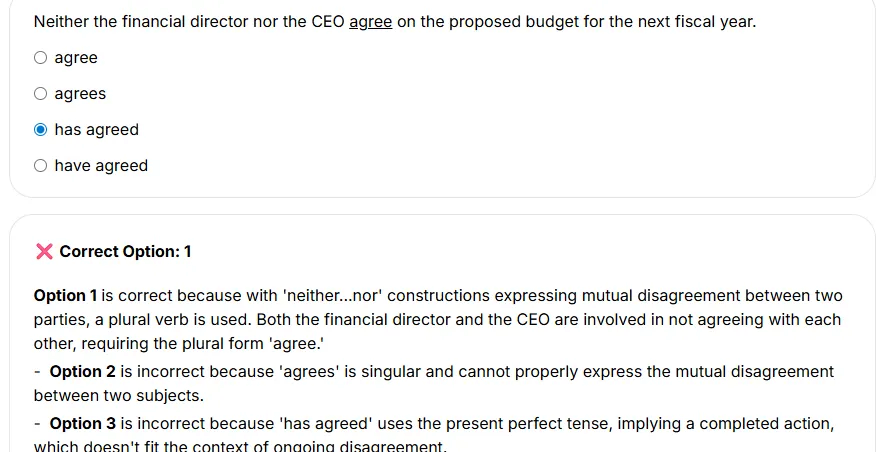
What is the supposed difficulty? I would say report this, even though I think Option 3 is actually correct (we need to make the solution a bit clearer)
Anyways, answer
In cases like these, we have to kinda break a rule and extrapolate a bit of context. Since we are talking about Director and CEO not agreeing for a proposed budget, it would make sense to assume it happened in the past. Because a proposal is presented at one point, and if both rejected it, it makes sense that it is in the past.
So Option 1 2 out.
Then Neither-Nor rule applies (use plural form verb) so Have is gone, meaning Option 3 is correct.