
Please log in to comment and participate in discussions.
Comments (8)
S
solulu
OP•7mos
I know that the explanation is detailed but I don't understand
1
IPMAT/Number System
Academic discussion and doubt solving for: HCF & LCM, Integral Solutions, Divisibility Rules, Factorisation, Unit Digit, Remainders.
1319Members
116
Online
Members can post and comment here, and get these posts in their Latest feed.
Moderators
Join AfterBoards
Create an account to join our community and participate in discussions.
- • Connect with peers
- • Resolve doubts
- • Learn more about admissions
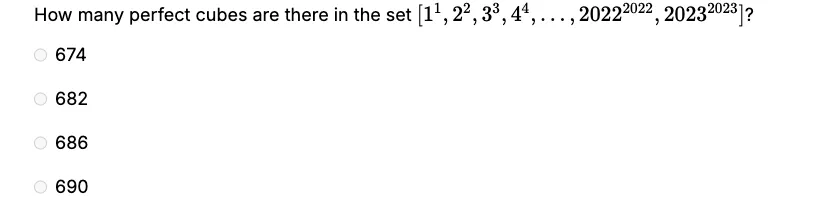
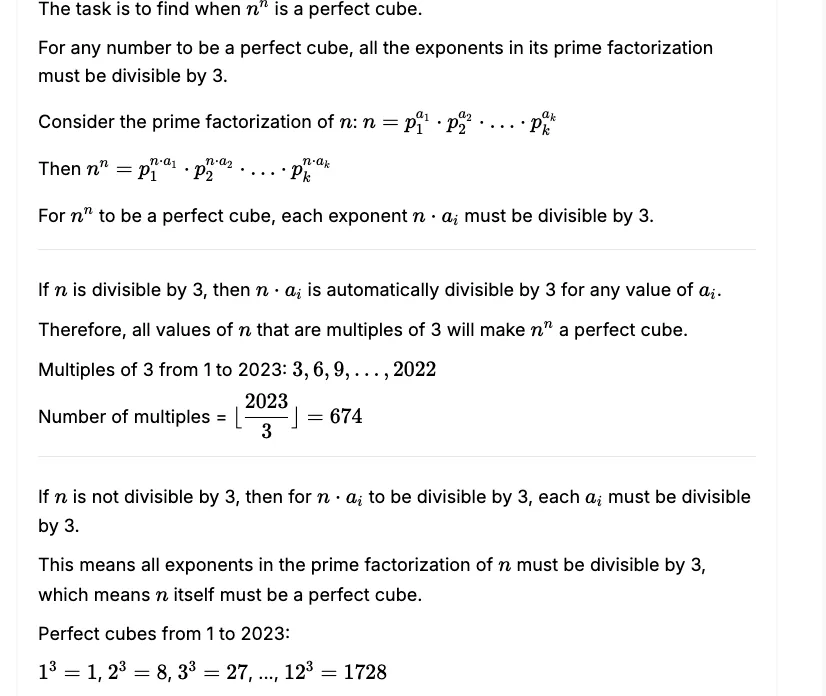
We need to find numbers which are of the form a^(3n) basically the exponent should be a multiple of 3.
The numbers of the series are of the form a^a, so for the power to be multiple of 3 the number itself should be we can find the total multiples of 3 by just dividing 2023/3 which is 674.333 => there are 674 full multiples of 3.
But there are another type of number which will fulfill this constraint of being perfect cube - number which already are perfect cube prior to having raised to some power. They already are a^3n form.
We count all such numbers below 2023 which are not multiples of 3 (because we already have counted ALL multiples of 3 so it would be overcounting) I'm getting 8 such numbers.
So 674+8 = 682
That should be the answer
How do you get those 8 numbers kindly explain.
Exlained below
ohh okay, and the 8 numbers you manually checked right? like 2 cube=8 etc.
Yes, manually just take all the cube of no. not divisble by 3 till 2023, 1^3, 2^3, 4^3... But if need be you can do it faster try to find the no. With cube just above 2023 by trial and error, it will be faster and the no. Is 13 so till 12 the cube is below 2023, now we subtract all multiples of 3 to avoid over counting that is 3, 6, 9 and 12.
4 no. Gone - 12-4 = 8
Oh okay thank you!
heyy i guess u dont need to subtract all the numbers divisble by 3 , because 3^3 27 ka power 27 is a perfect cube that is not counted in the first part, but u dont count it, so i think u just have to subtract the numbers whose cube gives an unit digit that consists of 3,6,9 which u would have already counted in the first part so the numbers included will be 1,8,27,64,125,512,1000,1331,1728 i.e 1-12 excluding 6,7 and 9 that gives unit digit as 3, 6 and 9 respectively.(i maybe wrong please check once)