
Please log in to comment and participate in discussions.
Comments (4)
See the equation:
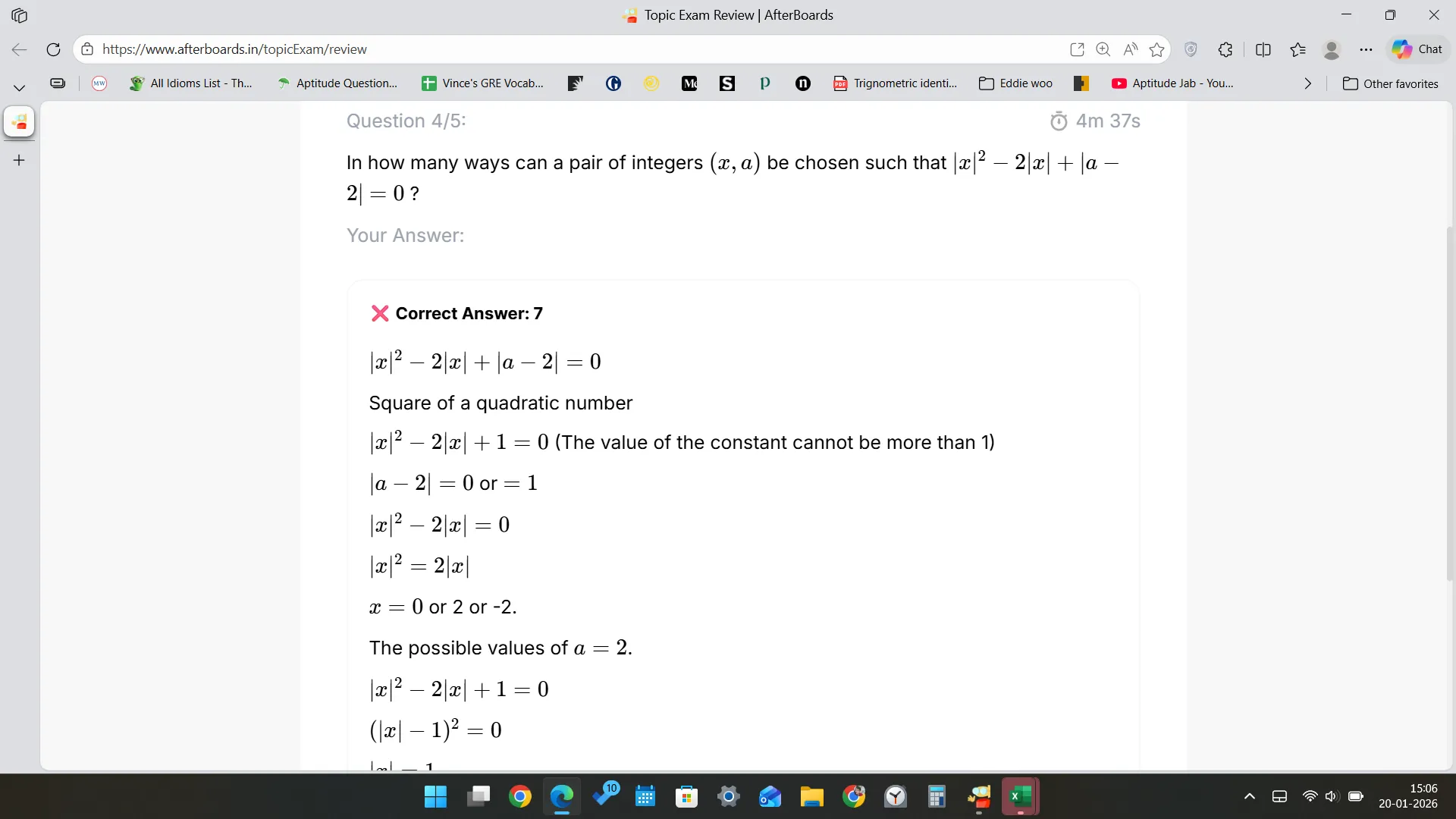
|x|² − 2|x| + |a − 2| = 0
Think of |x| as just a normal number y (because absolute value is always non-negative). So set y = |x|. Then the equation becomes:
y² − 2y + |a − 2| = 0.
Now rearrange it:
|a − 2| = 2y − y².
Left side is an absolute value, so it can’t be negative. That means 2y − y² must be ≥ 0.
So check small integer values of y.
If y = 0, right side = 0. Then |a − 2| = 0 → a = 2. Also y = |x| = 0 → x = 0. One solution (1 value of a for each of 1 value of x).
If y = 1, right side = 1. Then |a − 2| = 1 → a = 1 or 3. And |x| = 1 → x = 1 or −1. That gives 4 solutions (2 values of a for each of 2 values of x).
If y = 2, right side = 0. Then |a − 2| = 0 → a = 2. And |x| = 2 → x = 2 or −2. That gives 2 solutions (1 value of a for each of 2 values of x).
If y = 3, right side becomes negative, which is impossible. So we stop.
Total solutions = 1 + 4 + 2 = 7.
Yes I also have the same doubt why can't the coefficient be more than 1. is there any logic /rule behind it?
Let y = |x| ≥ 0. Then the equation becomes
|a − 2| = 2y − y².
Now rewrite the right side:
2y − y² = 1 − (y − 1)².
Since (y − 1)² is always ≥ 0, we get
1 − (y − 1)² ≤ 1.
So the maximum possible value of 2y − y² is 1.
That means |a − 2| cannot be greater than 1.
There is no special rule about the constant - it comes directly from the algebra.
Academic discussion and doubt solving for: HCF & LCM, Integral Solutions, Divisibility Rules, Factorisation, Unit Digit, Remainders.
Members can post and comment here, and get these posts in their Latest feed.
Moderators
Join AfterBoards
Create an account to join our community and participate in discussions.
- • Connect with peers
- • Resolve doubts
- • Learn more about admissions
Same why cant the value of constant be more than 1