
Please log in to comment and participate in discussions.
Comments (3)
A
aloo_samosa
SSCBS
•5mos
Aapko pura solution samajh nahi aaya ya some part of it?
Let me know and I will try to explain it in a more simple way.
1
D
devesh
OP•5mos
no no thanks got it solution
1
IPMAT/Number System
Academic discussion and doubt solving for: HCF & LCM, Integral Solutions, Divisibility Rules, Factorisation, Unit Digit, Remainders.
1324Members
65
Online
Members can post and comment here, and get these posts in their Latest feed.
Moderators
Join AfterBoards
Create an account to join our community and participate in discussions.
- • Connect with peers
- • Resolve doubts
- • Learn more about admissions
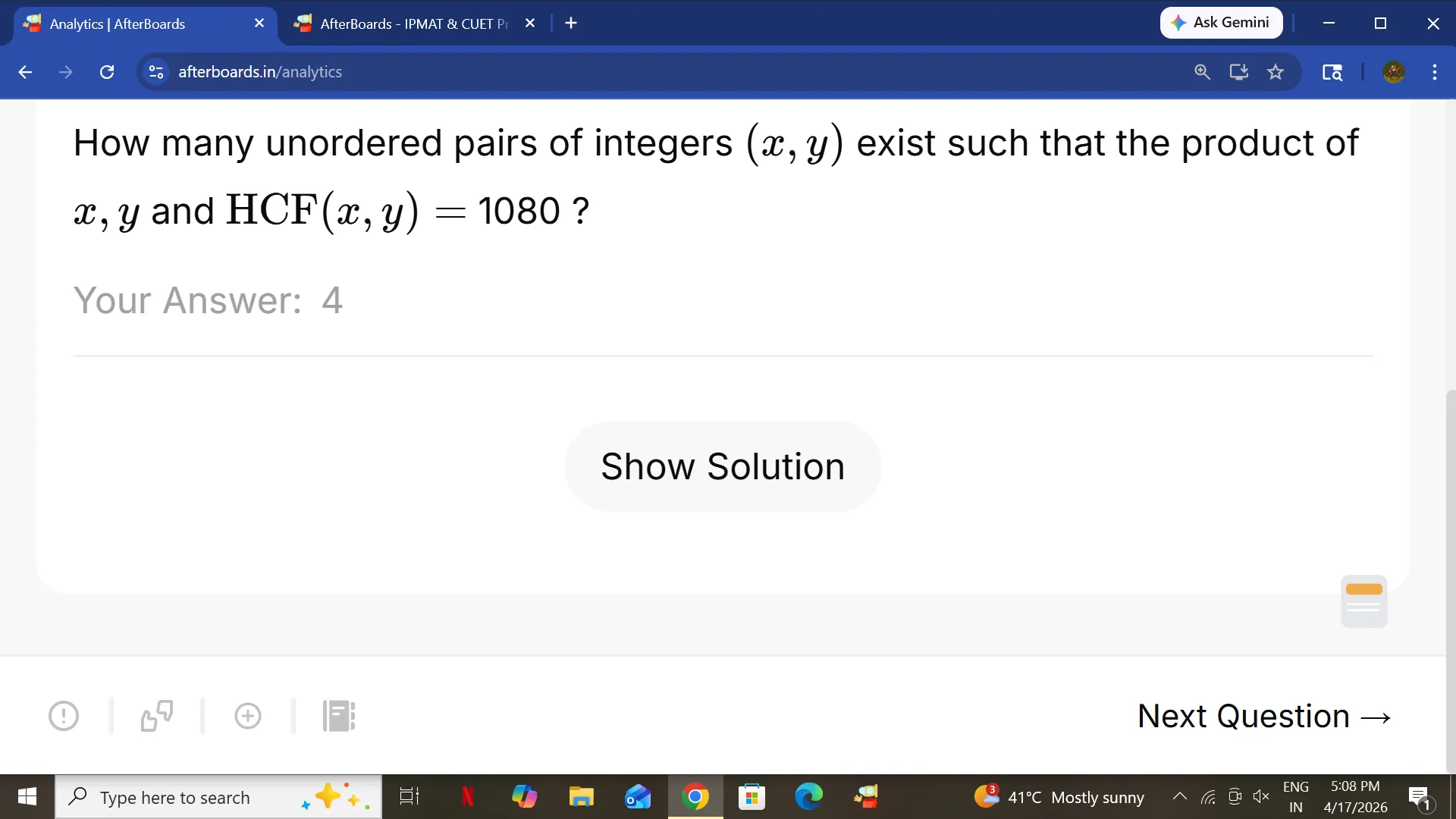
let x = d·a and y = d·b where gcd(a, b) = 1
then
x·y·gcd(x,y) = (d·a)(d·b)(d) = d³ab = 1080
so we need d³ab = 1080
prime factorize:
1080 = 2³ · 3³ · 5
now distribute powers between d³ and ab
since d³ has powers in multiples of 3, possible d:
d = 1, 2, 3, 6
now for each d, compute ab = 1080 / d³
d = 1 → ab = 1080 = 2³·3³·5 → primes = 3 → unordered coprime splits = 2^(3−1) = 4
d = 2 → ab = 1080 / 8 = 135 = 3³·5 → primes = 2 → ways = 2^(2−1) = 2
d = 3 → ab = 1080 / 27 = 40 = 2³·5 → primes = 2 → ways = 2
d = 6 → ab = 1080 / 216 = 5 → primes = 1 → ways = 1
total = 4 + 2 + 2 + 1 = 9
answer = 9
you got 4 because you probably only counted the d = 1 case and missed the other possible gcd values