
eyeyeyum
Venky (DU)
INCORRECT SOLUTION
 here is the solution provided :
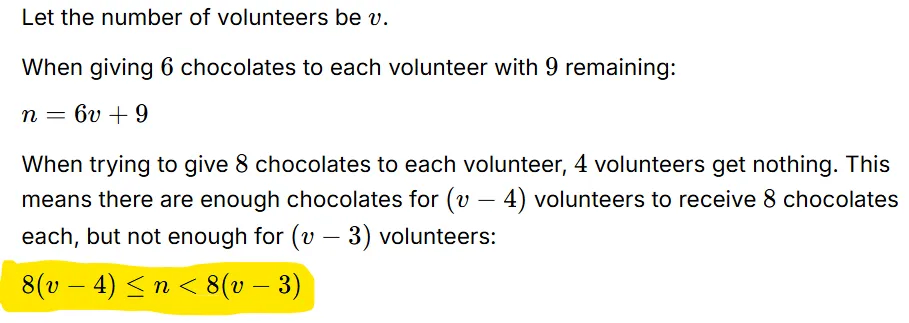 shouldn't the highlighted part be : 8(v-5) < n </= 8(v-4) ???
2
Please log in to comment and participate in discussions.
Comments (2)
IPMAT/Number System
Academic discussion and doubt solving for: HCF & LCM, Integral Solutions, Divisibility Rules, Factorisation, Unit Digit, Remainders.
1324Members
74
Online
Members can post and comment here, and get these posts in their Latest feed.
Moderators
Join AfterBoards
Create an account to join our community and participate in discussions.
- • Connect with peers
- • Resolve doubts
- • Learn more about admissions
No, the highlighted part is correct.
“4 volunteers would not get anything” means chocolates are enough for only (v − 4) volunteers, not more.
So:
For (v − 4) volunteers → chocolates are enough
For (v − 3) volunteers → chocolates are not enough
That translates to:
8(v − 4) ≤ n < 8(v − 3)
Your version 8(v − 5) < n ≤ 8(v − 4) would mean chocolates are enough for (v − 4) but not even for (v − 4), which contradicts the condition.
So the original inequality is the correct one.
but when i asked the same question to gemini this is what its response was :
we don't know the number of chocolates the (v-4)th guy received -- it could be anywhere between 1-8. the least he could receive is 1 chocolate hence n > 8(v-5). and on the higher end he could receive exactly 8 chocolates which means n can be equal to or less than 8(v-4).
idk how am i interpreting it wrong :(