Please log in to comment and participate in discussions.
Academic discussion and doubt solving for: Logarithms, Set Theory, Matrices & Determinants, Permutation & Combination, Probability, Binomial Theorem
Create an account to join our community and participate in discussions.

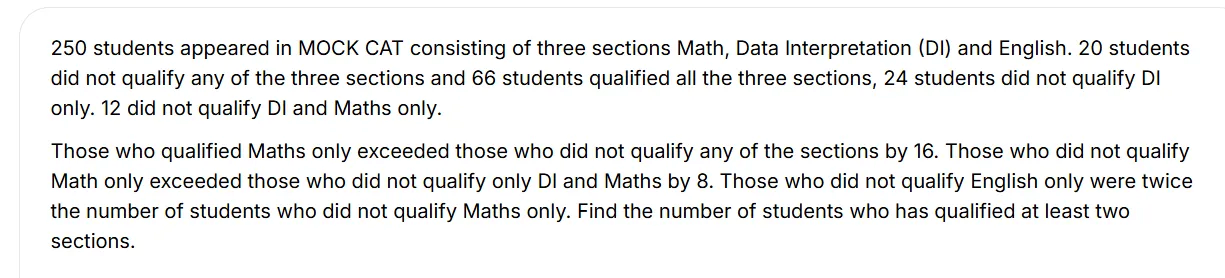 please explain the not only part how do we find the actual numbers from that?
this was more of a VARC question lmao. Anyways, final answer is 40 + 66 + 24 + 20 = 150
Further explanation (if needed): Since we were already given number of people who qualified all three or none at all, we do not need to take that into account. So, the given constraints became pretty obvious that they were either meant for exactly two or for exactly one. Why? Because well if they did pass more than two then they'd be counted in all three. Pretty simple logic but you might not be able to think this during the exam because of the language used. Now if someone didn't pass only maths, it means they passed the other two ie DI and English. Similarly for the other two as well. Last but not the least, ONLY english wasn't given so we calculated it by deducting everything else from 250 which gave 32.
Thankyou smm...!
Yes, kinda.. I actually was confused about the not only part.