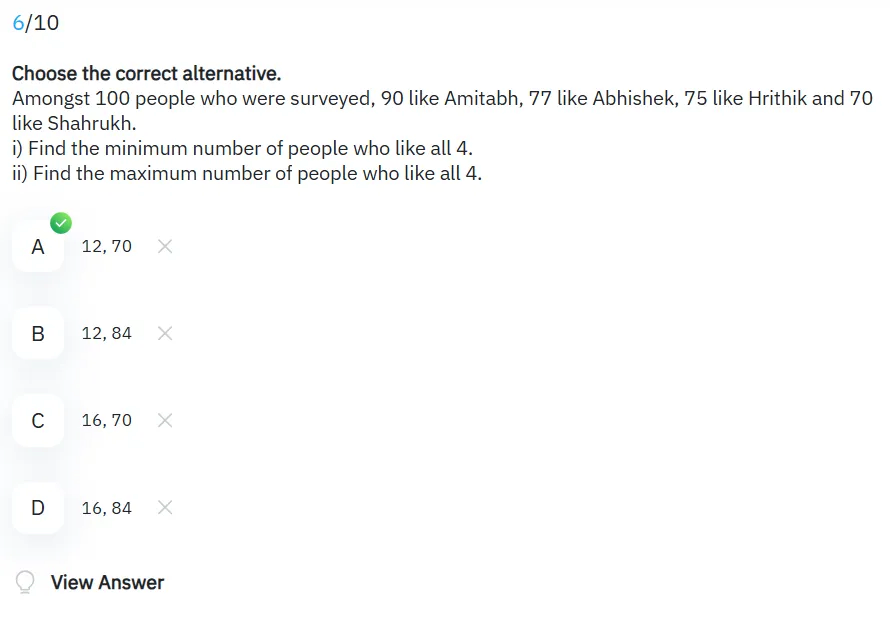
 I remember Bhavesh bhaiya answering a question of this sort with a bar graph-type method. I tried looking for that post, couldn't find it (saved posts feature please!). Could anyone tell me about that approach to solve these type of sets qns?
Please log in to comment and participate in discussions.
Academic discussion and doubt solving for: Logarithms, Set Theory, Matrices & Determinants, Permutation & Combination, Probability, Binomial Theorem
Create an account to join our community and participate in discussions.

Let A be the number of people who like all four actors, B be the number who like exactly three, C be the number who like exactly two, D be the number who like exactly one, and E be the number who like none. These five groups together make up the total of 100 people.
A+B+C+D+E=100
Each person in A contributes 4 likes, each in B contributes 3 likes, each in C contributes 2 likes, and each in D contributes 1 like. Adding the likes given in the question gives a total of 312 likes.
4A+3B+2C+D+E= 312
To find the minimum value of A, we try to keep as many people as possible in B so that nobody is forced into A. If all 100 people were in B, the total likes would be 300. But the actual total is 312, which is 12 more than 300. Those extra 12 likes must therefore come from people in A, so the minimum value of A is 12.
To find the maximum value of A, we try to put as many people as possible into A, but everyone in A must like Shah Rukh and only 70 people like him (the 4 likers can't be higher than 70 cuz that's the like count of the lowest guy). Therefore, the maximum value of A is 70.
Bar process is just a visual way to implement this very logic.