
Please log in to comment and participate in discussions.
Comments (1)
IPMAT/Modern Math
Academic discussion and doubt solving for: Logarithms, Set Theory, Matrices & Determinants, Permutation & Combination, Probability, Binomial Theorem
1438Members
123
Online
Members can post and comment here, and get these posts in their Latest feed.
Moderators
Join AfterBoards
Create an account to join our community and participate in discussions.
- • Connect with peers
- • Resolve doubts
- • Learn more about admissions
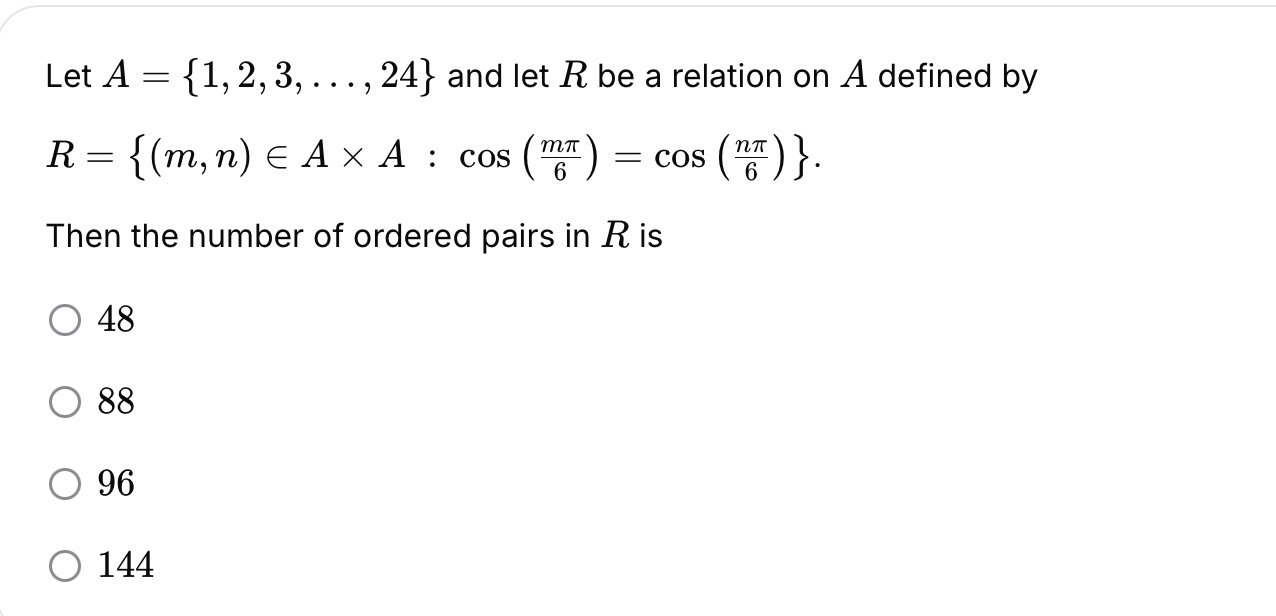
One solution is already given below the solution, you can check that out.
Here is another one:
If,
Cos ( A) = Cos ( B )
then
A = 2kπ + B or A = 2kπ -B ( k is any integer).
substitute values of A and B
mπ/6=2kπ +- nπ/6
m+n+ultiply by 6 and divide by π
m= 12k +- n
this gives two separate cases
m-n=12k
m+n=12k
Now for case 1
m-n=12k you need that the difference between m and n is a multiple of 12
now m - n can range from -23 to 23
you need the no. which are multiple of 12
In this case those are -12,0 , 12
substitute values one by one
a) m-n=-12 -> m=n-12 so n can be any no. from 13 to 24 , -> 12 pairs.
b) m-n=0 -< m=n so n can be any no. from 1 to 24 -> 24 pairs
c) m-n=12 -> m=n+12, n can be any value from 1 to 12 -> 12 pairs
total pairs in case 1 = 48
now come to case 2 -> m+n=12k
m+n can range from 2 to 48
we want those valus which are multiple of 12 so possible values are 12 24 36 48
a) m +n = 12 -> m = 12-n so n can be any value from 1 to 11 so 11 pairs
b ) m +n = 24 -< m =24-m so n can be any value from 1 to 23 -> 23 pairs
c) m+n=36 -> m = 36-n n can be any no. from 12 to 24 so 13 pairs.
d) m+n=48 -> m =48-n so n can be only 24 -> 1 pairs
total pairs in case B = 48
total cases A+B= 96
however there are some pairs which satisfy both the cases so those needs to be removed ( for ex - (12,12) )
For this we'll use modulo
case A -> M-n=12k that means when we m-n is a multiple of 12 so we can say when m-n is divided by 12 remainder is zero
so m-n =0 mod 12
or m =n mod 12
Case B -> M+n=12k
m+n =0 mod 12
from case 1 we can say m mod 12 = n mod 12
so substiture m=n in m+n =0 mod 12
m +m =0 mod 12
2m=0 mod 12
now ask yourself which no. from 1 to 24 when multiplied by 2 gives a remainder of 0 when divided by 12
these are 6,12,18,24
so possible values of m are 6 , 12 , 18 , 24
now we also know m mod 12 = n mod 12
when m =6
6 mod 12 = n mod 12 -> this means what no. when divided by 12 gives a remainder of 6 these are 6 and 18 so we get 2 pairs from here (6,18) , (6,6)
similarly for other 3 no.you ll get 2 pair each which are
(12,12), (12,24) , (18,6), (18,18),(24,12) (24,12)
so pairs which were double counted = 8
by exclusion inclusion principle , total cases = 48+48-8= 88 .
Take your time, let it sink in and then ask yourself to practice the following question