
aloo_samosa
SSCBS
How did we get a=c here? If they are equal then they can not be cut
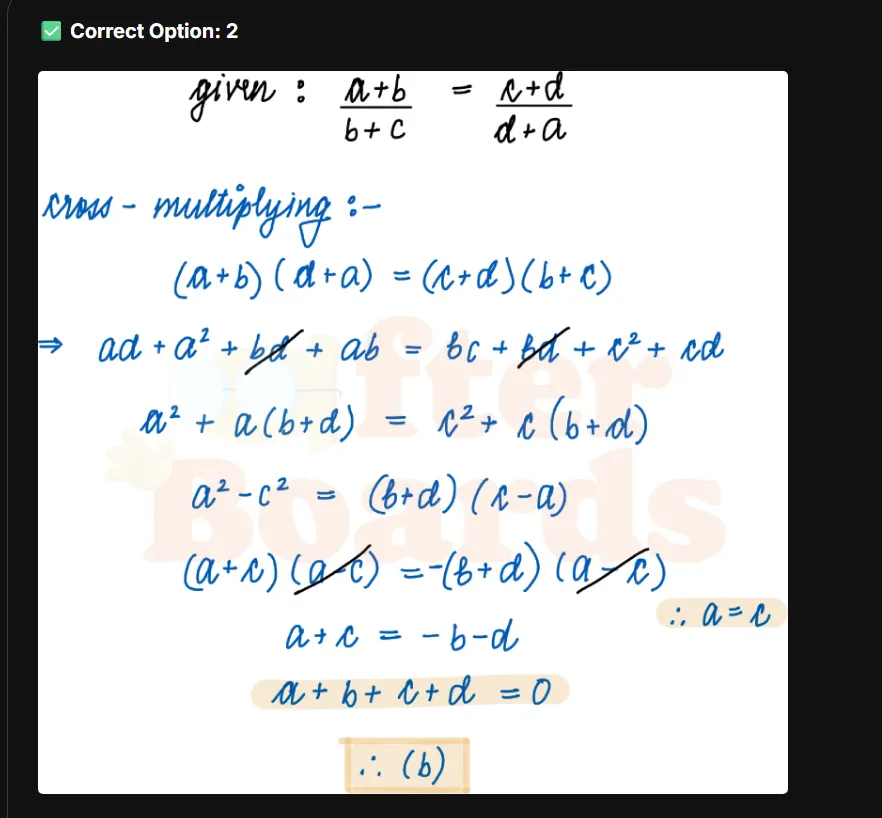 In this where we cancalled (a-c) this implies that a-c can not be zero because we can cut variables only when we are sure that it can not take the value of zero then how come they have implied that a=c after cancelling them out the whole point is that it must not be equal to zero
1
Please log in to comment and participate in discussions.
Comments (1)
IPMAT/Modern Math
Academic discussion and doubt solving for: Logarithms, Set Theory, Matrices & Determinants, Permutation & Combination, Probability, Binomial Theorem
1415Members
56
Online
Members can post and comment here, and get these posts in their Latest feed.
Moderators
Join AfterBoards
Create an account to join our community and participate in discussions.
- • Connect with peers
- • Resolve doubts
- • Learn more about admissions
how does cancelling a-c implies that it is not equal to zero?
it is same as taking 2 common from lhs and rhs both sides (or 4-2 and 4-2) . here, neither 4 nor 2 equals zero.