
Please log in to comment and participate in discussions.
Comments (4)
How to ask good doubts?
Point out the exact step you're stuck on and let us know what you've already tried. This helps others understand your thinking and guide you better.
The solution is already present in the question, let us know which line is confusing you!
1
X
xyzzzzzzz
OP•1yr
bhaiya i am just confused how to view and analyze the question to solve according to what option says?
1
IPMAT/Geometry
Academic discussion and doubt solving for: Trigonometry, Straight Lines, Conic Sections, Circles, Triangles, Quadrilaterals, Solids, Polygons
1424Members
89Posts
Members can post and comment here, and get these posts in their Latest feed.
Moderators
Join AfterBoards
Create an account to join our community and participate in discussions.
- • Connect with peers
- • Resolve doubts
- • Learn more about admissions
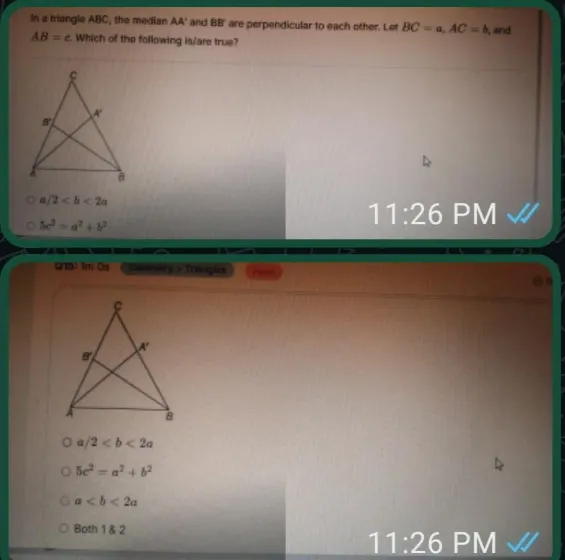
We consider triangle ABC with medians from A and B intersecting at the centroid G. The medians are perpendicular, so the angle at G is 90 degrees. The centroid divides each median in a 2:1 ratio:
AG = 2/3 of AA'
BG = 2/3 of BB'
The sides are BC = a, AC = b, and AB = c.
Proof for Statement 2 (5c^2 = a^2 + b^2):
Since the medians are perpendicular, we apply the Pythagorean theorem to triangle AGB:
c^2 = (2/3 * AA')^2 + (2/3 * BB')^2
c^2 = 4/9 * (AA')^2 + 4/9 * (BB')^2
Multiply both sides by 9:
9 * c^2 = 4 * (AA')^2 + 4 * (BB')^2 ... (Equation i)
Using Apollonius's theorem:
For median AA':
c^2 + b^2 = 2 * ((AA')^2 + (a/2)^2)
4 * (AA')^2 = 2 * c^2 + 2 * b^2 - a^2 ... (Equation ii)
For median BB':
c^2 + a^2 = 2 * ((BB')^2 + (b/2)^2)
4 * (BB')^2 = 2 * c^2 + 2 * a^2 - b^2 ... (Equation iii)
Substitute Equations ii and iii into Equation i:
9 * c^2 = (2 * c^2 + 2 * b^2 - a^2) + (2 * c^2 + 2 * a^2 - b^2)
9 * c^2 = 4 * c^2 + a^2 + b^2
5 * c^2 = a^2 + b^2
Therefore, Statement 2 is true.
Proof for Statement 1 (a/2 < b < 2a):
The square of any median must be positive:
From Equation ii:
4 * (AA')^2 = 2 * c^2 + 2 * b^2 - a^2 > 0
Substitute c^2 = (a^2 + b^2)/5:
Substitute c^2 = (a^2 + b^2)/5:
2 * ((a^2 + b^2)/5) + 2 * b^2 - a^2 > 0
Multiply by 5:
Multiply by 5:
2 * (a^2 + b^2) + 10 * b^2 - 5 * a^2 > 0
12 * b^2 - 3 * a^2 > 0
4 * b^2 > a^2 → b > a/2
From Equation iii:
4 * (BB')^2 = 2 * c^2 + 2 * a^2 - b^2 > 0
2 * ((a^2 + b^2)/5) + 2 * a^2 - b^2 > 0
2 * (a^2 + b^2) + 10 * a^2 - 5 * b^2 > 0
12 * a^2 - 3 * b^2 > 0
4 * a^2 > b^2 → b < 2a
Combining these inequalities:
a/2 < b < 2a
Therefore, Statement 1 is true.
Final Answer: Both Statement 1 and Statement 2 are correct.
May i know how did you get to know how and which step to do in order to reach the option?