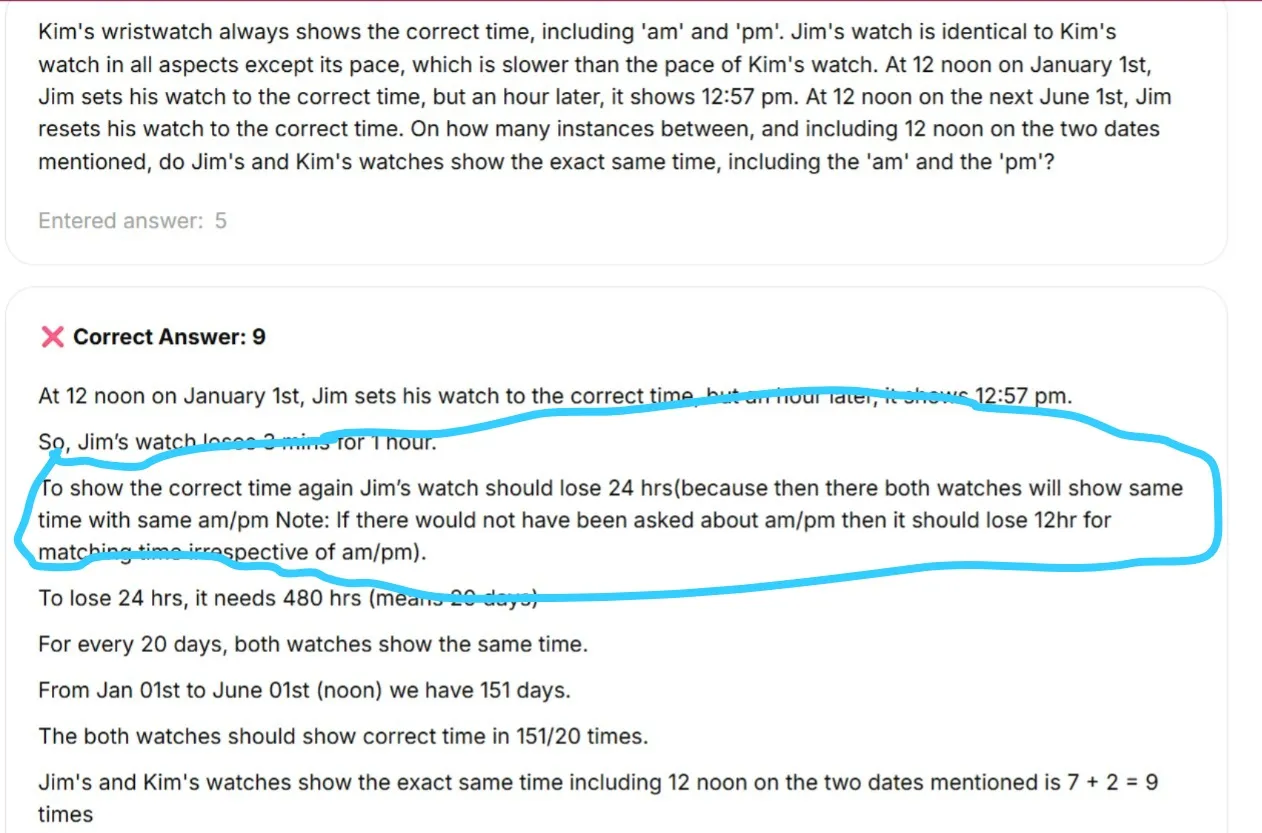
could someone please explain the blue part
Please log in to comment and participate in discussions.
think like this:
jim’s watch is slow, so over time it keeps falling behind real time
now, when will both watches show the same time again?
case 1: if am/pm didn’t matter
example: 3 pm and 3 am look the same on a normal clock
so even if jim is 12 hours behind, both watches will show “3:00”
so they match after a 12-hour lag
case 2: here am/pm DOES matter
3 pm ≠ 3 am
so even if jim is 12 hours behind, the watches will show different times (one says am, other pm)
so for them to match exactly (including am/pm), jim must be behind by a full 24 hours
only then both show same hour AND same am/pm
that’s why they’re saying:
if am/pm matters → need 24-hour lag
if am/pm doesn’t matter → 12-hour lag was enough
that’s the whole logic behind that line
Academic discussion and doubt solving for: Tournaments, Arrangements, Puzzles, Bar Graphs, Tabular Data
Create an account to join our community and participate in discussions.

 could someone please explain the blue part
think like this:
jim’s watch is slow, so over time it keeps falling behind real time
now, when will both watches show the same time again?
case 1: if am/pm didn’t matter
example: 3 pm and 3 am look the same on a normal clock
so even if jim is 12 hours behind, both watches will show “3:00”
so they match after a 12-hour lag
case 2: here am/pm DOES matter
3 pm ≠ 3 am
so even if jim is 12 hours behind, the watches will show different times (one says am, other pm)
so for them to match exactly (including am/pm), jim must be behind by a full 24 hours
only then both show same hour AND same am/pm
that’s why they’re saying:
if am/pm matters → need 24-hour lag
if am/pm doesn’t matter → 12-hour lag was enough
that’s the whole logic behind that line